A PEMF frequency range is a published operating parameter that shows how a home-use device expresses pulse-rate options in Hertz (cycles per second). It is useful for product comparison when clearly disclosed, but it does not by itself prove quality, outcomes, or suitability for any condition.
When you compare home-use PEMF mats and devices, one of the first specifications you encounter is the frequency range. Brands present it in different ways – some publish exact numbers, others hide behind preset labels – and that difference changes how much you can actually learn from the spec. This article explains what a published frequency range means, how to read it, and where its usefulness ends.
PEMF Advisor publishes buyer-oriented reviews, comparisons, and educational content for home-use PEMF mats and devices. This page is a constrained spec explainer within that system: it focuses only on how buyers should read published frequency ranges on product pages, not on treatment guidance, diagnosis, or condition-based frequency recommendations.
If you want the broader spec context around frequency, waveform, intensity, coil disclosure, and controller behavior, use our PEMF Specs and Controller Explained guide. This page supports that larger comparison framework by isolating one field – frequency range – and showing what it can and cannot tell a buyer on its own.
What Buyers Should Check First About a PEMF Frequency Range
A published frequency range is most useful when three things are clear at the same time: the low and high bounds are stated explicitly in Hertz, the buyer can tell whether the range is actually selectable or only bundled into presets, and the product page does not turn the number into an outcome promise. If any of those layers is missing, the comparison becomes weaker even when the spec looks precise.
This is why frequency should be read as a transparency field before it is treated as a product difference. A clean range tells you what the hardware is willing to disclose about pulse-rate options. It does not tell you whether the device is better overall, whether a specific frequency is “for” a specific result, or whether the rest of the operating profile is equally transparent.
What a published PEMF frequency range tells a buyer
A published frequency range is one of the operating parameters a PEMF device manufacturer discloses. It describes the span of pulse rates the hardware can produce, expressed as a low bound and a high bound measured in Hertz (Hz). This is a technical specification, not a performance promise. Its primary value is in buyer-side comparison: understanding what the device can do at the hardware level, not what it will accomplish for any individual.
Hz explained in buyer language
Hertz (Hz) is the standard unit for frequency. One Hz equals one electromagnetic pulse cycle per second. If a device operates at 10 Hz, it produces ten pulse cycles every second. The unit itself is stable and rooted in physics – it measures how often something repeats in a given time period. When you see Hz on a product listing, it refers to this physical measurement, not a marketing interpretation.
Think of Hz like beats per minute on a metronome. The number tells you the tempo of the pulses. A device rated at 1–50 Hz can pulse as slowly as once per second or as rapidly as fifty times per second.
Why most home-use mats are discussed in the ELF range
Most home-use PEMF mats operate within what is technically classified as the Extremely Low Frequency (ELF) range. ELF is a category label from electromagnetic spectrum classification, generally covering frequencies below 300 Hz. Many consumer PEMF products cluster within this band, which is why buyer-facing discussions and comparisons often reference it.
ELF is a descriptive category, not a quality indicator. The fact that most home-use mats fall within this range reflects common hardware design choices in the consumer market. It does not mean that ELF frequencies are inherently preferable or that devices outside this range are automatically inferior or superior.
Why frequency range matters in buyer-side product comparison
Frequency range becomes useful for comparison when it is clearly and explicitly disclosed. A product that publishes a range of 1–100 Hz with adjustable settings gives you concrete information to work with. A product that only says “pre-programmed wellness modes” does not.
The comparison value depends on two things: whether the brand provides exact numerical values (explicit disclosure) and whether the buyer can actually select from that range (adjustability). When both conditions are met, the spec becomes a meaningful comparison field. When either is missing, the comparison loses precision.
Key distinction
Transparency of disclosure determines comparison readiness. A published number you can verify is more comparison-useful than a preset label you cannot inspect – but neither tells you about outcomes.
How PEMF frequency is disclosed on home-use devices
Not all PEMF devices present their frequency specifications the same way. The disclosure model – how the brand communicates and structures the frequency information – directly affects how well you can compare one product against another. Some products give you full numerical transparency. Others offer only labeled presets with no visible values. Understanding the differences between these models is essential before you start comparing spec sheets.
| Disclosure Model | What the Buyer Sees | Comparison Value | What It Does Not Prove |
| Explicit open range | Exact Hz values, user-selectable across full range | High – direct numerical comparison possible | Does not prove outcomes, quality, or suitability |
| Explicit with presets | Published Hz values tied to named programs | Moderate – values visible but selection is constrained | Does not prove that preset groupings are optimal |
| Preset-only (opaque) | Program names or numbers without Hz values | Low – no numerical basis for comparison | Does not prove the device lacks capability – only that it is not disclosed |
| Proprietary / locked | Claims of special or secret frequencies | Very low – no independent verification possible | Does not prove superior technology or exclusive benefit |
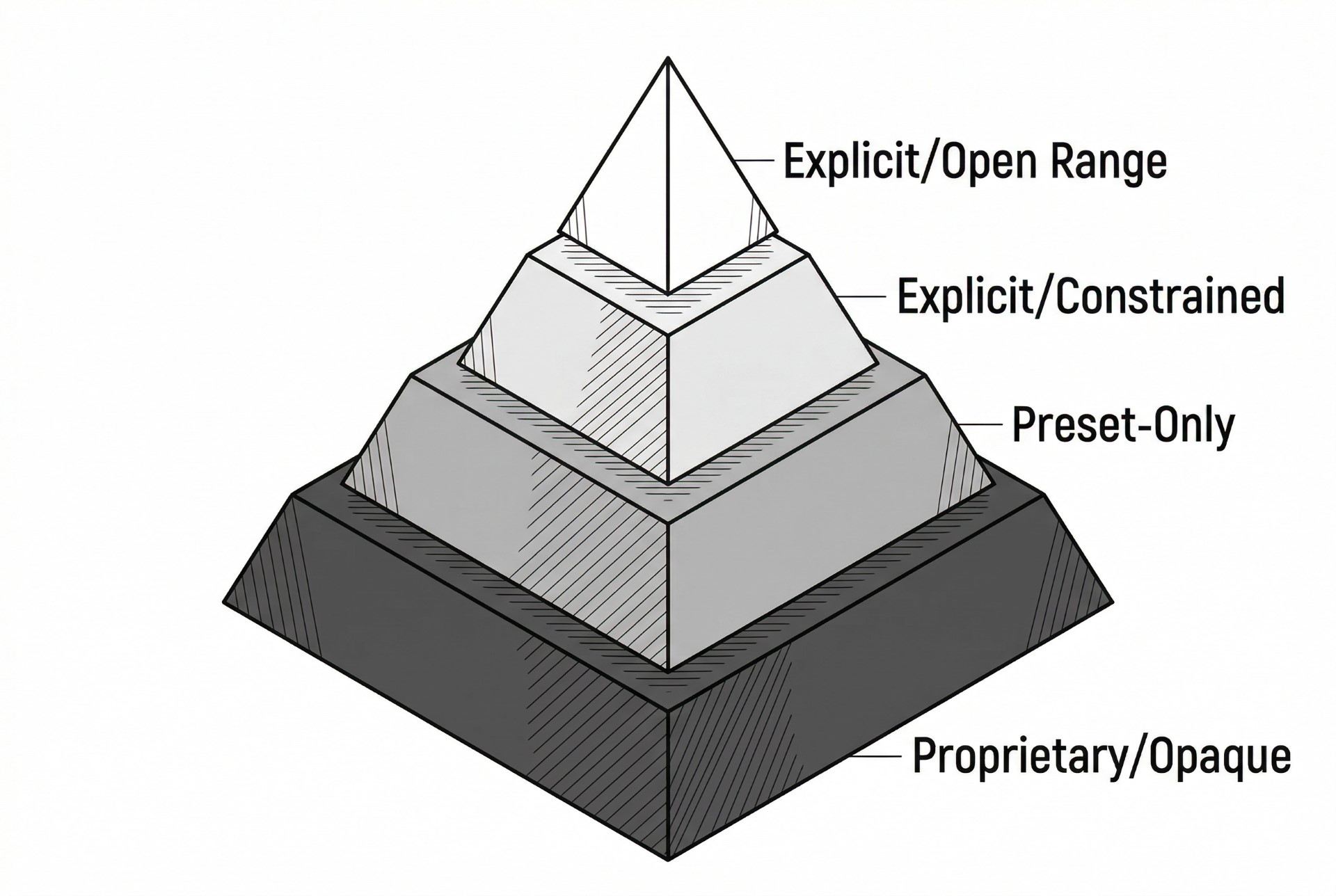
Fixed, preset, and adjustable operating models
PEMF devices use three broad control models that affect how a buyer interacts with the published frequency range:
| Control Model | How It Works | Buyer Implication |
| Fixed | The device operates at one frequency or a narrow set of frequencies that cannot be changed. | Simple to use, but no flexibility. What you see is the entire operating capability. |
| Preset | The manufacturer programs several frequency settings (often labeled by use case). The buyer selects a program, not a number. | Convenient, but transparency depends on whether the brand publishes the Hz value behind each preset. |
| Adjustable | The buyer can manually input or dial a specific frequency within the published range. | Offers the most control and comparison precision, assuming the interface shows exact values. |
None of these models is inherently better than another for all buyers. The right fit depends on whether you value simplicity, transparency, or manual control. The important thing is knowing which model you are looking at before you compare specifications.
Open range vs locked range
A product can publish a broad frequency range – say, 1–1,000 Hz – without giving the buyer direct access to every value within it. This is the distinction between an open range and a locked range.
In an open-range system, the buyer can select or input specific frequencies within the published span. In a locked-range system, the hardware may technically support the full range, but the interface restricts the buyer to a predefined subset of settings. Published range and user-selectable range are not always the same thing, and this gap matters for comparison accuracy.
Step values and sweep functions
Two secondary details change how an adjustable range behaves in practice: step value and sweep function.
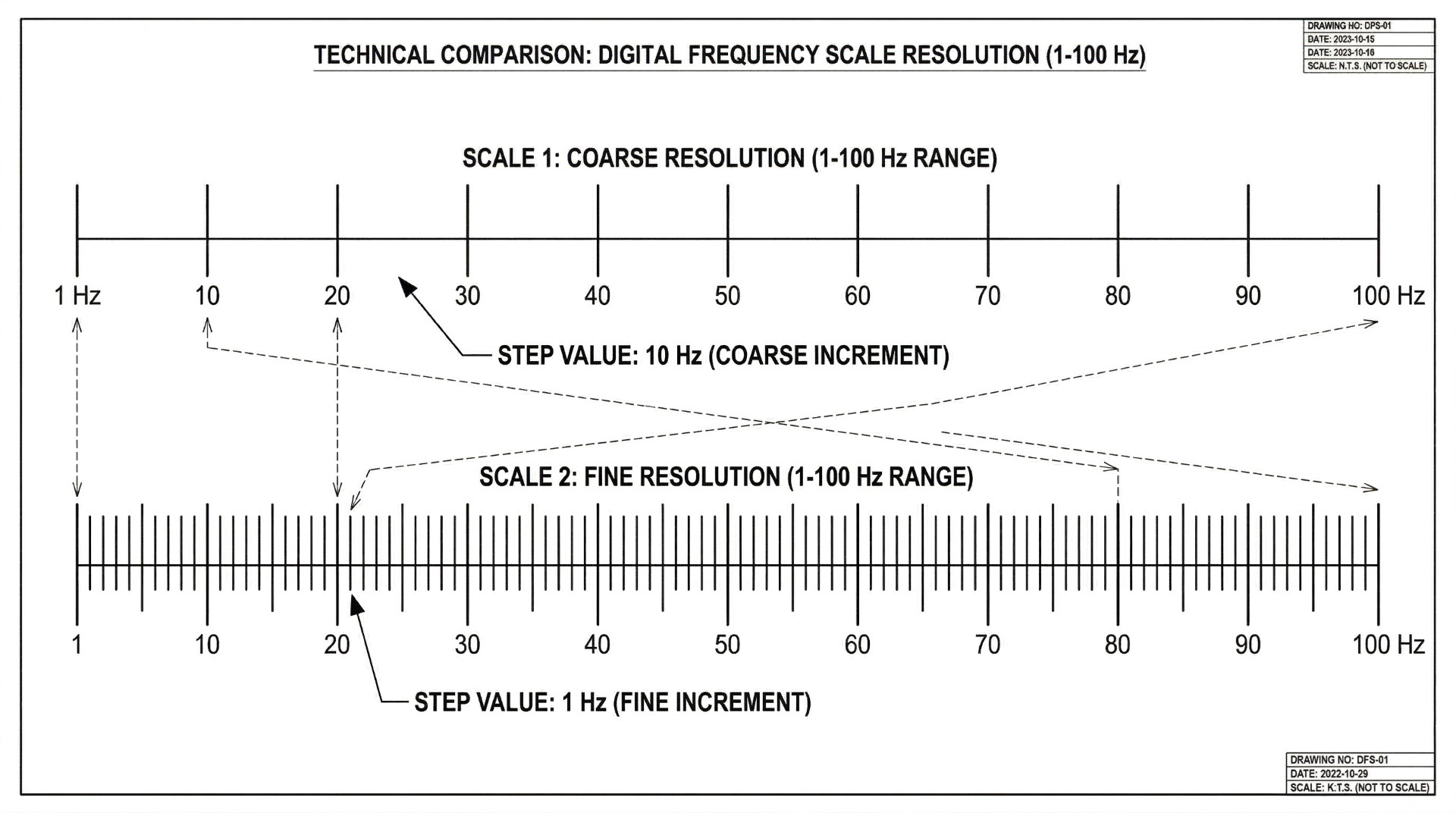
Step value refers to the increment size between available frequency settings. A device with a 1–100 Hz range and a step value of 1 Hz lets you select 1, 2, 3, all the way to 100. A device with the same range but a step value of 10 Hz only lets you choose 10, 20, 30, and so on. The range looks identical on paper, but the actual resolution of control is very different.
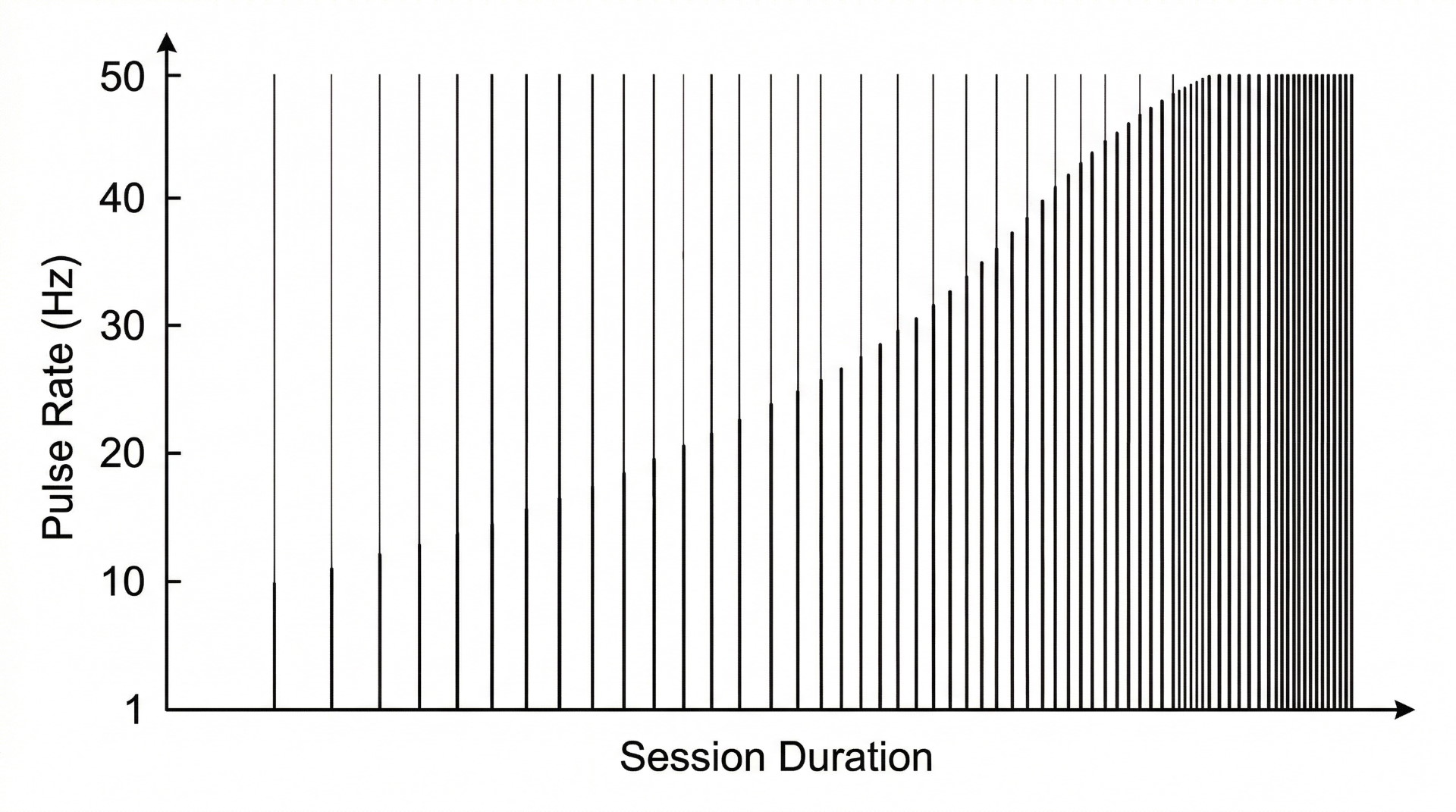
Frequency sweep is a feature that cycles the device automatically through a range of frequencies over time, rather than holding a single static value. A sweep moves from a starting frequency to an ending frequency across a session. This is a distinct operating behavior – not just a range label – and not all adjustable devices offer it.
Range breadth vs. resolution
A broad published range with coarse step values may offer fewer actual settings than a narrow range with fine increments. Always check both the range and the step value before assuming one device offers more control than another.
Transparency Tiers for Frequency Disclosure
| Disclosure Tier | What the Buyer Gets | Comparison Use |
| Explicit and selectable | Exact Hz values, visible range bounds, selectable values or fine step increments | Highest comparison usefulness |
| Explicit but preset-bound | Exact Hz values are published, but access is grouped into fixed programs | Moderate comparison usefulness |
| Partially explicit | A range is named, but step values, preset contents, or selectable behavior are unclear | Limited comparison usefulness |
| Opaque or proprietary | Program names, secret frequencies, or lifestyle labels without visible Hz values | Minimal comparison usefulness |
This kind of contrast helps separate published frequency data from disclosure style. A lower tier does not prove a product is worse. It shows that the buyer has less verified information to compare.
How the hardware interface displays frequency
The way a device presents frequency information on its control panel, screen, or app affects how much the buyer can verify in practice. Some devices display exact Hz values on a digital readout, letting you confirm the operating frequency at any moment. Others show only a program name, a numbered mode, or an icon with no numerical reference.
Interface-level transparency matters because it determines whether the published specification is actually visible during use. A device that publishes a 1–99 Hz range but only displays “Program 3” on its controller does not let the buyer confirm which frequency is active. This does not make the device nonfunctional, but it does reduce the buyer’s ability to verify what was advertised.
What Frequency Transparency Usually Looks Like
A transparent frequency disclosure usually does four things clearly. It states the range in exact Hz values, shows whether the range is fixed, preset-based, or manually adjustable, explains whether the buyer can access the full published span or only selected points within it, and avoids replacing standard numbers with proprietary labels. These are not extra details. They are what turn a frequency range from a decorative number into a comparison field.
The weakest disclosures usually look precise at first glance but leave out the part that gives the number meaning. A page may advertise a broad range without stating step values, mention presets without showing the Hz behind them, or reference special frequencies without telling the buyer what is actually selectable. In those cases, the range still describes something real, but its comparison value drops.
Comparison table: Frequency Disclosure Type
The following table summarizes the main disclosure types a buyer may encounter, their comparison utility, and their interpretive boundaries.
| Disclosure Type | Comparison Utility | What It Does Not Prove |
| Explicit values with open range and fine step values | Highest – allows direct, granular numerical comparison across products | Does not prove that the available settings produce any specific outcome |
| Explicit values with preset-only selection | Moderate – values are visible but buyer cannot freely select between them | Does not prove that the presets are grouped by any validated logic |
| Preset-only with no published values | Low – buyer cannot make numerical comparisons | Does not prove the device is inferior – only that comparison data is unavailable |
| Proprietary or secret frequency claims | Minimal – no verifiable data for comparison | Does not prove advanced technology, unique capability, or exclusive benefit |
| Sweep-enabled with published range | Useful – adds operating behavior detail to range data | Does not prove that sweep behavior produces different or better outcomes than static settings |
What frequency range does not prove on its own
Understanding what a frequency range tells you is only half the picture. Knowing what it does not tell you is equally important for accurate product comparison. A published frequency range is a hardware specification. It describes capability. It does not describe quality, efficacy, or suitability for any particular use.
Why a wider range may indicate versatility without proving superiority
A device with a 1–1,000 Hz range covers more of the frequency spectrum than a device rated at 1–50 Hz. That wider span may indicate greater hardware versatility – the device can operate at more frequency settings. But versatility and superiority are not the same concept.
A wider range does not automatically mean better build quality, more effective operation, or greater suitability for any buyer. A narrow-range device that does one thing with high precision and transparent disclosure may serve a buyer better than a wide-range device with opaque controls. The range tells you about capability breadth. It says nothing about capability depth or outcome quality.
Versatility vs. superiority
Versatility = the device supports more frequency options. Superiority = the device is better. These are different claims. A published range only supports the first.
Why frequency alone is not the full operating picture
Frequency describes how often a device pulses per second. It does not describe how long each pulse lasts, how much energy it delivers, or what percentage of each cycle is active versus idle. These details belong to other operating parameters – most notably duty cycle.
Duty cycle describes the ratio of active pulse time to total cycle time. A device running at 10 Hz with a 50% duty cycle is active for half of each cycle and idle for the other half. The same device at 10 Hz with a 10% duty cycle delivers a very different energy profile over the same period. Frequency and duty cycle together give a more complete picture of how a device operates over time. Frequency alone provides only one dimension.
Why buyers should not turn frequency specs into outcome expectations
A published frequency range describes an operating parameter. It does not describe what will happen to the buyer. Claims like “this frequency is optimal for [specific condition]” or “[specific Hz value] targets [specific tissue]” go beyond what a frequency specification can support on its own.
These types of claims are common in PEMF marketing, but they fall outside the scope of what a published operating parameter can verify. Frequency specifications are useful for comparing hardware capability and disclosure quality. They are not a basis for predicting personal outcomes, and treating them as such introduces risk into the buying decision.
Transparency as a useful signal without treating it as a guarantee
A brand that publishes exact frequency values, step increments, and control-model details is giving the buyer more information to work with. That transparency is a useful signal – it suggests the company is willing to let its specifications be compared directly against competitors.
But transparency is not a guarantee of product quality or outcomes. A device with fully transparent specs may still be poorly built, and a device with opaque disclosure may still function well. Transparency improves comparison accuracy. It does not replace the need to evaluate other factors like build quality, warranty, customer support, and independent testing.
Technical Meaning vs. Marketing Meaning
| Frequency Claim | What It Technically Means | What It Does Not Prove |
| 1–100 Hz adjustable range | The device can operate across that pulse-rate span | That the full range is useful for every buyer or purpose |
| 7.83 Hz setting | The device includes a setting associated with a known geophysical reference value | That the setting produces a specific outcome |
| Preset labeled “Sleep” or “Recovery” | The manufacturer has grouped one or more operating settings under a lifestyle label | That the frequency itself is validated for that use |
| “Proprietary frequencies” | The brand is not publishing the actual values openly | That the undisclosed values are superior or exclusive |
This distinction matters because frequency claims often become more persuasive as they become less measurable. The purpose of this page is to pull those claims back toward what can actually be compared.
Frequency terms buyers often see but should separate carefully
PEMF product listings use a variety of frequency-related terms, and not all of them refer to the same thing. Conflating different terms leads to comparison errors – like comparing a pulse rate on one device to a carrier wave frequency on another as if they were equivalent. This section separates stable, well-defined terms from volatile or low-trust marketing language.
Pulse rate frequency vs carrier wave frequency
Pulse rate frequency refers to how many discrete electromagnetic pulses the device produces per second. This is the number most home-use PEMF mats publish and the one buyers typically compare.
Carrier wave frequency refers to the base oscillation frequency of the electromagnetic signal itself, which can be much higher (often in the kilohertz or megahertz range). Some devices modulate a high-frequency carrier wave with a low-frequency pulse pattern.
These two values describe different aspects of the signal. If one product lists a pulse rate of 10 Hz and another lists a carrier frequency of 100 kHz, those numbers are not directly comparable – they measure different things. Always confirm whether a published “frequency” refers to pulse rate, carrier wave, or something else before placing two devices side by side.
Schumann Resonance as a reference point buyers may encounter
The value 7.83 Hz appears frequently in PEMF marketing. It refers to the Schumann Resonance – a measurable electromagnetic frequency generated by the cavity between the Earth’s surface and the ionosphere. It is a real physical phenomenon and a recognized measurement in geophysics.
In PEMF marketing, 7.83 Hz is often presented as a “natural” or “Earth frequency” with implied benefits. While the measurement itself is scientifically grounded, its presence in a product spec does not prove that operating at 7.83 Hz produces any specific effect on the user. Buyers should treat it as a historical and scientific reference point, not as evidence supporting a health-related claim.
“Natural,” “resonance,” and proprietary-frequency language as low-trust framing
Some PEMF marketing uses language like “natural frequencies,” “cellular resonance,” or “proprietary healing frequencies.” These phrases sound technical but function as marketing framing rather than measurable specifications.
“Natural” does not have a fixed technical definition in the context of PEMF device specifications. “Resonance” in a cellular context is a claim that falls outside the stable, well-supported measurement framework buyers can verify. “Proprietary frequencies” simply means the brand does not disclose the values – which reduces comparison transparency without proving that the undisclosed values are superior.
When you encounter this type of language, treat it as a signal to look for verifiable numbers rather than accepting the framing at face value. The absence of published, verifiable specifications is a disclosure gap, not proof of advanced technology.
A Quick Buyer Check for Pulse Rate vs. Carrier Wave Language
When a product page lists “frequency,” the first question is whether the number refers to pulse rate or to a carrier signal. A pulse-rate disclosure is usually shown in low Hz values and tied to the repetition speed of the pulses themselves. A carrier-wave disclosure is usually much higher and refers to the underlying oscillation that the pulse pattern may be modulating. These numbers describe different things and should not be compared as if they belong to the same layer.
A simple buyer check is to look at the scale and the context. If the number is presented as a user-selectable operating range in low Hz values, it is usually pulse rate. If it is presented as a deeper signal characteristic in much higher values, it may be carrier-wave language instead. The point is not to perform an engineering audit. The point is to avoid comparing two different signal descriptions as if they were the same field.
Why fear-based interpretation of high or low numbers is not a sound comparison method
Some marketing and community discussions frame certain frequency numbers as inherently dangerous (“high frequencies damage cells”) or inherently safe (“low frequencies are always gentle”). These framings reduce complex technical specifications to emotional shorthand.
Numeric magnitude alone does not determine safety or risk in the context of home-use PEMF devices. The operating behavior of a device depends on multiple parameters working together – frequency, intensity, duty cycle, duration, and waveform, among others. Isolating a single number and attaching fear or reassurance to it is not a sound comparison method and should not guide buying decisions.
Constraints and limits of frequency-only comparison
Even when frequency range is clearly disclosed, it represents one dimension of a multi-parameter system. Accurate comparison requires understanding several operational limits that frequency data alone does not address.
Published range vs actual selectable behavior
A product may advertise a frequency range of 1–1,000 Hz. But if the interface only lets the buyer choose from six preset programs, the actual selectable behavior is far narrower than the published range suggests. This gap between publication and access is common and can mislead buyers who assume the published range equals hands-on control.
When evaluating a device, ask whether the published range represents the full set of user-selectable options or just the theoretical hardware capability. The closer the selectable behavior matches the published range, the more comparison-useful the specification becomes.
Preset-only devices and partial transparency
A preset-only device is not necessarily a poor device. It may be well-engineered and effective for its intended use. But from a comparison perspective, it offers partial transparency at best. Without published Hz values behind each preset, the buyer cannot verify what frequency is being applied or compare it meaningfully against an explicitly disclosed competitor.
Partial transparency is a comparison limitation, not an automatic disqualifier. The buyer simply has less data to work with, which means the comparison must rely more on other factors – brand reputation, build quality, warranty terms, independent reviews – rather than on the frequency specification itself.
Duty cycle as a supporting operating parameter
Duty cycle describes what percentage of each pulse cycle is active. It works alongside frequency to define how the device delivers energy over time. A device at 10 Hz with a 50% duty cycle has a fundamentally different operating profile than one at 10 Hz with a 5% duty cycle, even though the published frequency is identical.
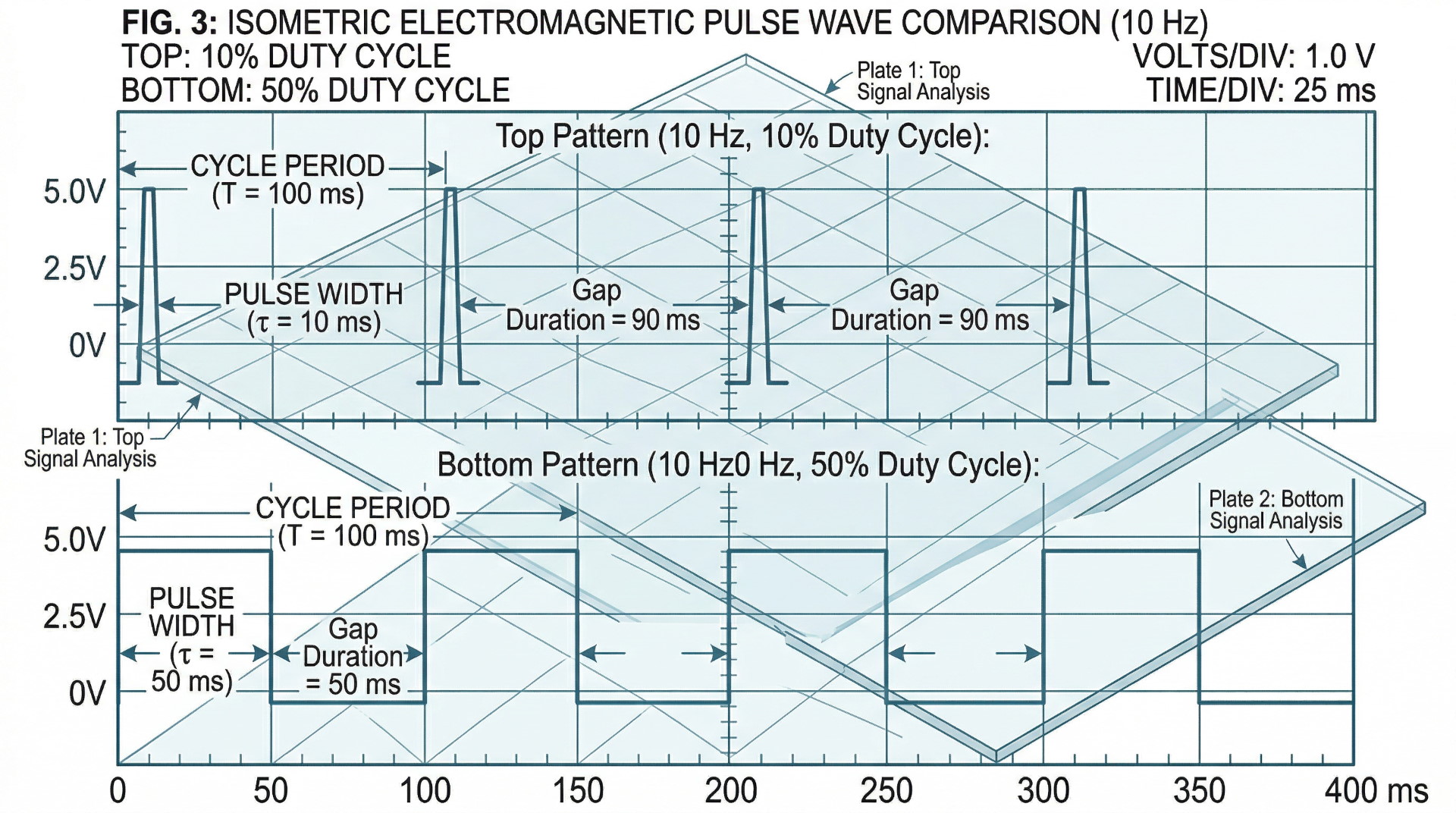
For comparison purposes, duty cycle adds a necessary layer of context. If two devices share the same frequency range but differ in duty cycle, their real-world operating behavior will not be the same. Treating frequency as the sole comparison parameter misses this distinction.
Why Frequency and Duty Cycle Should Not Be Separated Too Quickly
Frequency tells you how often the signal pulses. Duty cycle tells you how much of each cycle is active. A buyer does not need an engineering background to understand why these two fields belong together: the same pulse rate can operate very differently depending on how much active time is packed into each cycle.
That does not mean frequency becomes useless on its own. It means its comparison value becomes stronger when the surrounding operating context is also disclosed. If two devices publish the same frequency range but only one gives enough context to understand how those frequencies are actually delivered over time, the second device remains harder to compare even though the headline range looks identical.
Why comparison fit depends on more than one specification
Accurate comparison of PEMF devices requires reading several specifications together, not isolating any single number. Frequency range, disclosure type, control model, step value, sweep capability, and duty cycle all contribute to the overall operating picture.
| Parameter | What It Tells You | What It Does Not Tell You |
| Frequency range (Hz) | The span of pulse rates the hardware can produce | How those rates affect outcomes or quality |
| Disclosure type | How transparently the brand communicates specifications | Whether the product is well-built or effective |
| Control model | Whether you can select frequencies manually or only via presets | Whether manual control is necessary for your use case |
| Step value | The granularity of frequency selection within the range | Whether finer increments produce different results |
| Duty cycle | The active-to-idle ratio within each pulse cycle | What energy delivery profile is appropriate for any individual |
No single parameter carries the full comparison picture. The goal is not to find the device with the widest range or the most granular control, but to understand the complete operating profile well enough to make an informed buying decision.
Minimum Frequency Disclosure Threshold Before a Spec Becomes Useful
A frequency claim becomes meaningfully useful when the buyer can tell at least four things: the range bounds, whether the values are fixed, preset-based, or adjustable, whether the full range is actually accessible through the interface, and whether the page is using the frequency claim as a technical description rather than as a stand-in for outcomes. If too many of those layers are missing, the number may still be real, but its value in comparison drops sharply.
This is not a rejection rule and it is not a verdict on product quality. It is a comparison rule. The less a page explains how a frequency range is disclosed and controlled, the more the buyer is being asked to infer instead of compare.
FAQ
What does 1 Hz mean on a PEMF device?
One Hz means the device produces one electromagnetic pulse cycle per second. It is a standard unit of frequency based on physical measurement.
Is a PEMF frequency range the same thing as device quality?
No. A frequency range is one operating parameter among several. It describes hardware capability, not build quality, effectiveness, or suitability for any particular buyer.
What is the difference between fixed, preset, and adjustable PEMF frequency settings?
A fixed device operates at one frequency that cannot be changed. A preset device offers manufacturer-programmed settings the buyer selects by name or number. An adjustable device lets the buyer input or dial a specific frequency within the published range.
What does a frequency sweep mean on a PEMF mat?
A frequency sweep means the device automatically cycles through a range of frequencies during a session, moving from a starting value to an ending value over time, rather than holding one static frequency.
Why do some PEMF brands publish exact Hz values while others only mention presets?
Disclosure style varies by manufacturer. Some brands prioritize transparency by publishing exact values, which makes comparison easier. Others use preset-only labels, which may simplify the user experience but reduce comparison precision. The difference affects comparison readiness, not proven outcomes.
Does a wider PEMF frequency range mean a better device?
Not necessarily. A wider range may indicate greater hardware versatility – the ability to operate at more frequencies – but it does not automatically mean better quality, better construction, or better suitability for any individual buyer.
What is the difference between pulse rate and carrier wave frequency in PEMF specs?
Pulse rate frequency measures how many discrete pulses the device emits per second. Carrier wave frequency measures the base oscillation of the electromagnetic signal, which can be much higher. These are different measurements and should not be compared as if they describe the same thing.
Why is duty cycle relevant when comparing PEMF frequency specs?
Duty cycle describes the ratio of active pulse time to total cycle time. Two devices with the same frequency but different duty cycles will have different energy delivery profiles. Frequency alone does not capture this difference, so duty cycle adds necessary context for accurate comparison.
Why is 7.83 Hz mentioned so often in PEMF marketing?
The value 7.83 Hz corresponds to the Schumann Resonance, a measurable electromagnetic frequency in the Earth’s atmosphere. It appears in PEMF marketing as a recognizable reference point. Its presence in a device specification does not prove any specific effect on the user.
Can a published frequency range tell me what outcomes to expect?
No. A published frequency range is a hardware specification that describes the device’s operating capability. It does not predict, guarantee, or imply any specific personal outcome. Treating a frequency spec as an outcome indicator goes beyond what the parameter can support.
Are proprietary or secret frequencies a sign of better PEMF technology?
No. A claim of proprietary or secret frequencies means the brand does not disclose its values, which reduces comparison transparency. It does not prove that the undisclosed frequencies are superior, more advanced, or more effective than published alternatives.
Are very high frequency numbers inherently dangerous on home-use PEMF devices?
Fear-based claims that high frequency numbers are inherently dangerous oversimplify a complex technical picture. Device behavior depends on multiple parameters – frequency, intensity, duty cycle, duration, and waveform – not a single number in isolation. This article does not use numeric magnitude as a basis for safety claims in either direction.

The PEMF Advisor Editorial Team reviews consumer PEMF mats and related wellness devices. Our work focuses on verified specifications, documentation, usability, materials, warranty/returns, and ownership considerations. We do not provide medical advice or evaluate health outcomes. See our Review Methodology and Editorial Standards.