Magnetic intensity on a home-use PEMF product page is a measurement of magnetic field strength at a specific point, usually shown in Gauss or Tesla. Buyers can only compare that number fairly when the unit, measurement distance, and reporting style (peak, average, or RMS) are all disclosed.
This guide explains what PEMF intensity numbers actually measure, how the same product can produce different-looking specs depending on how the reading is taken and reported, and what details to look for before treating any Gauss or Tesla figure as a basis for comparison. The goal is spec-sheet literacy – not product recommendations.
PEMF Advisor publishes buyer-oriented reviews, comparisons, and educational content for home-use PEMF mats and devices. This page is a constrained spec explainer within that system: it focuses only on how buyers should interpret magnetic intensity claims on product pages, not on treatment guidance, diagnosis, or condition-based intensity recommendations.
If you want the broader spec context around frequency, waveform, coil disclosure, and controller behavior, use our PEMF Specs and Controller Explained guide. This page supports that larger comparison framework by isolating one field – magnetic intensity – and showing what it can and cannot tell a buyer on its own.
Compare PEMF Intensity Numbers the Right Way
Magnetic intensity is measured as magnetic flux density – the strength of a magnetic field at a specific point in space and time. On product pages, it typically appears in Gauss (G) or Tesla (T) and its sub-units. It is not a therapeutic outcome indicator. It is a measurement field, and it is only useful for comparison when the reporting conditions are visible.
Three disclosure fields determine whether two intensity numbers are actually comparable:
| Disclosure Field | What It Controls | Why It Matters for Comparison |
| Unit | Gauss, milliTesla, or microTesla | Without knowing the unit, you cannot convert or compare numbers across brands |
| Measurement distance | Surface (0 mm), 1 cm, 5 cm, etc. | A surface reading will always be higher than a reading taken farther from the coil |
| Reporting style | Peak, average, or RMS | Peak captures the highest pulse moment; average and RMS reflect output over time |
If any of these fields is missing, the comparison quality drops. A large headline number without method notes has weak comparison value regardless of how impressive it looks.
| Quick Conversion Reference
10 Gauss = 1 milliTesla (mT) 1 Gauss = 100 microTesla (µT) 1 Tesla = 10,000 Gauss |
Intensity Disclosure Tiers for Buyer Comparison
| Disclosure Tier | What Is Disclosed | Buyer Confidence |
| Full | Unit, measurement distance, and reporting style are all disclosed | High – the number can be normalized and compared across products when the conditions match |
| Partial | One or two disclosure fields are present, but at least one is missing | Moderate – the number describes something real, but comparison requires caution |
| Minimal | Only a headline number is published with weak or missing method notes | Low – the comparison surface is unstable |
| Opaque | No clear unit, no distance, and no reporting style are stated | Near zero – the number functions as marketing, not as a usable spec |
This kind of tiering does not rank products. It ranks disclosure quality. A lower tier does not prove a product is worse. It shows that the buyer has less reliable information to compare.
Intensity Reporting Pattern vs. Comparison Value
Not all intensity figures on a spec sheet describe the same thing. The table below maps the most common reporting patterns to their comparison usefulness and the misconception risk each one carries.
| Reporting Pattern | What It Measures | Comparison Utility | Misconception Risk |
| Surface Gauss | Field strength at or near the mat surface (0 mm) | Useful only when compared to another surface reading at the same distance | Often assumed to represent the field everywhere on and above the mat |
| Measured-at-distance intensity | Field strength at a specified distance from the coil (e.g., 5 cm) | Comparable when distance matches across products | Rarely disclosed; may be confused with surface values |
| Peak intensity | Highest point of a single pulse | Useful for pulse comparison if both products report peak | Suggests sustained output when it is actually a brief maximum |
| Average intensity | Output averaged over a full cycle including off-time | More representative of continuous exposure than peak | Appears lower than peak, which can look like a weaker product |
| RMS intensity | Root mean square of the waveform over time | Comparable when both products report RMS for the same waveform type | Not equivalent to peak; sometimes mistaken as such |
| Internal coil intensity | Field strength inside or at the coil itself, before passing through mat layers | Not directly comparable to user-facing surface readings | Can inflate perceived strength by reporting a number the user never actually encounters at the surface |
| Undisclosed method | Unknown – no unit, distance, or style is stated | No comparison value | The number may represent any of the above, making it uninterpretable |
Notice the gap between internal coil intensity and surface Gauss. A product page that publishes the field strength inside its coil hardware is reporting a different measurement layer than one that publishes the field above the mat where the user actually lies. Both numbers may be accurate, but they describe different things.
The Fastest Buyer Check Before Trusting Any Gauss Number
Before treating any intensity number as meaningful for comparison, run through three questions:
| Spec-Sheet Quick Check
1. What unit is used? (Gauss, mT, µT – if unlabeled, the number is uninterpretable.) 2. Where was it measured? (Surface, 1 cm, 5 cm – if not stated, assume the most favorable reading.) 3. Is it peak, average, or RMS? (If not labeled, you cannot tell what the number represents over time.) |
A product listing that answers all three questions gives you a number you can convert and compare. A listing that answers none of them gives you a number that may look impressive but carries no comparison weight.
| Red Flags in Spec-Sheet Reading
A Gauss number with no unit label beside it. No mention of measurement distance anywhere on the page. No indication of whether the figure is peak, average, or RMS. Vague power language like “strongest on the market” with no method disclosure. |
Why Intensity Numbers Are Only Comparable When the Reporting Method Matches
Consider two products. Product A reports 3,000 Gauss measured at the coil surface, peak value. Product B reports 300 Gauss measured at 5 cm from the surface, average value. The numbers look ten times apart. In practice, the reporting conditions are so different that the comparison is meaningless.
Surface Gauss varies by measurement distance because magnetic fields dissipate rapidly as you move away from the coil. Reported intensity also varies by reporting style: peak captures a brief maximum, while average folds in all the off-time between pulses. It varies further by coil position and coil density – where and how many coils sit inside the mat affects the reading at any given point.
Two products may each disclose a number, appear directly comparable on a spec sheet, and still describe fundamentally different measurement conditions. The real comparison gate is not the number itself. It is whether the method behind the number matches.
| Detail | Product A | Product B |
| Reported number | 3,000 Gauss | 300 Gauss |
| Distance | Surface (0 mm) | 5 cm from surface |
| Reporting style | Peak | Average |
| Directly comparable? | No – different distance and style | No – different distance and style |
The Most Useful Number Is Not Always the Biggest Number
On many PEMF product pages, the headline intensity figure is chosen because it is the largest number the reporting method allows. That usually means peak output, measured as close to the coil as possible, expressed in the unit scale that looks most impressive. This does not make the number false. It makes the number incomplete unless the rest of the method is visible beside it.
For comparison purposes, the most useful number is the one that comes with enough disclosure to be normalized: unit, distance, and reporting style. A smaller number with clear method notes is often more valuable than a bigger number that leaves the measurement conditions unstated.
What PEMF Intensity Means on a Product Page
Intensity, as it appears on a PEMF product page, is a label for magnetic flux density. That is the strength of a magnetic field measured at a specific point in space at a specific moment in time. It is expressed in either Gauss or Tesla and their sub-unit variants. Understanding what this term actually describes is the first step toward reading specs without confusion.
Magnetic Intensity as Magnetic Flux Density in Buyer Language
Magnetic flux density is a physics term, but for buying purposes it translates simply: it means how strong the magnetic field is at one particular spot. Think of it like a thermometer reading. A thermometer gives you the temperature at the exact point where the sensor sits. Move the sensor to a different location and the reading changes. Magnetic flux density works the same way. The number on the product page tells you the field strength at the point where the manufacturer placed the sensor – not everywhere across the mat, and not at every distance above it.
This matters because a single-point measurement does not describe the field distribution across the full surface. Two mats can share the same peak Gauss figure at the coil but deliver different field patterns depending on coil layout and spacing.
Unit Definitions Buyers Actually Need
Gauss and Tesla are both units for measuring magnetic field strength. They describe the same physical property, just at different scales. Some product pages use Gauss, others use milliTesla (mT) or microTesla (µT). Recognizing which unit you are looking at is enough to start comparing – but only after conversion.
| Unit | Scale | Where You See It |
| Gauss (G) | 1 G = 100 µT = 0.1 mT | Common on US-marketed PEMF mats and older spec sheets |
| milliTesla (mT) | 1 mT = 10 G = 1,000 µT | Common on clinical-grade devices and European product pages |
| microTesla (µT) | 1,000 µT = 1 mT = 10 G | Used for low-intensity devices or regulatory references |
| Tesla (T) | 1 T = 10,000 G | Rarely seen on home-use pages; used in research and MRI contexts |
These are measurement units for field strength, not indicators of product quality. A higher number in one unit may look smaller in another purely because of the scale difference.
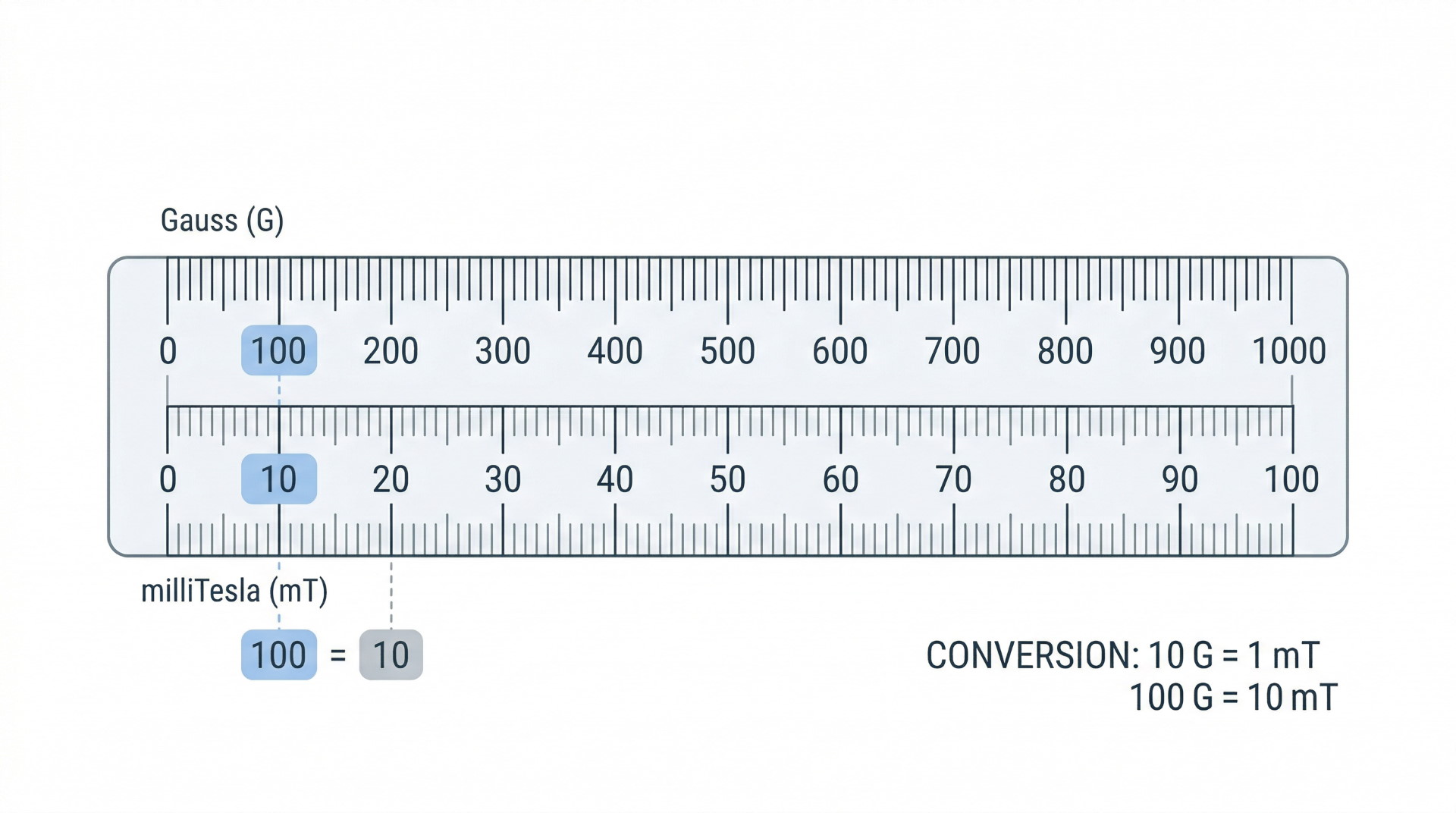
Conversion Math That Makes PEMF Specs Readable
The core relationship is simple: 10 Gauss equals 1 milliTesla. That single conversion handles most cross-brand comparisons where one page uses Gauss and the other uses milliTesla.
| Conversion Formula
Gauss ÷ 10 = milliTesla milliTesla × 10 = Gauss Example: A product lists 600 Gauss. In milliTesla, that is 600 ÷ 10 = 60 mT. Example: A product lists 5 mT. In Gauss, that is 5 × 10 = 50 Gauss. |
Conversion alone does not make two numbers comparable. It normalizes the unit so that both numbers sit on the same scale. You still need matching distance and reporting style before the comparison is valid.
Static Magnet Strength vs. Pulsed Electromagnetic Field Intensity
A refrigerator magnet and a PEMF mat both produce magnetic fields, but they work differently. A static magnet generates a constant field that does not change over time. A PEMF device produces a pulsed field – turning on and off in cycles, with the intensity rising to a peak and dropping back to zero during each pulse.
| Characteristic | Static Magnet | PEMF Device |
| Field behavior | Constant – always on at one level | Pulsed – cycles on and off |
| Intensity over time | Steady | Varies with each pulse |
| Reported number | Single constant value | May be peak, average, or RMS |
This distinction matters because comparing a static magnet’s rated Gauss to a PEMF device’s peak Gauss mixes two different field situations. They describe different physical behaviors and should be evaluated separately.
Why One Brand’s Number May Not Match Another Brand’s Number
Cross-brand intensity comparison breaks when the reporting practices differ. Two product pages can both display a Gauss figure, and those figures can still describe measurements taken under different conditions. The number is accurate to the method used – but the methods may not align.
Reported intensity can vary based on reporting style (peak vs. average), coil position within the mat, coil density, and measurement distance. On top of this, some brands foreground intensity as their primary selling narrative, while others emphasize frequency. These are different specification dimensions, not interchangeable value drivers.
Surface Gauss vs. Measured-at-Distance Reporting
A reading taken at the coil surface will always be higher than one taken a few centimeters above the mat. Magnetic field strength drops rapidly with distance from the source. This is why the same product could show dramatically different Gauss numbers depending on where the sensor was placed during testing.
In buyer terms: a surface Gauss reading tells you what the field measures right at the mat. It does not tell you what the field measures at your body if there are cushioning layers, clothing, or any gap between you and the coil. A reading taken at distance is closer to the field you would actually encounter, but it will always be a smaller number – which may look less impressive on a spec sheet.
A surface reading and a measured-at-distance reading should never be compared side by side as if they describe the same condition.
A Practical Distance Scenario Buyers Can Recognize
A surface reading describes the field right at or very near the mat. But many home-use setups add real distance between the coil and the body: a fabric cover, padding layers, clothing, or even a mattress topper. That means the number the buyer encounters at the body is not the same number published at the closest measurement point.
This does not mean the product is underperforming. It means distance changes the reading, and real-world use almost always introduces some distance. A surface Gauss figure is therefore best read as the highest external reference point, not as a universal description of the field everywhere above the mat.
Peak Intensity vs. Average or RMS Reporting
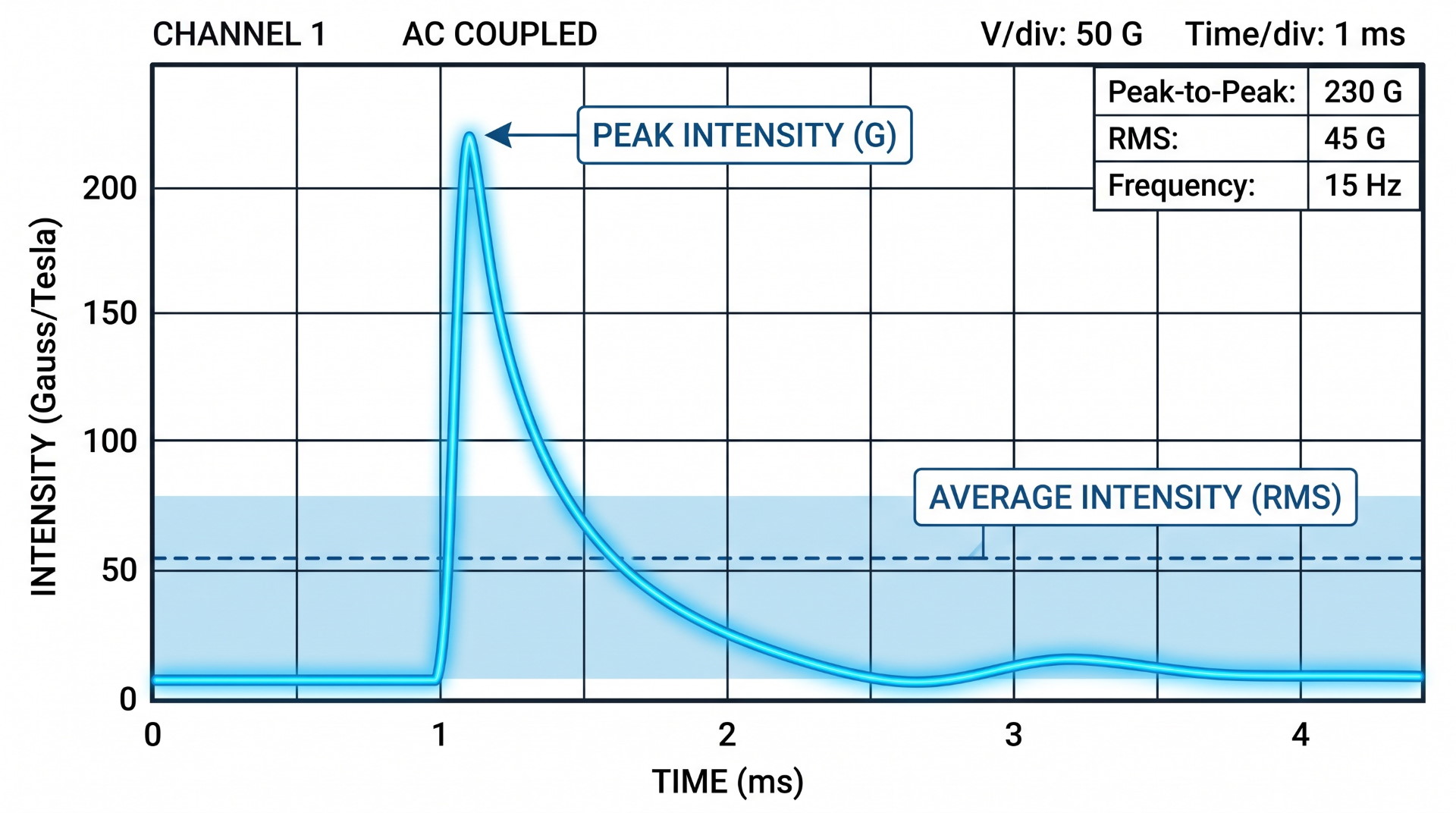
Peak intensity is the highest point of a single pulse – a brief maximum that lasts for a fraction of the cycle. Average intensity folds in all the time the pulse is off, spreading the total output across the full cycle. RMS (root mean square) is a mathematical method that accounts for the waveform shape, sitting between peak and simple average for most pulse types.
The relationship between peak and average depends on the duty cycle: the percentage of each cycle during which the pulse is actually on. A device with a 10% duty cycle is pulsing for only one-tenth of the time. Its peak number may be high, but its average will be much lower because the field is off for the other 90% of the cycle.
| Key Distinction
Peak = the tallest point of the pulse. It is a momentary maximum, not sustained output. Average = output spread across the entire on/off cycle. It reflects what the field looks like over time. RMS = a weighted calculation that gives a number between peak and average for most waveforms.
A product reporting 2,000 Gauss peak with a 10% duty cycle has an average output far below 2,000 Gauss. |
Why Peak Alone Can Mislead a Comparison
Peak intensity is easy to market because it produces the largest single number on the page. But peak describes only the highest moment of the pulse, not the full operating behavior over time. Once duty cycle is introduced, the difference between a dramatic peak and the field delivered across the full cycle can become very large.
This is why two products with very different headline peak numbers may look closer once average or RMS reporting is disclosed. A buyer does not need to reduce intensity to a single “best” style. The important thing is understanding that peak, average, and RMS are different reporting frames, not interchangeable versions of the same claim.
Internal Coil Output vs. User-Facing Field Disclosure
Some product pages report the magnetic field generated inside the coil hardware itself. Others report the field measured at the mat surface where the user lies. These are different measurement layers, and publishing one versus the other changes the visible number significantly.
Internal coil output will almost always be higher because the sensor is as close to the source as physically possible, often inside the device housing. Once the field passes through mat layers, padding, and any air gap, it has already dissipated. A user-facing surface reading accounts for that loss. A coil-level reading does not.
This creates disclosure asymmetry: Brand A might publish its internal coil figure while Brand B publishes its surface figure. A buyer comparing the two without knowing which layer each number represents may assume Brand A has a stronger product when the difference is actually in reporting method.
Why Brands Advertise the Biggest Number They Can Justify
In a competitive market, the most attention-grabbing intensity figure tends to land on the product page headline. That number is usually the peak reading, taken at the closest possible measurement point (surface or coil level), using the unit scale that produces the largest figure.
This is not necessarily dishonest – peak surface Gauss is a legitimate measurement. But the framing can create a gap between what the number technically describes and what a buyer assumes it means. A bigger number does not automatically mean a stronger product in use. It means the measurement was taken under conditions that produce the highest possible reading within the brand’s chosen reporting method.
| Biggest Number vs. Most Useful Number
The biggest number is usually peak, surface, Gauss-scale. The most useful number for comparison is one where unit, distance, and reporting style are all disclosed – even if that number looks smaller. |
What Changes Intensity Across a PEMF Mat or Device
The intensity number on a spec sheet reflects a single measurement under specific conditions. In reality, several physical factors shape what the magnetic field looks like at different points across the mat and at different moments in time.
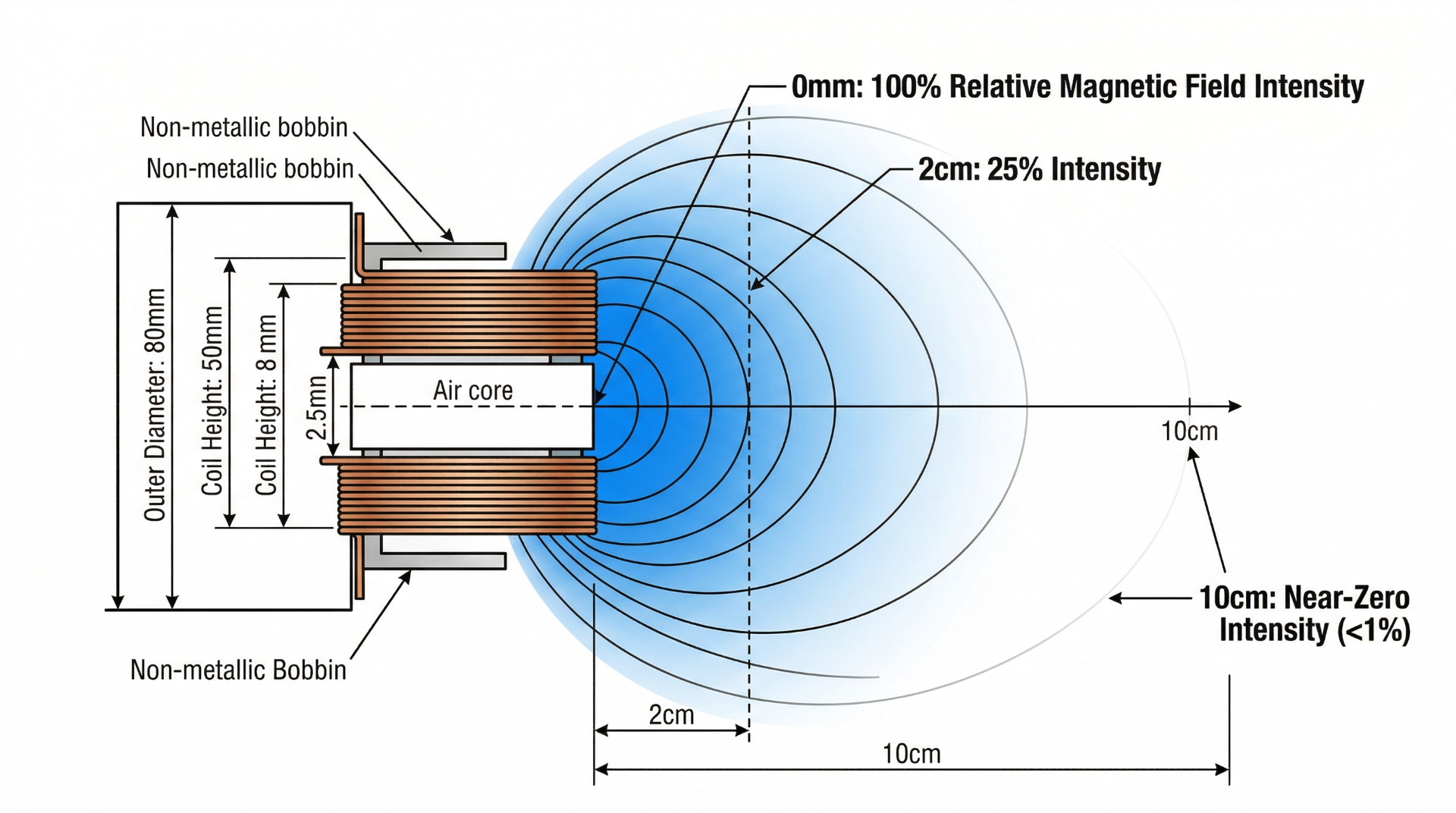
Distance From the Coil and Magnetic Field Dissipation
Magnetic field strength drops as you move away from the coil. This follows a principle known in physics as the inverse square law, which in buyer terms means: doubling the distance from the source does not halve the field – it reduces it by roughly a factor of four. The drop-off is steep and non-linear.
For PEMF mats, this means the number measured at the coil surface is always the highest. By the time you measure a few centimeters above the mat – roughly where a user’s body would be – the field has already weakened considerably. This is normal physics, not a product deficiency. But it does mean that a surface reading overstates what the user encounters at any distance above the mat.
Coil Density, Spacing, and Distribution Across the Surface
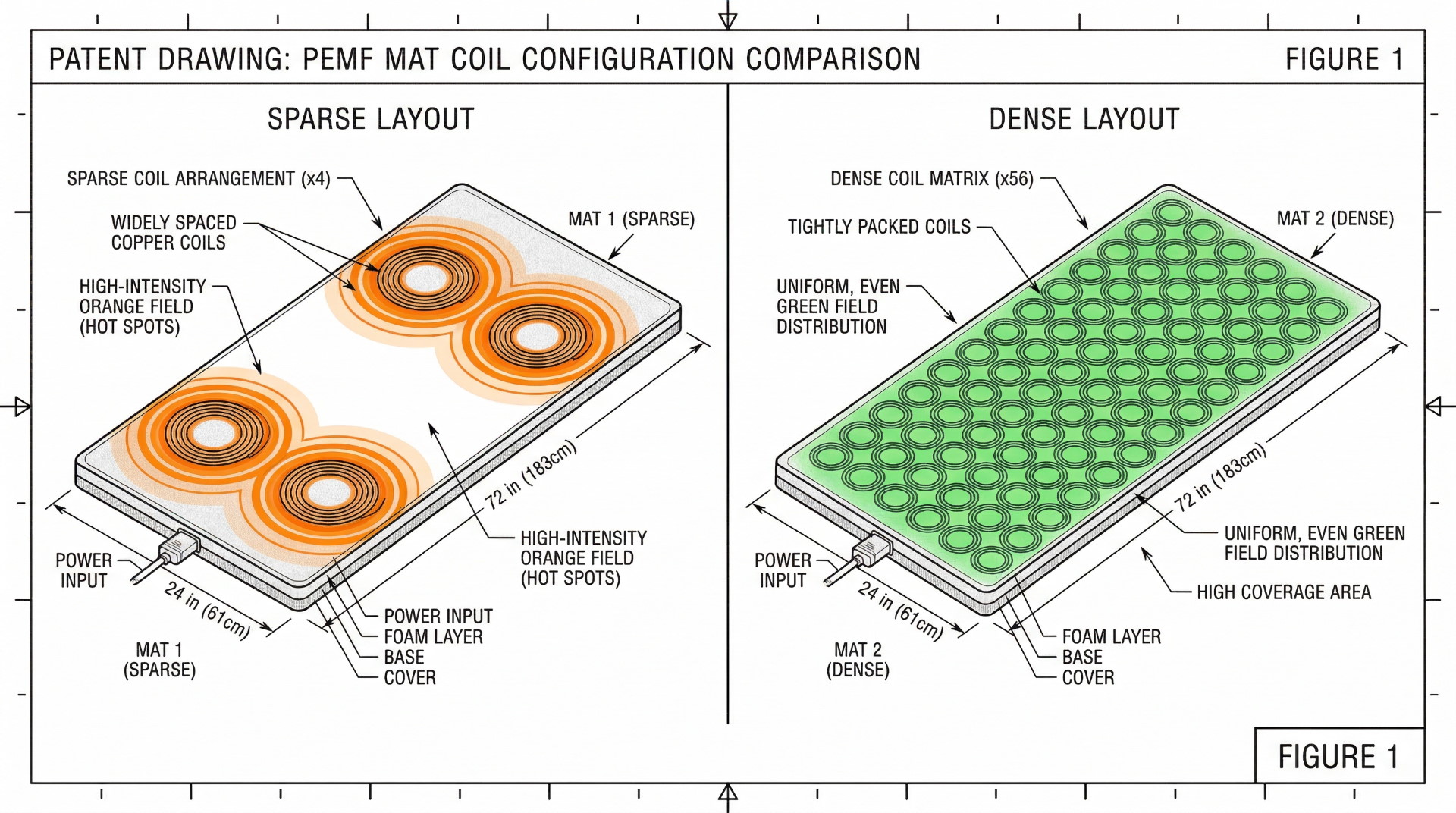
A PEMF mat contains copper coils that generate the magnetic field. How many coils are used, how far apart they sit, and how they are arranged across the mat surface all affect how evenly the field is distributed.
A mat with densely packed coils may produce a more even field distribution across its surface. A mat with fewer, widely spaced coils may have strong readings directly above each coil but weaker readings in the gaps between them. Neither layout is automatically superior – but a single-point Gauss reading does not tell you how the field behaves across the full surface. Coil layout context adds a dimension that the headline number alone cannot capture.
Duty Cycle and Why the Highest Pulse Is Not the Whole Story
Duty cycle refers to the percentage of each pulse cycle during which the field is actually on. If a device pulses for 1 millisecond out of every 10, its duty cycle is 10%. The peak intensity applies only during that 1-millisecond window. For the other 9 milliseconds, the field is at zero.
Think of it like a camera flash. The flash is extremely bright for a fraction of a second, but the average light output over the full minute is low because the flash is off most of the time. Peak intensity is the flash. Duty cycle determines how much of the time that flash is actually firing. A high peak number with a low duty cycle means the sustained output is substantially lower than the peak suggests.
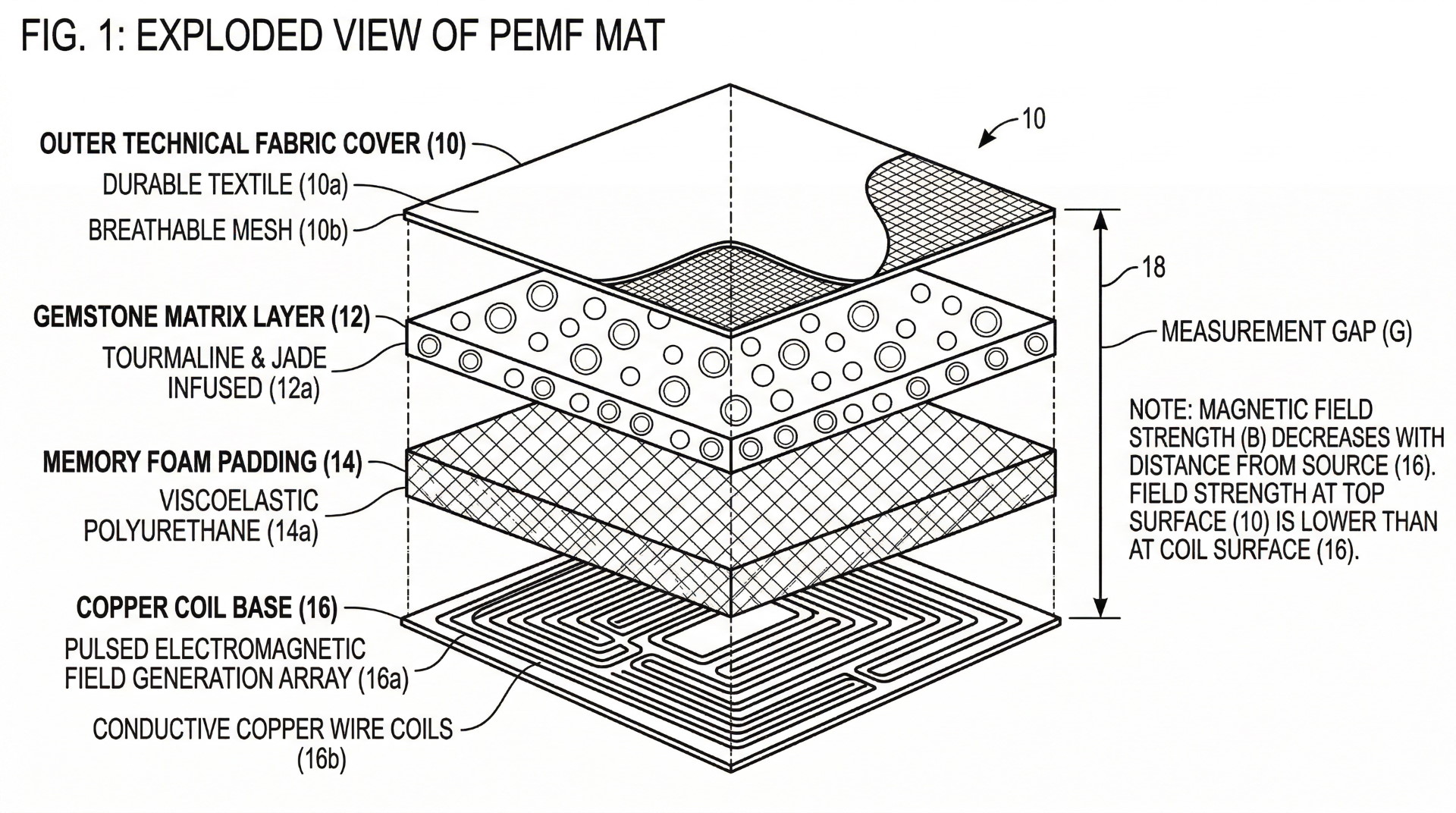
Construction Layers and How They Affect the Field Measured Above the Mat
The physical build of a PEMF mat – foam padding, fabric layers, protective housings – sits between the coil and the user. These layers increase the effective distance between the coil and the measurement point on the outer surface. A thicker mat may have the same coil output but a lower surface reading simply because the sensor is farther from the coil by the time it reaches the outside.
This is why reporting should not be detached from physical design. The same coil, in two mats with different construction thickness, will produce different surface Gauss readings. The coil is doing the same work; the measurement context has changed.
What Intensity Can and Cannot Tell You as a Buyer
Intensity is one specification field among several on a PEMF product page. It tells you something real about the magnetic field. It does not tell you everything a buyer needs to know. This section draws explicit boundaries around what the metric can and cannot establish.
What Intensity Helps You Compare
When unit, measurement distance, and reporting style all match between two products, intensity allows you to compare the disclosed field strength at a specific point. It supports spec-sheet reading: if Product A reports 500 Gauss at the surface (peak) and Product B reports 300 Gauss at the surface (peak), you can reasonably say Product A’s peak surface reading is higher. That is a valid, bounded comparison.
Intensity also helps you normalize across brands when conversion math is applied. A product listing 50 mT and another listing 500 Gauss are describing the same field strength, once you know that 10 Gauss equals 1 mT. Without conversion, the numbers look different. With it, they sit on the same scale.
What Intensity Does Not Prove
Intensity alone does not prove product quality. It does not prove how a product will feel during use or how it will perform over time. A higher Gauss number does not automatically mean a better product – it means a higher field strength at the measured point under the measured conditions.
Claims that higher intensity leads to deeper penetration, faster recovery, or specific biological outcomes remain contested and are not established by the intensity number on a spec sheet. The metric describes a physical measurement. It does not predict individual outcomes.
| Common Overinterpretations to Avoid
“Higher Gauss means deeper penetration.” – Not established by the spec-sheet number alone. “Low intensity means safer.” – Safety is a regulatory and clinical determination, not a spec-sheet conclusion. “This product is stronger, so it works better.” – Stronger field at the sensor point does not equal better product. |
Why Intensity and Frequency Are Different Comparison Fields
Some brands emphasize intensity as their primary specification. Others emphasize frequency – the number of pulses per second, measured in Hertz (Hz). These are separate dimensions of the product specification, not interchangeable value drivers.
Intensity describes how strong each pulse is. Frequency describes how often pulses occur. Disagreement exists across the market about which dimension matters more, and different manufacturers build their narratives around whichever one favors their product design. For comparison purposes, treat them as independent fields. Comparing a product’s intensity to another product’s frequency is not a valid spec-sheet comparison.
Regulatory, Standards, and Historical Context Without Over-Reading the Claim
Regulatory bodies like the FDA and FCC establish emission limits and classification frameworks for electromagnetic devices. Standards organizations like IEEE and NIST define measurement protocols. These references provide descriptive context – they help you understand the regulatory environment a product operates in. They do not prove that one intensity level is superior to another.
Similarly, references to NASA research or Earth’s natural magnetic field (approximately 25–65 µT) can provide historical and environmental context, but they should not be treated as direct product endorsements. A product citing a NASA study is referencing historical research context, not clinical proof of its own efficacy.
| Source-Type Reference
Regulatory (FDA, FCC): Sets compliance boundaries and classification. Does not rank products. Standards body (IEEE, NIST): Defines measurement methods. Does not endorse specific intensity levels. Manufacturer: Reports its own measurements. May choose the most favorable reporting method. Affiliate or reseller: May reframe manufacturer claims with promotional framing. Peer-reviewed research: Provides evidence under controlled conditions. Does not automatically apply to consumer products. |
Product-Page Details Buyers Should Look for Next to an Intensity Claim
An intensity number gains meaning when it appears alongside the disclosure fields that explain how it was measured. This section covers each field individually so you know what to look for – and what to flag when it is missing.
Unit Disclosure
The first thing to confirm is the unit. Is the number in Gauss, milliTesla, microTesla, or Tesla? Without a labeled unit, the number cannot be interpreted or converted. A listing that says “3,000” without specifying Gauss or milliTesla leaves the buyer unable to determine the actual scale.
If two products use different units, convert before comparing. The conversion anchor: 10 Gauss = 1 milliTesla. Do not mix units without converting first.
Measurement Distance Disclosure
The second field to check is measurement distance. Was the reading taken at the coil surface, at the mat surface, or at some specified distance above the mat? Field strength drops with distance, so a surface reading and a 5 cm reading from the same product can look vastly different.
If no distance is mentioned, assume the number reflects the most favorable reading available – likely at or very near the coil surface. This is the measurement-distance disclosure gap that weakens most spec-sheet comparisons.
Peak vs. Average or RMS Disclosure
The third field is reporting style. A peak number and an average number from the same device will differ, sometimes dramatically. If the spec sheet does not say which type is being reported, you cannot know what the number represents over time.
| Reporting Style | What It Captures | Typical Appearance |
| Peak | Highest momentary point of the pulse | Largest number on the spec sheet |
| Average | Output over the full on/off cycle | Smaller than peak, especially with low duty cycles |
| RMS | Waveform-weighted calculation | Between peak and average for most pulse shapes |
Coil-Layout or Distribution Disclosure
Coil density and layout shape how intensity is distributed across the mat. A single high Gauss reading at one point does not describe the field across the entire surface. If a product page provides information about coil count, spacing, or layout pattern, that context adds depth to the intensity number. If no layout information is given, the headline number describes a single measurement point – nothing more.
A Fast Reality Check for Comparing Two Intensity Claims
Before you compare one brand’s intensity number to another’s, ask four questions in order: are the units on the same scale, was the reading taken at the same distance, is the reporting style the same, and is the number tied to the same measurement layer (surface, measured-at-distance, or internal coil output)? If the answer to any of these is no, the comparison is only partial.
This is not an advanced audit. It is a normalization check. The purpose is to prevent a buyer from treating two technically different numbers as if they were directly interchangeable.
Red Flags in Vague PEMF Intensity Marketing
Missing disclosure is the most common red flag. Specifically:
| Red Flags to Watch For
No unit label: A number without Gauss, mT, or µT is uninterpretable. No measurement distance: Could be surface, coil-level, or arbitrary – you cannot tell. No peak/average/RMS label: The same device can produce numbers that differ by multiples depending on which reporting style is used. Vague power claims: Phrases like “powerful magnetic field” or “strongest available” without any method notes are marketing language, not specification data. Implied superiority from bigger numbers: A larger number does not mean a better product when the reporting conditions are unknown or different. |
Minimum Disclosure Threshold Before an Intensity Number Becomes Useful
An intensity number becomes meaningfully useful for comparison when the buyer can identify at least three things: the unit, the measurement distance, and the reporting style. A fourth layer – measurement position or disclosure about coil-level versus user-facing field – is even better when available. If too many of those layers are missing, the number may still describe a real measurement, but its comparison value drops sharply.
This is not a product verdict. It is a spec-literacy rule. The less a page explains how its intensity figure was produced, the more the buyer is being asked to infer instead of compare.
FAQ
What is PEMF intensity in plain buyer language?
PEMF intensity is the strength of the magnetic field at a specific point in space and time. It is usually reported in Gauss or Tesla on product pages. It describes a physical measurement, not a promise about what you will experience.
Is Gauss the same thing as Tesla?
Gauss and Tesla are different units for the same type of measurement – magnetic field strength. They relate by scale: 10,000 Gauss equals 1 Tesla. On home-use product pages, you will more commonly see Gauss or milliTesla (mT).
How do you convert Gauss to milliTesla?
Divide the Gauss number by 10. For example, 500 Gauss ÷ 10 = 50 milliTesla. To go the other direction, multiply milliTesla by 10.
Why is 1 mT equal to 10 Gauss?
The Tesla is the SI unit for magnetic flux density, and the Gauss is the CGS unit. Their scale relationship is fixed: 1 Tesla = 10,000 Gauss. Stepping down to the milliTesla (one-thousandth of a Tesla), you get 1 mT = 10 Gauss.
What is magnetic flux density?
Magnetic flux density is the technical term for field strength at a specific point. On product pages, it is usually simplified to “intensity.” It describes how strong the magnetic field is where the sensor was placed during measurement.
Why are two PEMF mats with different Gauss numbers not automatically different in real use?
Because the numbers may have been measured at different distances, using different reporting styles (peak vs. average), or at different coil positions. A difference in reported Gauss does not necessarily reflect a difference in what the user encounters.
What is the difference between peak intensity and average intensity?
Peak intensity is the highest point of a single pulse – a brief maximum. Average intensity spreads the total output across the full on/off cycle, including the time the field is at zero. Peak is always higher than average for any pulsed device.
What does RMS mean on a PEMF specification sheet?
RMS stands for root mean square. It is a calculation that gives a time-weighted value of the waveform, usually falling between peak and simple average. It should not be assumed equivalent to peak output.
What does surface Gauss mean?
Surface Gauss is a field strength reading taken at or very near the mat’s outer surface. It is the closest external measurement point to the coil and will always be higher than a reading taken farther away.
Why does measurement distance matter when comparing PEMF devices?
Magnetic field strength drops as distance from the coil increases. A reading at the surface and a reading at 5 cm describe different field conditions. Comparing them as if they were the same type of measurement is misleading.
Does magnetic intensity drop as you move away from the coil?
Yes. Field strength decreases rapidly with distance from the source. This follows the inverse square law, meaning the drop-off is steep and non-linear.
What is the inverse square law in PEMF buyer terms?
It means that as you double the distance from the coil, the field strength drops by roughly a factor of four – not two. The farther you are from the source, the steeper the decline in field strength.
Does coil density change how intensity is distributed across a mat?
Yes. More coils packed closer together tend to produce a more even field across the surface. Fewer, widely spaced coils may produce strong readings above each coil but weaker readings in the gaps between them.
What is the difference between static magnet strength and PEMF intensity?
A static magnet produces a constant, unchanging field. A PEMF device produces a pulsed field that cycles on and off. The two describe different physical situations and should not be compared directly.
Why do some brands advertise very high Gauss numbers?
Brands typically foreground the most attention-grabbing number their reporting method allows. This usually means the peak reading, at the closest measurement point, using the unit scale that produces the largest figure.
Is higher intensity automatically better?
No. A higher intensity number means a stronger field at the measured point under the measured conditions. It does not establish that the product is superior. Claims linking higher intensity directly to better outcomes remain contested.
Can intensity alone tell you how a PEMF product will feel or perform?
No. Intensity is one specification field. How a product feels or performs depends on multiple factors including frequency, waveform shape, coil layout, construction, and individual variability.
Why do some brands focus on frequency instead of intensity?
Frequency and intensity are separate specification dimensions. Some product designs favor one over the other, and brands naturally emphasize whichever dimension favors their design. Neither is inherently more important – they measure different things.
What product-page details should appear next to an intensity claim?
At minimum: the unit (Gauss, mT, µT), the measurement distance (surface, 1 cm, 5 cm, etc.), and the reporting style (peak, average, or RMS). Coil-layout or distribution context adds further comparison value when available.
Does duty cycle change the meaning of a peak intensity number?
Yes. Duty cycle determines how much of each pulse cycle the field is on. A high peak with a low duty cycle means the average output is much lower than the peak number suggests.
Do regulatory references prove that one intensity level is superior?
No. Regulatory bodies like the FDA and FCC set compliance boundaries and classification frameworks. They do not rank intensity levels or declare one level superior to another.
What should buyers treat as a red flag in PEMF intensity marketing?
Missing unit labels, no measurement distance disclosure, unlabeled peak/average/RMS reporting style, and vague power language with no method notes. Any of these reduce the comparison value of the number to near zero.

The PEMF Advisor Editorial Team reviews consumer PEMF mats and related wellness devices. Our work focuses on verified specifications, documentation, usability, materials, warranty/returns, and ownership considerations. We do not provide medical advice or evaluate health outcomes. See our Review Methodology and Editorial Standards.