Bottom line: Different PEMF mat types fit different buyers mainly by space, storage footprint, portability burden, setup effort, and controller complexity. Full-body floor mats usually fit dedicated-space buyers, while smaller, foldable, or more portable formats tend to fit buyers who need easier storage, lighter handling, or simpler routines.
This guide compares PEMF mat categories the way home buyers actually live with them: how much floor they take up when in use, how they store between sessions, how much they weigh to move, and how quickly they start when you just want to use them. The goal is to help you match a physical format to your home environment and routine before any brand-level comparison begins.
PEMF Advisor publishes buyer-oriented reviews, comparisons, and educational content for home-use PEMF mats and devices. This page is a constrained buyer-fit explainer within that system: it focuses only on how different PEMF mat types fit different ownership needs, not on treatment guidance, diagnosis, or condition-based product matching.
If you want the broader category context before matching formats to needs, use our Types of PEMF Mats guide. That page explains the main home-use PEMF mat categories by format, portability, ownership burden, and feature stacking so you can place this buyer-fit question inside the wider market before comparing specific products.
Ownership-fit vs treatment-fit: how to read this guide
This page compares PEMF mat categories by ownership-fit and routine-fit rather than by medical suitability. In plain terms, that means the comparison is built around how a mat physically fits your space, storage, and daily handling – not around which mat is “best” for any condition, symptom, or outcome.
Physical format is what drives lifestyle fit. A full-body floor mat, a mini pad, a foldable full-length mat, a flexible wrap, and a heavier stationary system all create different demands on floor space, storage, weight handling, setup time, and controller learning. Those differences are concrete and verifiable.
Some sources in the market connect PEMF mats to outcomes like back pain, sleep, detoxification, cellular repair, circulation, or bone density. Those claims are governance-restricted under this page’s framing and do not drive any recommendations here. Observed is not the same as endorsed.
| Ownership-fit (this guide)
How the mat fits your floor space and storage. How heavy it feels to move, fold, or store. How long it takes to start a session. How complex the controller is to learn. Whether format matches your routine. |
Treatment-fit (not this guide)
Which mat helps a specific condition. Which format is best for a symptom. Which gauss level delivers an outcome. Which mat “works” for sleep, pain, or recovery. Any claim tying format to medical results. |
This page maps mat types to space, storage, and routine needs
PEMF mat categories differ on a handful of concrete, lived-in variables: physical dimensions (both deployed and stored), storage footprint, portability, setup burden, and controller complexity. Category fit is constrained by how much floor you can dedicate, how tolerant your household is of visible gear, and how much handling you’re willing to do every time you want to use it.
If your mat won’t fit behind the couch when folded, that matters. If your mat takes eight minutes of menu navigation to start, that matters too. The sections below translate those realities into category fit.
- This guide helps you match format to home environment. It uses buyer tasks – room fit, put-away, travel, startup – instead of technical jargon.
- Category fit is conditional. Fit depends on floor space, storage tolerance, and handling tolerance, not on any single spec.
- Stored size is as important as deployed size. A mat that’s fine to use can still be a burden to put away.
This page does not map mat types to conditions, symptoms, or treatment outcomes
This guide does not sort mat categories by pain, sleep quality, circulation, bone density, or any similar outcome. Hardware characteristics – coverage area, coil layout, intensity range – do not, on their own, prove that one format is clinically suited to a specific condition better than another.
That distinction is deliberate. Some public sources do make those connections. Those claims are low-stability in this context and are set aside so the comparison stays useful for actual ownership decisions.
| What this page is not doing
• Not ranking mats by health outcome. • Not claiming any mat type treats a condition. • Not using gauss or coverage as proof of medical benefit. • Not inferring systemic effects from physical format. |
Buyer need table: which PEMF mat type fits which ownership need
This is the page’s main decision artifact. Read it as a fit map, not a ranking. “Best-fit” here means the category that tends to fit a given ownership condition – it does not mean the category that “works best” in any medical sense.
Two contradictions worth resolving before you scan: feature-stacked systems carry a hidden mastery cost (menus, presets, settings to learn) that can matter more than the features themselves, and a mat labeled “portable” is not automatically “travel-light” – room-to-room carry, car travel, and airline carry-on are three different demands.
| Buyer need / constraint | Best-fit category | Why it fits | What it does not prove |
| Space-first (tight rooms, shared spaces) | Mini or localized mat; foldable full-length mat | Smaller deployed footprint or reduced stored footprint eases tight-space ownership. | Smaller format does not prove whole-body equivalence or any outcome. |
| Storage-first (closet, under-bed, corner) | Foldable full-length mat; flexible wrap or pad | Folding and flexibility reduce stored size and improve closet or shelf compatibility. | Easier storage does not prove broader suitability than rigid formats. |
| Low-setup routine (quick starts) | Mini or localized mat with one-button or preset controls | Lighter handling and simpler interfaces shorten time from idle to use. | Low setup does not prove superior performance or condition fit. |
| Full-body coverage preference | Full-body floor mat; foldable full-length mat | Built around larger deployed footprint and broader physical coverage area. | Broader physical coverage is not a claim about broader outcomes. |
| Localized use preference | Mini or localized mat; flexible wrap or pad format | Smaller footprint and placement flexibility match localized-use routines. | Smaller coverage does not imply targeted therapeutic effect. |
| Travel and portability | Portable mini; lighter foldable designs | Lower weight and case compatibility ease carrying; verify airline fit separately. | “Portable” does not automatically equal airline-carry-on compatible. |
| Low learning curve | One-button or preset-driven systems | Simpler controller models reduce comparison burden and startup friction. | Simpler controls do not prove inferior or superior outcomes. |
| Feature-stacked ownership | Heavier stationary or programmable systems | Deeper control customization for buyers with interface tolerance and permanent space. | More features do not prove universally better fit or outcomes. |
Space-first fit
Floor space is usually the first real constraint. Full-body floor mats require a clear run of floor roughly in the 65–75 inch length range to use comfortably, which is not negotiable in small rooms. Mini and localized formats – often closer to 20 inches on a side – ask for far less deployed area and can live on a couch, chair, or small free patch of floor.
Stored size matters just as much as deployed size. A full-body mat that rolls into a cylinder still needs somewhere for that cylinder to live. A foldable full-length mat collapses into a smaller rectangle and handles closet storage more gracefully. Evaluate both states before choosing.
Vague words like “compact” only help when tied to use context. “Fits on a sofa” or “stows under a bed” is useful; “compact” by itself is not.
Storage-first fit
If your mat has to disappear between sessions, the storage equation changes. Foldable full-length mats exist precisely to compress a full-length format into a smaller stored footprint, usually at the cost of some hinge-zone layout compromise. Rigid or heavier stationary systems preserve a cleaner internal layout but do not store flat or small.
Storage reality is about compatibility with your actual storage real estate. Under-bed clearance, closet shelf depth, corner width, and doorway width are all real constraints. A mat that fits the living room floor but not the closet is not actually a storage-friendly mat.
Low-setup routine fit
Low-setup fit is about minutes and friction, not feature count. Simpler formats and simpler control models – one-button, preset-driven – usually produce shorter time from decision to session. Heavier or more programmable systems add initialization steps: unrolling or unfolding, positioning, reading labels, selecting modes, confirming settings.
| Low-setup checklist
✓ Can you start a session with one or two interactions? ✓ Can one person lift and position it without help? ✓ Does it live near an outlet so you skip cable routing each time? ✓ Can you put it away in under a minute if needed? ✓ Are the presets labeled clearly enough to use without the manual? |
Full-body coverage preference fit
A full-body floor mat is designed around broader physical coverage – typically a bed-length format roughly 65–75 inches long. If you prefer to lie down across a single surface rather than position a smaller mat under one area, this category is built for that preference.
Be precise about what the choice means. Choosing a full-body format expresses a preference for broader physical area and head-to-toe placement. It does not imply that broader physical coverage produces broader outcomes. Coverage is geometry, not evidence.
Localized-use fit
Mini or localized mats cover a smaller physical area and fit localized-use preferences naturally. Flexible wrap or pad-style formats go further, allowing placement around a single body area rather than beneath it.
Smaller size changes two things: the physical area covered during a session, and the storage and handling practicality between sessions. It does not change whether a mat is “better” or “worse” than a full-body format. Keep the comparison at the level of placement, storage, and handling, not inferred outcomes.
Travel and portability fit
Portability is one of the most overloaded terms in this category. In practice, “portable” can mean three different things, and they are not the same.
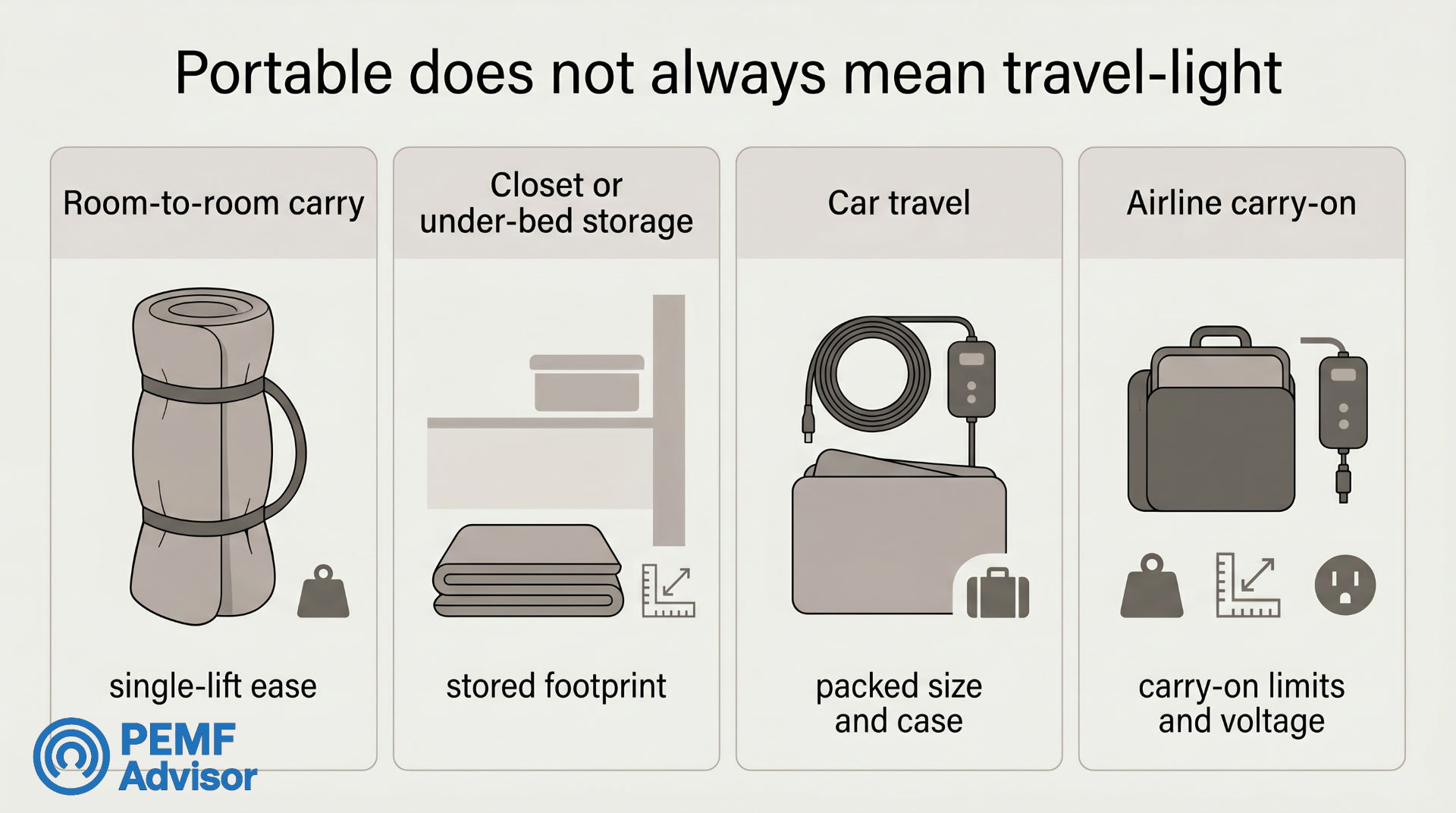
| Travel context | What matters most | Typical fit |
| Room-to-room carry | Weight and awkwardness of a single lift; whether one person can move it. | Most foldable, mini, or wrap formats. Heavier stationary systems fit poorly. |
| Car travel (trunk, road trip) | Folded or rolled size, case compatibility, cable bundle, outlet at destination. | Foldable full-length mats and mini mats usually fit. Full-body rigid mats are bulkier. |
| Airline carry-on | Weight under airline limits, packed dimensions under carry-on spec, voltage compatibility abroad. | Mini or pad-style formats are the most realistic. “Portable” labels alone do not guarantee fit. |
Key distinction: “Portable” in product copy often just means “not a stationary system.” That is not the same thing as “fits in your carry-on.” Verify weight, packed size, and voltage separately if travel is the driver.
Low-learning-curve fit
Controller complexity ranges from a single physical button with two or three presets to programmable systems with adjustable frequency, intensity, duration, and waveform settings. One-button preset systems are typically easier for beginners to operate and keep ongoing setup fast.
The hidden cost in feature-stacked interfaces is mastery time – hours spent reading documentation, comparing settings, and second-guessing choices. This is a real comparison burden, and it exists before you ever press start. Simpler controls are not a sign of a less serious buyer; they are a fit condition.
Feature-stacked buyer fit
Feature-stacked stationary systems fit buyers who want deeper control customization and have the tolerance for menus, settings, and longer setup logic. The trade-off is honest: greater customization usually requires higher controller familiarity, and these systems typically live in a permanent spot because they are not the easiest formats to move.
Do not read “feature-stacked” as prestige. A programmable system is a fit condition, not a superiority claim. If you prefer adjustability and have a permanent space and the patience for the interface, it fits. If you prefer to keep things simple, it probably does not.
What PEMF mat types actually differ by
Underneath the marketing, home-use PEMF mat categories differ on a small, concrete set of variables: physical dimensions, coverage area, portability factor, setup burden, controller complexity, and coil layout. These are the variables that actually shape ownership. Labels like “professional” or “advanced” rarely are.
When two mats feel similar online and different in real use, the difference almost always lives in these variables – not in headline specs. A useful spec hierarchy for beginner buyers puts dimensions, weight, controls, and storage fit before isolated technical metrics.
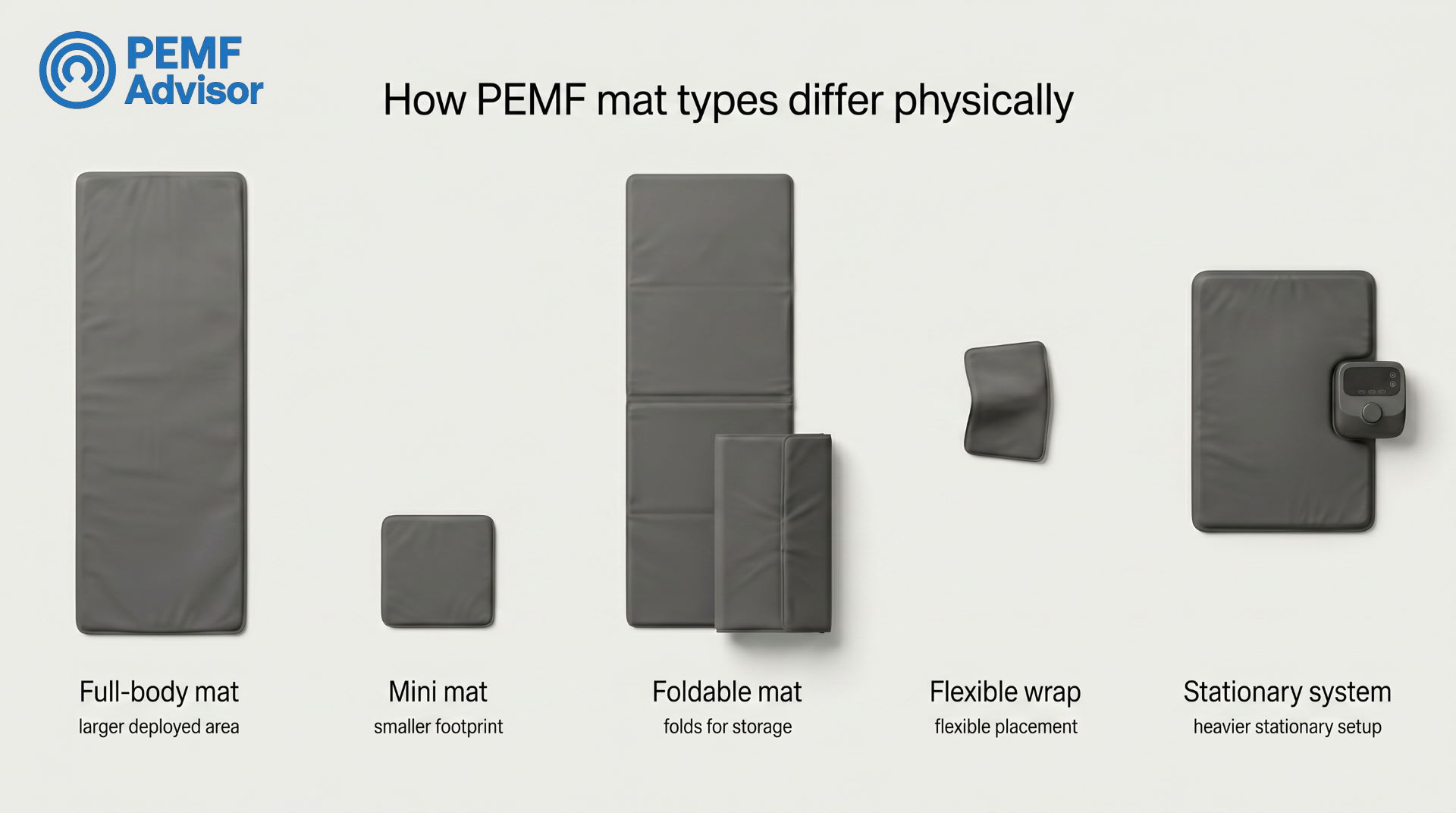
Physical dimensions: deployed vs stored
Physical dimensions show up in two states, and buyers should never rely on just one. Deployed dimensions determine whether the mat fits your room during use. Stored dimensions determine whether it fits your life between uses.
A simple example: a full-length mat that’s roughly 73 inches long when deployed may only be 30 inches long when folded in thirds – but it’s now thicker, and the folded rectangle still has to live somewhere. A mini mat at 20 × 20 inches deployed may be essentially the same size stored. The ratio between the two states is worth checking as carefully as any other spec.
Coverage area: full-body vs localized
Categories vary in the physical area they cover. Full-body formats cover head-to-toe by design; localized formats – mini mats, wraps, pads – cover a smaller area. This is coverage geometry, nothing more.
The language is worth keeping precise. “Full-body” and “localized” describe coverage format, not a guaranteed outcome type. A smaller mat does not prove whole-body equivalence, and a full-body mat does not prove broader effect. Coverage is a physical fact; outcome claims are a separate conversation and not the one this page is having.
Portability factor: weight, carryability, travel realism
Weight is the primary driver of portability for home-use devices. Full-body floor mats commonly range from about 15 to 30+ pounds depending on included layers, crystals, and heating elements. Mini and portable formats often come in under 12 pounds. These differences matter much more for day-to-day handling than most spec sheets suggest.
Case compatibility and carryability also matter. A mat with a dedicated carry case rolls and stows differently from one that comes bare. Travel realism depends on use case – lifting between rooms, loading a trunk, and packing for a flight all apply different standards.
Setup burden and controller complexity
Setup burden is the sum of handling time (unfolding, positioning, plugging in) and interface time (selecting a mode or session). Controller complexity sits on a spectrum from a single-button preset unit to programmable systems with adjustable frequency and intensity, adjustable session length, and multiple waveform options.
Hidden mastery cost – the time it takes to learn what every setting does, and the quiet anxiety about whether you’re using it “right” – is a real ownership variable. Buyers often feel the weight of a complex interface long after they’ve memorized the buttons.
Coil layout and format constraints
Coil layout is one of the hardware differences that varies between rigid and foldable categories. In rigid full-body mats, coils are distributed across a single continuous surface. In foldable designs, coils have to be arranged around hinge areas, which can introduce distribution limits or possible quieter zones at the fold lines.
This is a format constraint, not a universal superiority argument for rigid mats. Foldability exists because it solves a real storage problem. Some hinge-area compromise is the price of that solution. Both designs have honest trade-offs; neither is categorically better.
Main PEMF mat categories for home use
Five home-use categories cover most of what buyers actually see on the market. These are defined by physical operating model – what the format is built around – not by marketing labels. Definitions are deliberately non-ranking.
Full-body floor mats
Built around broader physical coverage, typically in a bed-length format roughly 65–75 inches long. Usually paired with a separate control unit and a power adapter. Requires more deployed floor space than any other home category.
Most compatible with dedicated home setups where the mat can live in place – a wellness corner, a guest room, a permanent spot next to a bed or sofa. Less compatible with transient-space households where the mat has to be moved or stored between uses.
Mini or localized mats
Built around a smaller physical coverage area – often around 20 inches on a side. Easier to store and easier to move in many homes. Commonly used on a chair, sofa, or small patch of floor rather than in a lie-down position.
Smaller size is a geometric fact, not a performance claim. Do not read “mini” as “less capable” or “whole-body equivalent” – it is simply a different physical format built for a different use pattern.
Foldable full-length mats
Aim to preserve larger-format use while improving storage convenience. A full-length deployed surface folds into a much smaller stored footprint, usually with the help of a carrying bag. Common fold patterns include thirds and quarters.
Foldability introduces the hinge-area trade-off described earlier. Rigid full-body mats avoid this at the cost of storage flexibility. Neither is automatically superior – the right choice depends on whether your constraint is storage or layout.
Flexible wrap or pad-style formats
Shaped by placement flexibility. Where a mat lives under a body, a wrap or pad can be placed around or beside a specific body area. Flexibility changes both storage options (rolled, folded, tucked away) and placement options.
Flexibility does not remove the need to compare weight, controls, and outlet dependence. A wrap is still a device with a cable, a controller, and handling characteristics. Format flexibility solves placement, not every other ownership variable.
Heavier stationary or feature-stacked systems
Combine lower portability with higher controller complexity. These are designed around permanent placement and programmable control – adjustable intensity, adjustable frequency, adjustable session logic, sometimes multiple waveforms.
“Feature-stacked” is a fit condition, not a superiority signal. The category is better matched to buyers who have stable floor space, tolerate more interface learning, and value adjustability over simplicity. Buyers without those conditions often find the same features a source of friction.
How buyer constraints change the best-fit category
The same mat category does not fit every home. Best-fit depends on home size, storage routine, transport expectations, and interface tolerance. Small shifts in one of those variables can change which category makes practical sense.
The subsections below walk through the five most common constraint patterns. They are meant to be scanned, not memorized.
Small home or shared room constraints
Small apartments, shared rooms, and dense households raise the importance of both deployed and stored footprint. A full-body mat that lives on the floor of a studio apartment dominates the room. A foldable or mini format can live in a corner, under a bed, or inside a closet without visibly taking over.
Routine friction also rises when a larger mat must be moved often. If “using the mat” involves clearing a floor and rearranging furniture each time, the routine will break down. Smaller or foldable formats tend to survive these conditions better.
Frequent setup and put-away routines
If the mat can’t live deployed, every session includes a setup cost and a put-away cost. Weight, stored footprint, and interface simplicity matter more here than feature depth. Three extra pounds and two extra menu steps feel small once but expensive across hundreds of sessions.
Permanent-space assumptions fit poorly in this pattern. Systems built around “set it up once” reveal their weight and complexity fastest when they have to move daily.
Dedicated wellness corner or permanent floor space
A dedicated space changes the math. Permanent floor space lowers the penalty on larger deployed footprint and lower portability, because the mat doesn’t need to be moved or stored. Full-body or heavier stationary systems become practical in this environment.
This is a space-and-routine fit, not a superiority judgment. A dedicated corner makes bulkier systems viable; it does not make them universally better than smaller formats for someone with a different living situation.
Car-travel vs airline-carry-on expectations
Travel-focused buyers often conflate three different realities. Car travel tolerates more size and weight – a folded full-length mat in a trunk is perfectly reasonable. Airline carry-on is much stricter: packed dimensions, total weight, and destination voltage all apply.
If a mat is marketed as “portable,” that does not automatically mean airline-friendly. Check weight, packed size, case compatibility, and voltage compatibility separately before assuming it fits any specific travel mode.
Simplicity-first vs programmability-first ownership
Interface tolerance varies, and so does day-to-day practicality. A buyer who wants minimal control friction often fares better with one-button or preset-driven models. A buyer who enjoys adjustability and learning curves may feel under-served by that same simplicity.
More options are not proof of broader suitability. They increase comparison burden before purchase and ongoing interface burden after. Read simplicity as a practicality choice, not a sign of a less serious buyer.
What hardware differences can help you compare – and what they do not prove
Gauss strength, coil layout, power dependence, and coverage area are all valid comparison inputs. They help you differentiate categories. What they do not do is prove superiority, prove faster recovery, or prove suitability for a specific condition.
A reliable frame is “helps you compare” vs “does not prove.” The same hardware difference can be useful for picking between categories and useless as evidence of an outcome.
| Helps you compare
Dimensions → room fit. Stored dimensions → storage fit. Weight → handling and carrying fit. Controller type → learning curve. Coil layout → coverage distribution. Outlet dependence → placement options. |
Does not prove
That one category “works better.” That higher gauss equals faster recovery. That more features equal better outcomes. That “professional” labels equal home fit. That a format is right for a specific condition. That coverage area produces broader effects. |
Gauss strength as a comparison input, not a standalone answer
Gauss strength is one useful piece of a category comparison. It helps differentiate mats that operate at very low intensities from those with higher adjustable ranges. It does not, on its own, tell you whether a mat fits your space, storage, or routine.
Some sources claim higher intensity equates to faster recovery or better outcomes. Those claims are governance-restricted here and should not drive category choice. A higher-gauss mat in the wrong format for your home is still the wrong mat.
Coil layout as a coverage and format issue
Coil layout affects how a format is physically arranged. Rigid full-body mats can distribute coils across an unbroken surface; foldable designs arrange coils around hinge zones and may have slightly different distribution at the folds.
This is a coverage and format issue – how the mat is physically built. It is not proof that one format produces different outcomes than another. Keep the comparison at the level of geometry and construction.
Power and outlet dependence as a real ownership variable
Most home-use PEMF mats require outlet proximity. This single fact affects where the mat can physically live in your home, how cable routing works, and how much flexibility you actually have in daily placement. It also tempers any “portable” claim – a mat that needs an outlet is not a free-roaming device.
- Check cable length on the spec sheet, not just mat size.
- Consider outlet proximity in every intended use location (bedroom, living room, office).
- Factor in travel destinations: a mat that works at home may not work abroad without a voltage-compatible adapter.
Why smaller coverage does not automatically equal whole-body fit
Smaller mats cover smaller physical areas. That is a geometric fact. A mini mat placed under the lower back covers the lower back. It does not cover the legs, the shoulders, or the head at the same time. Treating smaller physical coverage as whole-body equivalence is a category error.
- Smaller mat → localized physical coverage.
- Full-body mat → head-to-toe physical coverage.
- Same category fit? No. Different physical formats serve different placement patterns.
Why “professional” and “home” labels are weak evidence
Labels like “professional grade,” “medical grade,” or “home use” are often arbitrary or marketing-led. They rarely carry consistent meaning across brands. Two “professional” mats from different companies may have very different dimensions, controls, and construction – and two “home” mats may include features that exceed a “professional” label elsewhere.
Category comparison should rely on verifiable hardware and ownership factors: dimensions (deployed and stored), storage needs, weight, controls, coil layout, and outlet dependence. Those are the signals that don’t shift with marketing copy.
Constraints and limits that affect ownership fit
Every category has trade-offs. These are honest ownership constraints – not proofs of inferior outcomes. Surfacing them before brand-level comparison helps you rule out formats that will not fit your life, regardless of how appealing the specs look.
Fold lines, hinge zones, and possible coverage compromises
Foldable mats solve storage by introducing fold lines. Those lines can affect how the mat’s internal components are laid out, and some designs may have slightly different characteristics at the hinge areas compared to the flat sections.
This is a trade-off that exists because foldability exists. Buyers who prioritize storage flexibility are accepting this compromise by definition. Buyers who care more about layout consistency across the whole surface should look at rigid designs.
Weight burden and carrying friction
Weight drives portability. A full-body mat at 25+ pounds is a two-handed lift that many people will find awkward to move alone, especially across stairs or doorways. Lighter formats – often in the 5 to 12 pound range for mini and Go-style portable designs – disappear into a closet or suitcase without strain.
Carrying friction matters most in room-to-room or put-away routines. If you’ll move the mat weekly, weight affects the occasional lift. If you’ll move it daily, weight is a constant companion. Match weight expectations to routine, not to an imagined one-time setup.
Controller learning time and hidden comparison burden
The interface is part of the product, and learning it is part of ownership. Feature-stacked systems may require more setup interpretation, more comparison effort between settings, and more time spent second-guessing which mode to use. This burden begins during product research – comparing feature lists is slower than comparing dimensions – and continues after purchase.
Beginners often underestimate this cost. The “most advanced” mat on a spec sheet can end up being the mat that sits unused after two weeks because no one wants to think about menus at 9 p.m.
Material durability and daily handling
Material durability affects repeated handling and storage routines. Vinyl surfaces wipe clean quickly and tolerate frequent folding; fabric surfaces feel softer but may wear differently at fold lines. If daily use involves folding, rolling, carrying, or repositioning, durability becomes a practical concern.
Durability is a supporting ownership variable, not a primary decision driver. It should enter the decision after dimensions, weight, and controls – not before.
Voltage compatibility for global use
Voltage compatibility matters more for travel-focused or international buyers. Most home-use PEMF mats are shipped configured for the country of purchase (110V in the US, 220–240V in most of Europe, and so on). Using a mat outside its configured region without a proper adapter can damage the unit and void the warranty.
Check both voltage compatibility and plug type before assuming a mat travels well internationally. This is a support-level variable: critical for global users, irrelevant for most others.
Trust, corroboration, and restricted claims
Before moving from category choice to specific products, a short trust frame helps. Not every fact in this category is equally stable, and not every claim that shows up in reviews or product copy deserves equal weight.
High-trust facts you can verify before purchase
These facts are stable across sources and directly usable in ownership decisions. Verify them on the product page or spec sheet and you will have most of what you need for a category choice.
| Verify before you buy
✓ Deployed dimensions (length × width × thickness). ✓ Stored / folded dimensions and weight. ✓ Controller type (one-button, presets, programmable). ✓ Outlet requirement and cable length. ✓ Voltage and plug type for your region. ✓ Carry case or storage bag included (yes/no). ✓ Warranty length and return window. |
Low-trust labels and marketing shortcuts
Some claims circulate widely in product copy and reviews but do not hold up as reliable fit signals. “Professional grade” is often arbitrary. “Medical grade” is used loosely. Universal superiority claims – “rigid is always better than foldable,” “higher gauss is always better” – ignore the trade-offs that actually define fit.
- “Professional” / “medical grade” – vague label, varies by brand.
- “NASA-proven” and similar slogans – broad marketing language, not an endorsement of a specific consumer product.
- “Rigid is always better than foldable” – a superiority claim that ignores storage reality.
- “Higher gauss = faster results” – conflates intensity with outcomes.
- “Portable = travel-ready” – ignores weight, voltage, and packed size.
Observed but governance-restricted claim areas
Some sources connect PEMF mats to back pain, sleep quality, circulation, bone density, detoxification, or cellular repair. These connections are observed in the market and appear in product copy and third-party content. They are governance-restricted under this page’s framing and are not used to drive any category recommendation.
Preserving the classification matters. The claims exist; they are not endorsed as facts here. Buyers who want to evaluate outcome-related claims should do so separately, through appropriate sources and with qualified professionals – not through a format-comparison guide.
How to read specs without over-interpreting them
Specs are fit inputs, not proof of outcomes. A clean reading order for beginner buyers looks like this: dimensions first, then weight, then controls, then storage fit. Only after those four are resolved should technical metrics like gauss strength or frequency range enter the comparison – and even then, as differentiators between already-fit categories, not as independent winners.
The underlying discipline is modest: match the mat to your home, your routine, and your interface tolerance. Let outcome interpretation happen in its own separate conversation, with its own sources.
FAQ
What is the difference between a full-body PEMF mat and a mini PEMF mat?
They differ mainly by coverage area and physical dimensions. A full-body mat is built around a bed-length format – typically 65–75 inches long – and is used lying down. A mini mat covers a much smaller area, often around 20 inches on a side, and is usually used on a chair, sofa, or small section of floor. The distinction is physical operating model, not treatment role. Neither size implies condition-specific suitability.
Which PEMF mat type fits small spaces best?
Smaller or easier-to-store formats – mini mats and foldable full-length mats – usually fit small spaces better than larger permanently deployed formats. Both stored footprint and weight matter. Small-space fit is about room practicality, not about outcomes or suitability for any condition.
Are foldable PEMF mats easier to store than rigid mats?
Foldable mats are often easier to store because their stored footprint is smaller than a rigid mat’s. Foldability can introduce hinge-area layout trade-offs, and “easier to store” is not a universal quality claim – it is a storage characteristic, not a signal that foldable mats are better overall.
What does “portable PEMF mat” usually mean in real ownership terms?
“Portable” usually means easier handling, lighter weight, or easier carrying than a larger stationary format. The exact meaning depends on the use case – room-to-room carry is not the same as car travel, which is not the same as airline use. Portable is not automatically travel-light.
Is a portable PEMF mat the same thing as an airline-carry-on PEMF mat?
No. A portable mat is not automatically airline-carry-on sized or carry-on compliant. Airline fit depends on packed dimensions, total weight, and often voltage compatibility at the destination. Travel-focused buyers should verify all three separately before assuming “portable” means “flies with me.”
Which PEMF mat type has the lowest setup burden?
Simpler, lighter, or preset-driven formats usually feel easier to start using regularly. Setup burden depends on both handling (unfolding, positioning, plugging in) and interface (mode selection). Lower setup is a routine-fit factor – not proof that one mat performs better than another.
Do heavier PEMF mats usually feel less convenient to use regularly?
Heavier mats can feel less convenient when they must be moved often. This matters most in repeated setup or room-to-room use. The inconvenience is an ownership issue, not a performance judgment – heavier does not mean worse, just heavier.
Why does storage footprint matter when comparing PEMF mat types?
Storage footprint affects whether the mat fits your daily environment. A format that fits fine during use can still fit poorly in storage, which silently erodes routine consistency: if putting the mat away is a hassle, sessions slowly stop happening. Stored size deserves the same attention as deployed size.
How does coil layout differ between rigid and foldable PEMF mats?
Rigid mats distribute coils across a continuous surface. Foldable mats arrange coils around fold lines, which can create distribution constraints at hinge areas. This is a physical design distinction, not proof that one layout produces different outcomes than the other.
Can hinge areas change how a foldable PEMF mat is laid out?
Yes. Hinge areas can affect physical layout in foldable formats. This is one of the trade-offs accepted in exchange for easier storage, and this guide treats it as a format constraint – not a universal flaw. Foldable designs remain a valid category for storage-first buyers.
Does a smaller PEMF mat provide the same physical coverage as a full-body mat?
No. Smaller formats provide smaller physical coverage areas than full-body formats. Category fit stays tied to coverage geometry – head-to-toe placement versus localized placement – not to inferred outcomes. Smaller physical coverage should not be treated as whole-body equivalence.
Does higher gauss strength automatically make one PEMF mat type a better fit?
No. Higher gauss strength does not automatically create better ownership fit. Fit still depends on size, storage, controls, and routine compatibility. Intensity-based recovery claims are governance-restricted in this guide and should not drive category choice.
Are one-button PEMF mats easier for beginners than programmable systems?
Usually, yes. One-button or preset-led systems are generally easier for beginners to operate because they require less interface interpretation. Programmable systems ask for more interface comfort and more comparison effort. This is an ownership and routine-fit distinction, not a ranking of user sophistication.
Which PEMF mat type fits a dedicated home setup best?
Larger full-body or heavier stationary formats often fit better when permanent space is available, because the usual penalties – deployed footprint, lower portability, heavier handling – are neutralized. This does not make these formats universally better; it makes them a better fit for buyers whose space supports them.
Which PEMF mat type makes the most sense for frequent put-away routines?
Buyers who store the mat after each use typically need lighter, easier-to-handle, or easier-to-store formats. Foldable full-length mats and mini or localized mats generally suit this routine better than heavier stationary systems. This is a routine-fit question, not a performance question.
Do PEMF mat types differ in power outlet dependence?
Most home-use mats require outlet proximity, and this affects placement and realistic portability. Some portable or battery-assisted designs reduce outlet dependence for short sessions, but verify this on the spec sheet. Power dependence is a practical ownership variable worth checking early.
Does voltage compatibility matter for travel-focused buyers?
It matters more when a buyer expects cross-region use. Voltage compatibility works alongside weight and packing practicality to determine whether a mat is realistically usable abroad. It is a support variable – critical for international travel, largely irrelevant for most domestic buyers.
Are “professional grade” PEMF mats automatically better for home buyers?
No. “Professional grade” is not automatically a stronger fit signal for home buyers. Verified hardware and ownership factors – dimensions, weight, controls, storage fit – matter far more than prestige labels. Labels like this are often marketing-led and low-trust as fit signals.
What should buyers check first: dimensions, weight, or controller features?
Start with dimensions and room/storage fit, then weight and handling, then controller complexity. This order prevents over-focusing on isolated spec claims and keeps the decision grounded in ownership-fit. Most buyers are better served by a format that fits their space than by one with more features they rarely touch.
What does a PEMF mat’s physical format not prove?
Physical format does not prove condition-specific suitability or medical outcomes. It does not prove universal superiority across categories. What it does prove is straightforward and useful: how the mat will fit into your space, storage, and routine – which is what this guide is built to help you evaluate.

The PEMF Advisor Editorial Team reviews consumer PEMF mats and related wellness devices. Our work focuses on verified specifications, documentation, usability, materials, warranty/returns, and ownership considerations. We do not provide medical advice or evaluate health outcomes. See our Review Methodology and Editorial Standards.