Home-use PEMF mats differ mainly by format, coverage footprint, portability, controller design, and feature stacking. Buyers should use mat types as ownership-fit categories rather than as proof of treatment suitability.
If you are comparing PEMF mats for the first time, the sheer number of product listings, feature claims, and marketing labels can make it difficult to see where one category ends and another begins. This article breaks the home-use PEMF market into four main mat types – full-body mats, portable mats, localized applicator pads, and hybrid stacked systems – and explains how each type changes setup burden, storage needs, and comparison logic. None of these categories proves a medical outcome.
PEMF Advisor publishes buyer-oriented reviews, comparisons, and educational content for home-use PEMF mats and devices. This page is a Seed-level buyer-comparison guide within that system: it classifies the main mat types by architecture, ownership fit, and comparison logic, but it does not provide medical advice, diagnosis, treatment guidance, or condition-based product matching.
If you want the broader category context before narrowing by mat type, start with our PEMF Buyer Education guide. That page explains the overall product category, core specification concepts, and how to separate PEMF operating data from bundled features before you compare formats.
Core PEMF vs. Hybrid Stacked: What Changes and What Does Not
Before comparing brands, it helps to understand a fundamental split in the market: products built around PEMF as the sole technology versus products that layer additional features on top of PEMF. This is the difference between a core PEMF system and a hybrid stacked system. Recognizing this boundary early prevents buyers from confusing bundled features with core device type.
| Attribute | Core PEMF System | Hybrid Stacked System |
| Primary technology | Electromagnetic field via copper coils | PEMF coils plus one or more added layers |
| Added layers | None | May include infrared heat, red light, gemstone layers |
| Price driver | Format, coil layout, controller | Feature stacking is a major price differentiator |
| Comparison focus | Architecture: format, coverage, portability | Architecture plus add-on layer evaluation |
| Marketing risk | Straightforward spec comparison | Feature-stack claims may blur architectural differences |
Core PEMF Systems
A core PEMF system centers on copper coils that generate pulsed electromagnetic fields. These products are categorized primarily by their physical format (full-body or localized), their coverage footprint, how portable they are, and how their controller is designed. Think of this category as the baseline architecture. Every other comparison – including hybrid systems – builds on top of it.
Hybrid Stacked Systems
Hybrid stacked systems combine PEMF with one or more extra layers. The most common additions are far-infrared heat, red light therapy panels, and gemstone layers (such as amethyst or tourmaline). These layers differ by integrated feature stacking, not necessarily by core PEMF format. A hybrid mat can still be a full-body mat or a localized pad underneath its extra features.
Some marketing materials claim that gemstone layers amplify or enhance PEMF effectiveness. These claims are not well-supported at the level of evidence needed to anchor a product comparison, and they should not be treated as settled fact. Similarly, some hybrid listings use volatile labels like “bio-resonance” or “scalar field” that do not correspond to stable, widely accepted product categories.
Which Differences Are Architectural, and Which Are Add-On Layers
| Architectural Differences | Add-On Layers |
| Physical dimensions and format (full-body, portable, pad) | Infrared heat integration |
| Coverage pattern and footprint | Red light therapy panels |
| Coil layout, density, and placement | Gemstone or crystal layers |
| Portability and foldability | Additional vibration or sound modules |
| Controller type and design | Marketing-specific “therapy mode” labels |
The practical takeaway: compare architecture first – format, footprint, coil layout, portability, and controller. Then decide whether added layers matter for your ownership preference. Many comparison pages blur these two categories together, which makes it harder to evaluate what you are actually buying.
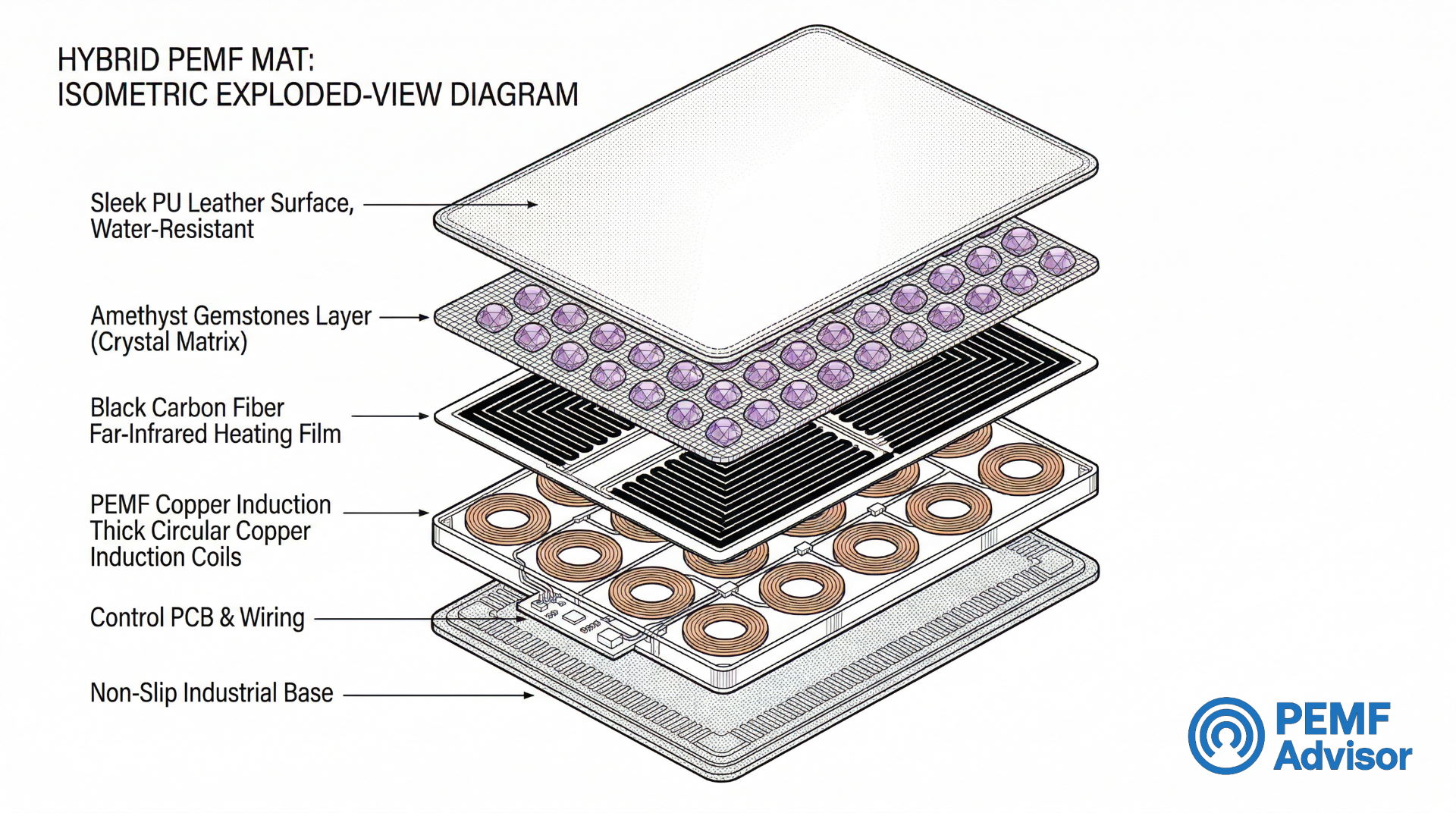
Why Added Layers Should Not Be Treated as Proof of Stronger Outcomes
A product category or feature stack does not prove treatment suitability. A mat type does not prove condition-specific benefit, cure, relief, or biological superiority. Some sources claim that extra layers improve PEMF effectiveness, but those claims do not meet the evidence threshold needed to serve as a buying guide.
This article uses ownership fit – how a mat fits into your space, routine, and handling preferences – instead of outcome-based language. That framing is deliberate: it keeps the comparison grounded in what can be verified by the buyer.
| What This Does Not Prove
Adding infrared, red light, or gemstones to a PEMF mat does not prove the mat delivers stronger or more effective electromagnetic fields. A more expensive feature stack does not prove a better health outcome. This article compares ownership attributes, not treatment suitability. |
Common Brand and Product-Line Examples by PEMF Mat Type
Abstract type labels become easier to use once they are anchored to real market examples. Buyers usually do not think only in category language like “full-body mat” or “hybrid stacked system.” They also want to know which kinds of recognizable products tend to sit inside each group. This section exists for that reason.
Use the table below as a classification aid, not as a recommendation table. It maps commonly seen PEMF brands or product lines to the type categories used in this article. The point is to help you recognize what kind of product you are looking at before you compare specs, ownership burden, controller design, or feature stacking in more detail.
| Brand / Product Line | Common Type Placement | Core or Hybrid | Typical Ownership Fit |
| HealthyLine Platinum Series | Full-body mat | Hybrid | Broad home coverage; stationary use; higher storage and setup burden |
| HealthyLine TAO Series | Full-body mat | Hybrid | Entry-level full-body ownership fit; stationary home placement |
| Bemer Classic / Bemer Evo systems | Full-body mat / system-style setup | Core-oriented system positioning | Structured home setup; ecosystem-led ownership model |
| OMI Full Body / Beyond-style mats | Full-body mat or foldable full-body format | Usually core-oriented or lightly stacked depending on model | Buyers prioritizing full-body coverage with varying portability by model |
| HigherDOSE Go Mat | Portable / foldable mat | Hybrid | Smaller-space ownership fit; easier movement and storage |
| Localized PEMF pads / applicator mats across multiple brands | Localized applicator pad | Usually core-oriented, sometimes hybrid | Compact ownership fit; limited coverage per session; minimal setup burden |
| Hybrid gemstone / infrared PEMF mats across multiple brands | Hybrid stacked mat | Hybrid | Buyers willing to manage higher price, more weight, and more comparison complexity |
Note: Brand placements reflect common market positioning at the time of writing. Manufacturers may update product lines, features, or labeling. This table is for comparison context – not endorsement, ranking, or treatment recommendation.
The practical use of this table is simple: first identify which architectural bucket a product most likely belongs to, then compare it against other products inside that same type before jumping across categories. This reduces one of the most common buyer mistakes in the PEMF market, which is comparing a portable hybrid mat, a full-body core mat, and a localized applicator pad as if they were interchangeable versions of the same product.
The boundary also matters. A recognizable brand appearing in one category does not make that category better, more therapeutic, or more “professional.” This section is here to improve market orientation and classification clarity, not to assign winners.
Comparison Table: Main PEMF Mat Types at a Glance
The table below organizes the four main PEMF mat categories by format, coverage, ownership fit, comparison notes, and an explicit column for what each category does not prove. Use it to compare architectural and ownership differences before looking at brands.
| PEMF Mat Type | Typical Format | Coverage / Footprint | Ownership Fit | Comparison Notes | What It Does Not Prove |
| Full-body mat | Flat, unfolded mat; roughly 70+ inches long | Broad; spans most or all of the body when lying down | Stationary home use; needs dedicated floor or bed space; heavier setup | Largest coverage area per session; highest storage and setup burden | Does not prove stronger field, better outcomes, or treatment suitability |
| Portable / foldable mat | Foldable or rollable; smaller footprint when stored | Varies; may approach full-body or be mid-sized | Easier storage and repositioning; may suit renters or multi-room use | Portability often involves trade-offs in weight or coil density | Does not prove equal or lesser effectiveness versus full-body |
| Localized applicator pad | Small pad; typically covers one body region | Narrow; targets a specific area | Compact; easy to store; minimal setup; can be used seated or reclining | Smallest footprint; limited to localized coverage per session | Does not prove a different medical category or targeted treatment class |
| Hybrid stacked mat | Full-body or mid-sized with added layers | Similar to core equivalent, plus added feature coverage | Higher price point; more complex comparison; more features to evaluate | Feature stacking drives price and marketing differentiation | Does not prove that added layers enhance PEMF field strength or efficacy |
Short Interpretation Guide for the Table
Read the table from left to right: start with architectural format, then check ownership fit, then read the limitations column. A bigger or more feature-rich category does not automatically produce better outcomes. This table is for filtering and comparison – not for treatment matching.
The Fastest Way to Narrow the PEMF Mat Market
Use mat type as a first-pass filter rather than as a final decision. Start by removing any format that does not fit your space, your handling tolerance, or your setup routine. Then compare controller style, feature stacking, and storage burden inside the remaining type group.
This keeps the comparison stable. Buyers often jump too early into brand claims or outcome language when the more important first question is architectural: what kind of mat are you actually willing and able to own day to day?
How to Use PEMF Mat Categories as Buyer Filters
Categories are most useful when treated as comparison filters rather than treatment categories. The filters below help you sort the market by format, footprint, portability, controller design, and feature stacking – practical attributes that can be verified before purchase.
Group by Physical Format and Coverage
The most stable way to group PEMF mats is by physical dimensions and coverage style. Full-body mats occupy the most space and cover the broadest area. Portable mats offer a middle ground. Localized applicator pads are the most compact. Start here before evaluating any other attribute, because format is the most verifiable and least marketing-dependent grouping.
Room Footprint Is Often the First Real Filter
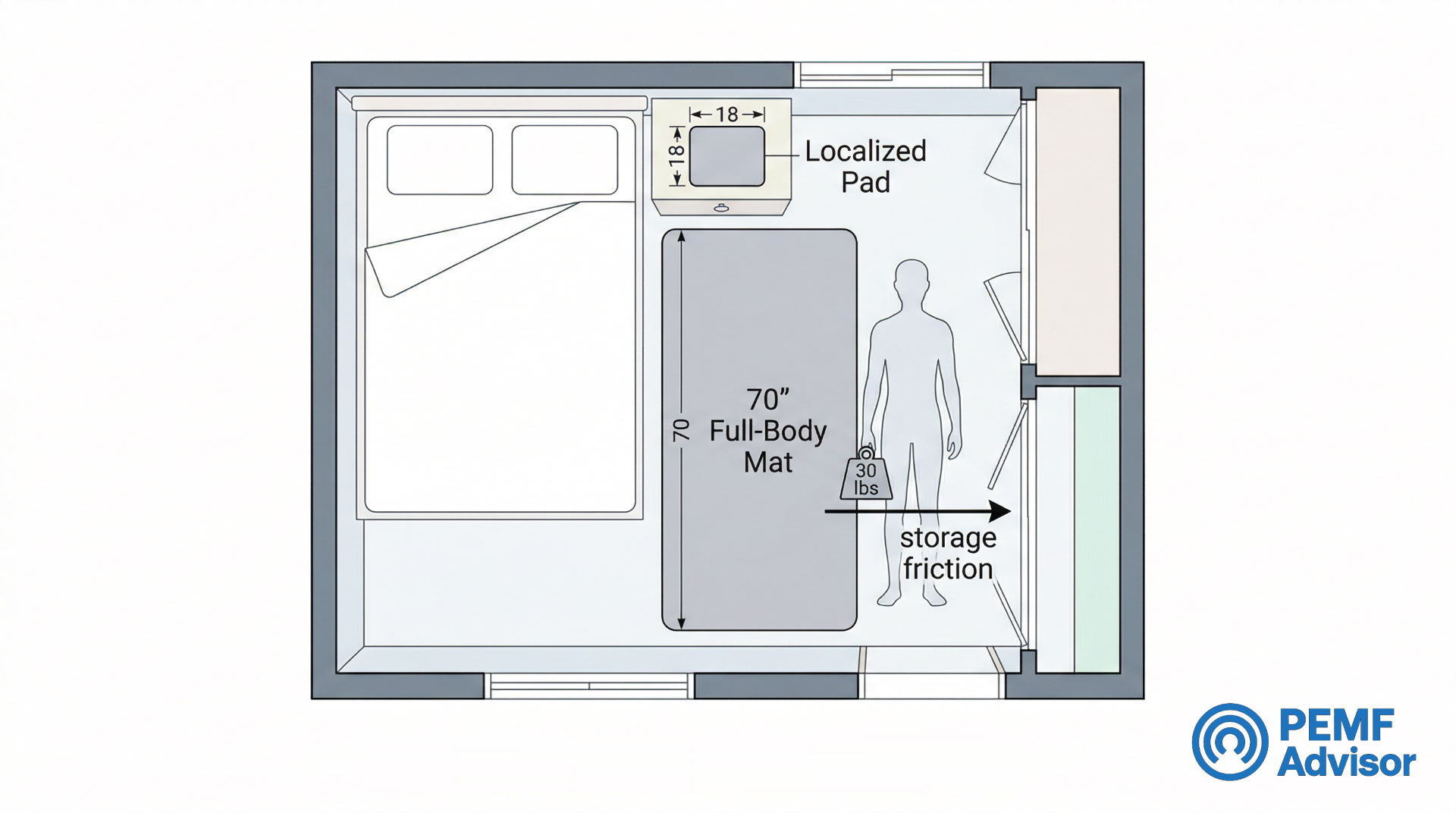
Format decisions become easier when buyers stop thinking in abstract product categories and start thinking in floor space, storage space, and movement path. A full-body mat may fit the buyer’s interest in broad coverage while still failing the basic ownership test if there is no practical place to leave it down or store it between sessions.
This is why room footprint should be treated as a primary filter rather than a minor convenience detail. A mat that fits the home realistically is easier to compare honestly than one that only fits in theory.
Group by Portability and Storage Burden
Portability is constrained by coil size and overall weight. Larger mats with denser coil layouts tend to be heavier and harder to move. If you do not have a permanent spot for a mat, storage burden becomes a first-class filter. Setup burden – unrolling, positioning, and storing after each session – is the real-world measure of portability, not just the marketing label.
| Format | Typical Weight Range | Storage Burden | Setup Friction |
| Full-body mat | 15–30+ lbs | High; needs dedicated space or large closet | Unroll, position, connect controller |
| Portable / foldable | 8–20 lbs | Moderate; folds or rolls for closet storage | Unfold, position, connect controller |
| Localized pad | 2–8 lbs | Low; fits in a drawer or bag | Place and plug in |
| Hybrid stacked | 20–40+ lbs | High; extra layers add bulk | Unroll, position, connect controller and extra features |
Group by Controller Sophistication
The control console is the interface between the buyer and the mat. Some controllers offer preset programs – push a button, start a session. Others offer manual adjustment of frequency, intensity, and duration. Preset-based controllers reduce the learning curve. Manual controllers offer more flexibility but add complexity. Be cautious with advanced-sounding labels like “professional-grade controller” or “clinical interface” – these are often part of label inflation and should be interpreted carefully rather than taken at face value.
Group by Intensity Range Without Outcome Framing
Intensity range, usually expressed in Gauss or MicroTesla, is a visible comparison attribute in PEMF listings. Higher-gauss positioning is often marketed as providing deeper penetration or stronger effects, but these claims are not well-supported enough to anchor a buying decision. Intensity range helps categorize products descriptively – low-intensity versus high-intensity – but it does not prove clinical necessity or superior results.
| Caution: What Higher Intensity Does Not Prove
Higher Gauss output does not automatically prove deeper tissue reach. Intensity is a descriptive spec, not a treatment hierarchy. Compare intensity as one attribute among many, not as the deciding factor. |
Group by Feature Stacking Without Assuming Synergy
Some mats differ by integrated feature stacking: infrared heat, red light panels, gemstone layers, or combinations of all three. These features change category complexity and price positioning significantly. Some sources claim that stacking these layers creates a synergistic effect that improves PEMF outcomes. That claim is not well-supported enough to serve as a comparison anchor. Feature stacking is best handled as a design and pricing category – more features mean more to evaluate and typically a higher price, but not a presumed improvement in electromagnetic field delivery.
The Main PEMF Mat Types and Their Tradeoffs
Each mat type comes with a distinct set of ownership trade-offs. The sections below cover what each format offers, where it creates friction, and what it does not prove.
Type Differences Start with Ownership, Not Outcomes
The four types in this article are not arranged as better versus worse. They are arranged as different ownership patterns: how much space the mat takes, how much handling effort it creates, how much controller complexity it introduces, and how much feature stacking changes the comparison burden.
That distinction matters because the PEMF market often turns format differences into implied treatment differences. This page does not do that. It treats mat type as a practical ownership and architecture question first.
Full-Body PEMF Mats
Full-body mats are defined by their larger physical dimensions and broad coverage style. Most run roughly 70 inches or longer, designed for the user to lie fully on the surface. This format covers the widest area per session, but it comes at the cost of portability and storage flexibility.
Ownership fit: Full-body mats work best for buyers with a dedicated room or permanent floor space. If you need to set up and tear down each session, expect to manage 15–30+ pounds of mat, plus a controller and cables. Setup burden and storage friction are the primary ownership trade-offs.
What it does not prove: Larger coverage does not prove a stronger electromagnetic field or a better outcome. Full-body format is a coverage and convenience choice, not a treatment tier.
Portable / Foldable PEMF Mats
Portable PEMF mats are designed for easier movement and storage. Portability is shaped by coil size, overall weight, and how the mat folds or rolls. “Portable” does not necessarily mean easy to travel with – it may simply mean more manageable than a full-body stationary mat.
Ownership fit: This category suits buyers who lack permanent placement, move between rooms, or need to store the mat between sessions. Expect trade-offs in coverage area or coil density compared to full-body mats.
What it does not prove: A portable format does not prove lesser or equal effectiveness. Claims that foldable mats are inherently less durable are common but not well-established as settled fact.
Portability Is About Repeat Handling, Not Just Weight
A mat becomes truly portable only when the full handling cycle is manageable: lifting it, unfolding or rolling it out, positioning it, connecting the controller, and putting it away again. Weight matters, but so do bulk, stiffness, hinge behavior, and how awkward the mat is to carry through a real room.
This is why portability should be read as a repeat-use ownership issue rather than a single-spec issue. Two mats can weigh the same and still create very different handling burden.
Localized Applicator Pads
Localized applicator pads are the smallest-format category. They cover one body region at a time and occupy minimal room and storage space. These pads can typically be used while seated or reclining, and many weigh under 8 pounds.
Ownership fit: Applicator pads suit buyers who want minimal setup, easy storage, and a compact device. The trade-off is limited coverage per session – you can only address one area at a time.
What it does not prove: A smaller footprint does not create a separate treatment class. Localized coverage is a handling and convenience distinction, not a medical category.
Hybrid Stacked PEMF Mats
Hybrid stacked PEMF mats add one or more extra layers – typically infrared heat, red light therapy, gemstone layers, or combinations – on top of a core PEMF system. These products tend to sit at higher price points and involve more complex comparison logic.
Ownership fit: Hybrid mats suit buyers who want multiple features in a single device and are willing to pay for that bundling. The trade-offs include higher price, heavier weight, more complex controls, and a thicker comparison burden when evaluating whether the extra layers justify the cost difference.
What it does not prove: Claims that gemstone layers or multi-therapy stacking improve PEMF effectiveness are not well-supported. More features mean more complexity and higher price, not a proven upgrade in electromagnetic field delivery.
Added Layers Change Comparison Burden Faster Than They Change Type
A hybrid stacked mat often looks like a separate category because the added layers dominate the product page. In practice, those layers usually increase comparison burden more than they change the underlying architectural type. The buyer still needs to ask the same base questions about format, footprint, portability, coil layout, and controller behavior before the stacked features can be evaluated sensibly.
This is why feature stacking should be treated as a second-layer decision. Compare the mat as a PEMF mat first. Then decide whether the extra layers justify the added weight, price, and comparison complexity.
Decision Drivers That Matter Before Brand Comparison
Once you understand the four mat categories, the next step is to filter by practical decision drivers. These attributes should be compared before price-led or outcome-led narratives enter the picture.
Coverage Area vs. Room Footprint
A full-body mat may cover your entire torso and legs in a single session, but it also demands a 6-foot stretch of floor space and somewhere to store it afterward. A localized pad covers far less per session but fits on a desk or in a drawer. This is an ownership trade-off, not proof of a better outcome. Ask yourself: how much space can you permanently or repeatedly dedicate to this device?
Setup Time Is a Better Ownership Filter Than Feature Count
Many buyers notice feature lists first, but daily setup time usually determines whether a mat becomes part of a routine or stays in storage. A larger, heavier, more layered product can look impressive on the page while still creating enough friction that it gets used less often in real ownership conditions.
That is why setup burden belongs alongside footprint and portability as a first-wave filter. It does not tell you what the mat does therapeutically. It tells you how realistic the product is to live with.
Coil Layout, Density, and Field Uniformity Basics
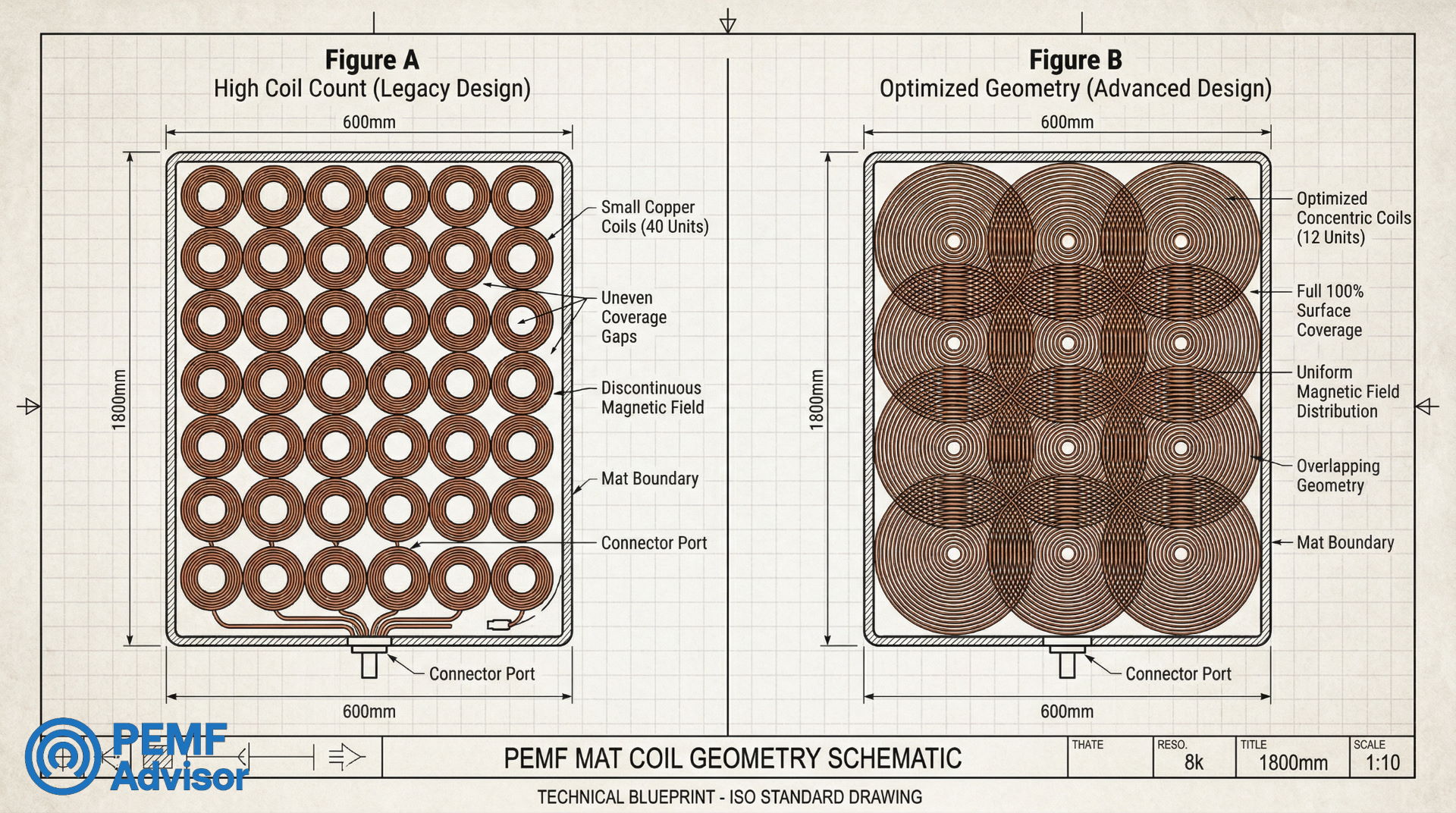
Coil layout is one of the most frequently discussed attributes in PEMF comparisons. The number of coils, their density, and their geometric arrangement affect how evenly the electromagnetic field is distributed across the mat’s surface. However, more coils do not automatically make a mat better. Coil quality, geometry, and spacing also matter. A mat with fewer, well-placed coils can produce a more uniform field than one with many poorly arranged coils. Treat coil count as one comparison input, not a standalone verdict.
Portability vs. Weight and Movement Burden
Portability should be judged by the full handling experience: lifting, unrolling or unfolding, positioning on a surface, connecting the controller, and then reversing the process for storage. A mat labeled “portable” that weighs 25 pounds and requires careful unfolding is not the same as a 5-pound pad you can toss in a bag. Setup burden is the real-world evaluation lens.
Presets vs. Manual Controls
Preset-based controllers let you start a session with minimal input – select a program, press start. Manual controllers let you adjust frequency, intensity, and session duration individually. Presets reduce friction for daily use. Manual controls offer more flexibility but require a higher learning curve. Neither is inherently superior; the right fit depends on how much time and attention you want to invest per session.
| Control Type | Ease of Use | Flexibility | Learning Curve | Ownership Fit |
| Preset-based | High | Limited to available programs | Low | Suits daily-use buyers who want simplicity |
| Manual adjustment | Moderate | Full range of frequency, intensity, duration | Higher | Suits buyers who want to customize sessions |
| Hybrid controller | Moderate to high | Presets plus manual override | Moderate | Suits buyers who want both options |
Material Durability, Warranty, and Support Expectations
Material quality, warranty terms, and manufacturer support are part of ownership fit. Some products carry labels like “medical-grade” or “professional-grade” materials – these may signal higher build quality, but they do not automatically create a medically distinct category. Warranty length, coverage scope, and ease of manufacturer contact vary widely. Durability assumptions about foldable mats should stay tentative unless directly supported by long-term user data.
Power, Voltage, and Household Practicality
Household placement is shaped by power consumption and voltage requirements. Buyers in different countries may need to check plug compatibility and ensure the mat works with local electrical standards. Some larger mats draw more power and may need a dedicated outlet. This is a home-use ownership issue – not a performance claim.
Household Practicality Is Part of Type Comparison
Power requirements, outlet placement, controller cable routing, and the amount of permanent or temporary room the mat needs are all part of what separates one type from another in ownership terms. These factors are easy to ignore during shopping because they do not sound exciting, but they often shape long-term satisfaction more than additional feature layers do.
This should still be read as a practicality filter, not as a performance filter. A mat that is easier to power and place is easier to own. That does not make it stronger or more effective.
How Format Changes Ownership Burden
Format does not just change how a mat looks – it changes how you handle it day to day. This section explains why physical format affects setup burden, storage friction, and everyday handling.
Coils and Field Basics in Buyer Language
PEMF mats use copper coils to generate pulsed electromagnetic fields. The coil layout – how many coils there are, how densely they are packed, and how they are arranged – shapes the coverage pattern. When you compare mats, coil layout is one of the architectural foundations. This section exists to support your comparison logic, not to prove health outcomes.
Why Distance Matters When Comparing Format Sizes
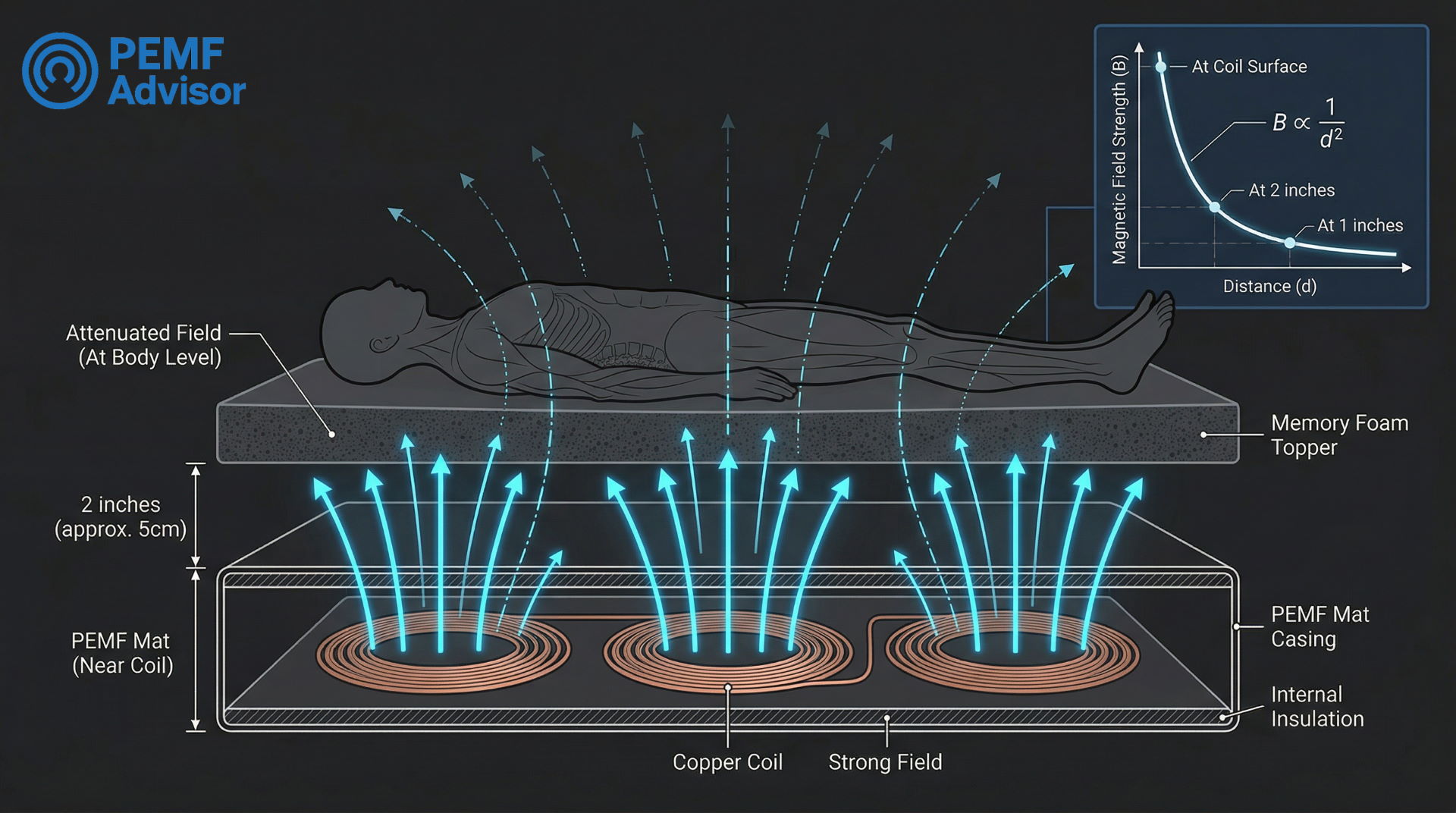
Electromagnetic fields follow the inverse square law: field strength drops significantly as distance from the source increases. In buyer terms, this means the gap between your body and the coils matters. Thicker mats, padding layers, or using a mat on top of a mattress can increase that distance. Format and placement affect how far the coils sit from the user, which is why format is part of the comparison. However, this does not create a therapeutic hierarchy between categories – it is a physical property, not a treatment verdict.
Why Larger Mats Usually Create Higher Setup and Storage Demands
A full-body mat measuring 70+ inches and weighing 20 pounds needs floor space, a flat surface, and somewhere to go after each session. If you live in a smaller home or apartment, that setup and teardown cycle is a real ownership cost. Moving a 20-pound mat from a closet, unrolling it, connecting the controller, and then reversing the process adds friction that smaller formats avoid. Larger format means larger storage footprint and higher handling effort.
Controller Placement, Cables, and Everyday Handling
The control console needs a surface, an accessible outlet, and a cable run to the mat. Where you place the controller, how long the cable is, and whether the cable creates a tripping or tangling risk all affect daily handling. These details may sound minor, but over weeks and months of ownership, they distinguish convenient setups from frustrating ones.
Ownership Friction Usually Builds in Small Repeated Steps
Most buyers do not abandon a mat because of one dramatic flaw. Ownership friction usually builds through repeated small inconveniences: carrying a heavier unit, finding floor space, managing cables, repositioning the controller, or deciding whether the setup is worth doing that day. Larger and more layered formats tend to accumulate more of these small frictions over time.
This is why format should be evaluated as a repeated-use pattern rather than as a one-time unboxing decision. A type that seems manageable once may feel very different after weeks of normal use.
Electronics Proximity and Household Placement Considerations
Some buyers ask whether PEMF mats should be kept away from other electronics, or whether “dirty electricity” from nearby devices affects the mat’s operation. These concerns are best treated as practical placement questions rather than proven efficacy issues. As a general rule, follow the manufacturer’s placement guidance, keep the mat away from devices that could be physically damaged by repeated exposure, and ensure adequate ventilation around the controller.
Claims That Need Caution When Comparing PEMF Mat Types
Some claims that appear frequently in PEMF comparisons are not stable enough to anchor a buying decision. This section names the most common ones and explains why they should be handled carefully.
“More Coils Is Always Better” vs. Coil Quality and Geometry
It is common to see marketing that positions higher coil counts as automatically superior. In practice, coil layout is more nuanced. The quality of the coils, their geometric arrangement, and their spacing all contribute to how uniform the field is across the mat. A mat with 20 well-placed coils can outperform one with 40 poorly arranged coils in terms of field consistency. Coil count alone should not be treated as a shortcut verdict.
“Professional” vs. “Home” Labels
The labels “professional” and “home” appear across many PEMF listings, but their meaning is inconsistent. The difference may reflect durability, warranty length, controller range, or simply a higher price with more accessories. These labels should not automatically be read as intensity-based superiority or as a medical hierarchy. In many cases, this distinction is closer to semantic inflation than a stable category boundary.
Waveform Superiority Claims
Some PEMF comparisons discuss waveform types – sinusoidal, sawtooth, square wave – as if one is clearly better than the others for home users. Claims about relative superiority of waveform types for home use are not well-supported enough to serve as a reliable comparison axis. Waveform labels are descriptive specifications. They should not be used as standalone proof that one mat type is a better fit.
More Hardware Detail Is Better Than Bigger Hardware Claims
A product page that explains coil layout, controller design, weight, foldability, and basic power behavior gives the buyer more useful comparison material than a page that relies on broad superiority language. In this category, useful technical detail usually improves comparison more than dramatic wording does.
That does not mean every technical-looking claim is trustworthy. It means buyers should prefer specific, checkable architecture details over broad statements about being stronger, deeper, or more professional.
Gemstone-Enhancement and Multi-Therapy Synergy Claims
Some sources claim that gemstone layers – typically amethyst or tourmaline – amplify PEMF effectiveness. Others claim that combining PEMF with infrared and red light creates a synergistic effect that exceeds what each technology delivers alone. These claims are not well-supported at the evidence level needed to anchor a product comparison. Hybrid stacked products can still be compared descriptively by their architecture and ownership fit, but the synergy narrative should not be assumed.
What a PEMF Mat Type Does Not Prove About Outcomes
No mat type proves treatment suitability. No mat type proves condition-specific benefit. No mat type proves cure, relief, or biological superiority. These are format and ownership categories, not medical classifications. The correct buyer lens is ownership fit: how does this mat fit into my space, my routine, and my handling preferences?
| Key Boundary
Mat type = ownership category, not treatment proof. Feature count = comparison complexity, not outcome upgrade. Price tier = bundled features, not validated effectiveness. |
The Minimum Comparison Standard Before You Pick a PEMF Mat Type
Before choosing a type, a buyer should be able to identify at least four things clearly: the physical format and footprint, the handling and storage burden, the controller style, and whether stacked features are core to the product or added on top of the PEMF layer. If those layers are still blurred, the buyer is not really comparing mat types yet.
This is not a product verdict. It is a classification rule. The clearer the architectural and ownership picture becomes, the less likely the buyer is to mistake format differences for treatment proof or feature inflation for meaningful category difference.
FAQ
What are the main types of PEMF mats for home use?
The main home-use categories are full-body mats, portable or foldable mats, localized applicator pads, and hybrid stacked mats. These are format and ownership categories – not treatment categories.
How is a full-body PEMF mat different from a localized applicator pad?
The difference is mainly physical dimensions, coverage style, footprint, and handling burden. A full-body mat covers the largest area and demands the most space. A localized pad covers one area and stores easily. Localized coverage does not create a separate treatment class.
Are portable PEMF mats mainly about convenience rather than coverage?
Portable mats are primarily defined by easier handling, folding, storage, or movement. Convenience is a major ownership-fit lens for this category. Portable design may involve trade-offs in size or coil density, but it does not produce a treatment verdict.
What is a hybrid PEMF mat?
A hybrid PEMF mat combines PEMF with one or more added layers such as infrared heat, red light, or gemstone layers. “Hybrid” refers to the stacked design, not to proven stronger outcomes. Claims that these layers enhance PEMF effectiveness are not well-supported.
How should buyers compare PEMF mat types without turning them into treatment categories?
Compare by ownership fit: footprint, portability, controller design, feature stacking, and support terms. These are comparison filters, not medical suitability signals.
Does a larger mat automatically mean a stronger or better field?
No. Larger size changes footprint and coverage style, but size alone does not prove a stronger or better field. Evaluate size through coverage needs and ownership burden first.
Does more coil count automatically make a PEMF mat better?
No. Coil geometry, spacing, and quality also matter. A well-designed layout with fewer coils can produce a more uniform field than a poorly arranged layout with more coils.
What does controller sophistication change for home ownership?
Controller sophistication changes ease of use, learning curve, and adjustment style. Preset controllers reduce daily friction. Manual controllers offer more flexibility but take more time to learn. Neither is inherently superior.
Are “professional” PEMF mats truly different from home-use mats?
The difference may reflect durability, warranty scope, accessories, or control range. The label should not automatically be read as medical superiority. “Professional” is often closer to a marketing tier than a stable technical category.
Do waveform labels prove one PEMF mat type is better for home users?
No. Waveform labels are descriptive specifications. Claims that one waveform type is clearly superior for home use are not well-supported enough to serve as a standalone comparison filter.
Do gemstone or multi-therapy layers prove a PEMF mat is more effective?
No. Claims that gemstone or multi-therapy layers improve PEMF effectiveness are not well-supported at the evidence level needed to guide a purchase. These layers are a feature-stacking and pricing category, not proof of enhanced field delivery.
What setup and storage burdens matter with large PEMF mats?
Weight, lifting, unrolling, positioning, connecting the controller, and storing afterward all matter. A 20-pound full-body mat that needs to be set up and torn down each session creates meaningful daily friction, especially without permanent floor space.
What should buyers check about power, voltage, and household placement?
Check plug compatibility, local voltage standards, room placement options, and proximity to a suitable outlet. Some larger mats draw more power. Electronics proximity is a practical placement consideration, not a proven performance factor.
What does a PEMF mat type not prove about outcomes?
A mat type does not prove treatment suitability, condition-specific benefit, or cure, relief, or biological superiority. Mat types are ownership and format categories. The correct comparison lens is ownership fit, not medical outcome.

The PEMF Advisor Editorial Team reviews consumer PEMF mats and related wellness devices. Our work focuses on verified specifications, documentation, usability, materials, warranty/returns, and ownership considerations. We do not provide medical advice or evaluate health outcomes. See our Review Methodology and Editorial Standards.