Quick answer: Portable PEMF mats and pads are smaller home-use PEMF formats defined by practical ownership traits – lighter weight, reduced dimensions, easier storage, and simpler movement than larger full-body mats. Their portability describes carry, storage, and setup behavior, not a proven difference in strength, gentleness, beginner suitability, or any health outcome.
If you’re shopping for a PEMF device and keep running into the word “portable,” this guide explains what that actually means in buyer terms. The goal here is to help you understand the portable format as a physical ownership category – how it differs from larger full-body mats, where it fits naturally into a home, and where its limits sit. Nothing below is a treatment claim or a recommendation for any condition. Portable is a logistics word, and that is how we will treat it.
PEMF Advisor publishes buyer-oriented reviews, comparisons, and educational content for home-use PEMF mats and devices. This page is a constrained format explainer within that system: it focuses only on what defines portable PEMF mats and pads and which ownership situations they tend to fit, not on treatment guidance, diagnosis, or condition-based product matching.
If you want the broader category context before focusing on this one format group, use our Types of PEMF Mats guide. That page compares portable mats and pads against full-body, localized, and hybrid formats so you can place portability inside the wider market before comparing specific products.
Portable format at a glance: what changes physically, and what it does not prove
Before getting into definitions, it helps to see the portable format split clearly into two columns: what genuinely changes when a PEMF product is built as a portable mat or pad, and what portability does not prove on its own.
| Ownership trait | What portability changes | What portability does not prove |
| Dimensions (unfolded vs folded) | Smaller footprint; folds or rolls into a more compact shape for storage. | No claim about signal strength, intensity, or output profile. |
| Total weight | Lower weight usually means easier lifting and repositioning. | Lighter weight does not prove gentler, stronger, or beginner-safe output. |
| Storage profile (foldable, rollable, rigid) | Fits smaller household zones – closets, shelves, under-bed bins. | Storage geometry does not imply a biological effect tier. |
| Surface coverage area | Portable formats are usually localized or segmental. | Smaller coverage is not a marker of suitability for any condition or user group. |
| Power connectivity | Corded or battery-operated models change movement freedom and travel planning. | Battery operation does not automatically mean travel-friendly. |
| Carrying accessories | Integrated handles or dedicated bags reduce transport friction. | Presence of a carry case does not qualify a device for any specific travel context. |
| Key takeaway
Portability is a storage-and-movement trait, not a biological tier. Read it as “how this product lives in your home” rather than “how this product performs.” |
What portable PEMF mats and pads are
A portable PEMF mat is a flexible, usually foldable surface unit designed around smaller dimensions and lower weight than a full-body mat. A PEMF pad is a more compact, sometimes rigid unit shaped for a smaller placement area. Both categories sit under a broader portable PEMF format that is defined by unfolded dimensions, folded dimensions, total weight, storage profile, and surface coverage area.
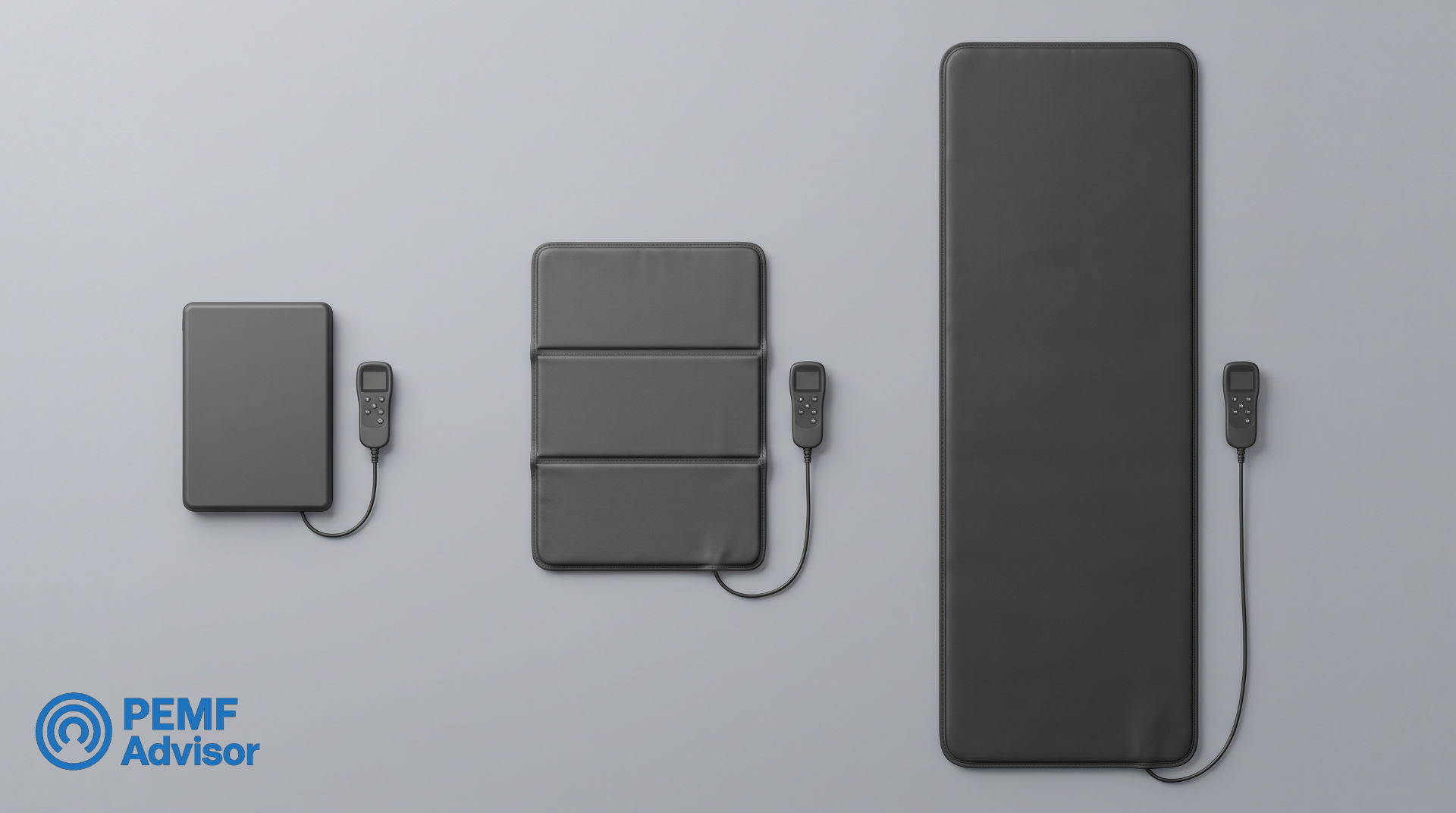
In practical terms, portable mats and pads are measured by the same ownership variables: how much they weigh, how big they are when set up, how small they become when packed, how they’re stored, and what kinds of carrying accessories ship with them. They are generally designed around localized or segmental coverage – a part of the body, not the full body at once – which is one of the clearest format-level differences from a full-body mat.
| Format | Typical form factor | Coverage area |
| Portable PEMF mat | Flexible, foldable or rollable surface | Localized or segmental |
| PEMF pad | Compact, often rigid or semi-rigid | Localized |
| Full-body mat | Larger, usually flat and less foldable | Full-body or near-full-body |
Portable format as a physical ownership category
It helps to think of portability as a closet-and-carry behavior rather than a performance claim. A portable PEMF format differs from a larger mat through weight, dimensions, storage profile, and how easy it is to pick up and move. It enables a lower storage footprint and simpler room-to-room movement. It still requires power connectivity and some form of controller management, so the “portability” you actually experience depends on the entire kit, not just the surface.
- Buyers should treat portability as an ownership trait, not a treatment tier
- Buyers should evaluate it through storage fit, routine fit, and movement fit
- Buyers should check the full kit – mat + controller + cables + bag – not only the mat
Portable mat vs portable pad
The mat and the pad are two different physical shapes. A portable PEMF mat is typically flexible and folds or rolls for storage. A PEMF pad is often rigid or compact, shaped like a small panel rather than a roll-up surface. Both can be portable; the word describes the carry and storage behavior, not the material.
| Trait | Portable PEMF mat | PEMF pad |
| Flexibility profile | Usually foldable or rollable | Often rigid or semi-rigid |
| Storage geometry | Collapses into smaller stored shape | Stores in its fixed form factor |
| Placement behavior | Can drape over or lay across surfaces | Placed on a flat area or cushion |
| Carry format | Often ships with a bag; folds for transport | May be carried as-is or in a sleeve |
A rigid pad can still be portable if its dimensions and total carrying burden stay low. Rigidity and portability are separate variables – do not read one as disqualifying the other.
Portable format as localized or segmental coverage, not full-body coverage
Portable PEMF formats are generally built around a smaller surface coverage area. Full-body mats cover a broader area and require more floor space to use. Portable mats and pads trade off total coverage for smaller size, lower weight, and easier storage.
This is a physical-format distinction. It describes how much surface the device places against the body at once. It does not describe which users or which body regions should use which format – that is a different decision that sits outside what portability itself can tell you.
Portable mats and pads vs larger PEMF formats
This is the comparison most buyers actually want to see: portable format against larger full-body format, expressed in practical ownership terms. Portable mats differ from full-body mats by smaller dimensions, lower weight, a smaller storage burden, and lower floor-space demand. Full-body mats differ by broader surface coverage area and a noticeably larger storage footprint.
| Ownership dimension | Portable PEMF mat / pad | Full-body PEMF mat |
| Unfolded size | Smaller; fits a partial body region | Larger; accommodates most or all of the body |
| Folded / stored size | Compact; often fits in a shelf or closet bin | Bulkier even when folded |
| Total weight | Lower; easier to carry | Higher; harder to move regularly |
| Setup friction | Less dedicated floor space needed | Needs a clear flat area each use |
| Storage burden | Lower; multiple placement options | Higher; fewer placement options |
| Surface coverage area | Localized or segmental | Full-body or near-full-body |
The short version: portable format usually reduces setup friction and storage friction at the same time, while full-body format prioritizes coverage at the cost of both.
Size and storage footprint differences
Portable mats and pads differ from larger mats in two size dimensions at once – unfolded size and folded size. The unfolded dimension tells you how much space the device needs during use. The folded dimension tells you how much space it occupies when put away. Larger mats create a bigger storage burden in both states.
In real homes, this usually decides where the product lives: a folded portable mat can sit inside a standard closet shelf, a wardrobe drawer, a cabinet, or an under-bed storage bin. A full-body mat almost always needs a dedicated wall lean, a large shelf, or a storage bag parked in a corner.
- Standard closet shelf – often feasible for a folded portable mat or pad
- Under-bed bin – often feasible depending on folded thickness
- Wardrobe drawer – feasible for many pads, tighter for mats
- Floor corner or dedicated lean – usually required for full-body mats
Weight and carry behavior differences
Portable formats are lower in total weight than full-body mats, which reduces the lifting and repositioning burden. This mostly matters for users who move the device around – from bedroom to living room, from a chair to a bed, or from one household member to another.
Carrying accessories shape the real carry behavior more than the raw weight number. A mat with integrated handles or a fitted travel bag is easier to pick up and move than an equally light mat without any carry infrastructure. Also keep in mind that home mobility (moving a device between rooms) is a different thing from travel mobility (moving it between cities); the same product may handle one well and the other less so.
Setup friction and floor-space differences
Portable formats need less dedicated floor space than larger full-body mats, which generally lowers setup friction. You can place a portable mat or pad on a bed, couch, chair, or floor area without clearing a large footprint first. Storage ease and setup ease are related but not identical – a product can be easy to store and still have setup friction due to cable routing or controller placement.
- Portable mat on a chair or couch – minimal setup effort
- Portable pad on a bed or small flat area – minimal setup effort
- Full-body mat on the floor – requires clear floor area each session
- Controllers and cables – can add friction to any format
Flexibility differences: foldable, rollable, or rigid
Portable formats differ in how they pack down. Foldable mats collapse along hinges or seams. Rollable mats wind into a cylinder. Rigid pads keep their shape and are stored as-is. Each geometry changes how the device is packed, how it fits into a bag, and where it can realistically live in a home.
| Packing geometry | Typical stored shape | Common trade-off |
| Foldable | Rectangular block, 2–4 folds | Crease lines over time |
| Rollable | Cylinder or tube | Needs a strap or bag to stay rolled |
| Rigid | Fixed panel shape | Less compact, more predictable dimensions |
| A quick note on marketing language
Marketing terms like “mini” or “concentrated” sometimes suggest that a smaller format is stronger, gentler, or more advanced. Under this guide’s boundaries, those claims are not authoritative and should not be used to infer output behavior. Read them as descriptive shorthand, not performance evidence. |
||
The ownership traits that make a PEMF format portable
Portable PEMF mats and pads are measured by a small set of ownership traits: total weight, unfolded vs folded dimensions, storage profile, surface coverage area, carrying accessories, and controller interface. Portability is shaped by the whole kit – the surface unit, the controller, the cables, the power adapter, and any bag or case – not only by the mat itself.
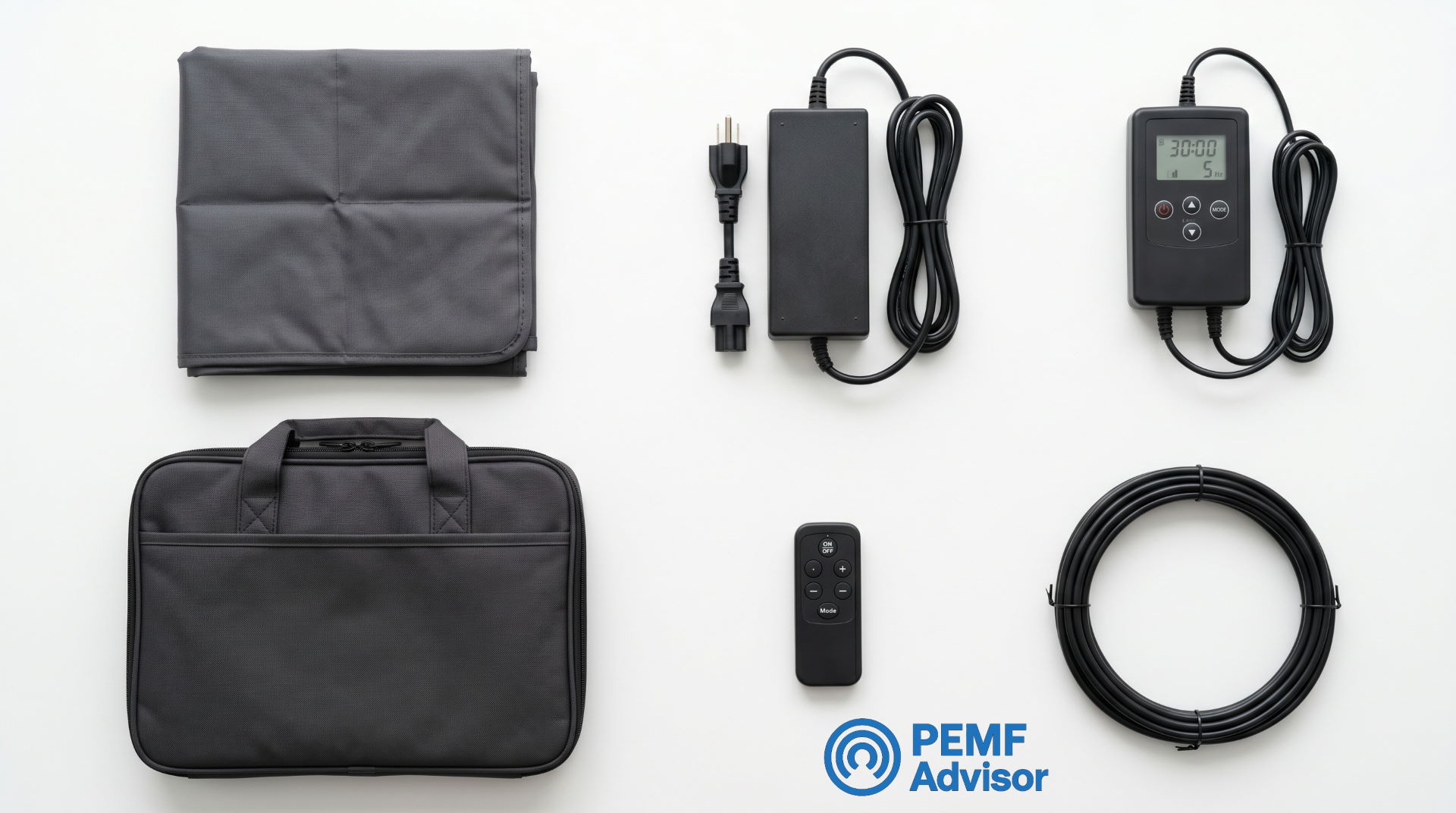
A mat can be genuinely portable while its controller and power adapter add enough bulk that the full kit stops feeling portable in practice. The checklist below is the easiest way to judge that honestly.
| Whole-kit portability checklist
• Folded size of the mat or pad • Total weight of the mat or pad • Size and weight of the controller (remote or control box) • Power adapter or brick form factor • Cable length and cable-management burden • Presence of integrated handles or a fitted carry case • Battery vs corded operation, and charging expectations |
Unfolded dimensions vs folded dimensions
Both size states matter. The unfolded dimension tells you whether the mat or pad will fit where you plan to use it – a chair, a bed, a specific section of floor. The folded dimension tells you whether it will fit where you plan to store it. Product pages often emphasize one number and leave the other in the fine print.
| Size state | What to check |
| Unfolded | Length × width × thickness during use |
| Folded | Length × width × thickness when stored or transported |
Buyer takeaway: verify both numbers against your actual use space and your actual storage space. Lifestyle product photography does not always match folded-size realism.
Total weight and carrying burden
Portable mats are measured by total weight, and lower weight usually reduces the burden of carrying and repositioning. The number that matters most is not the mat’s weight alone but the total system weight – mat plus controller plus cables plus adapter plus bag. A mat that weighs four kilograms can easily sit inside an eight-kilogram total kit once accessories are added.
- Mat weight – the most visible number
- Controller weight – often overlooked
- Power adapter weight – small, but real
- Carry case weight – relevant for travel contexts
Storage profile and household placement
Storage profile can be foldable, rollable, or rigid, and that profile decides where the product can actually live in the home. Foldable mats tend to fit closet shelves and larger drawers. Rollable mats fit tight vertical gaps or standing closets. Rigid pads fit drawers and shelves where their fixed shape can be accommodated.
| Household placement | Foldable mat | Rollable mat | Rigid pad |
| Closet shelf | Usually yes | Usually yes | Usually yes |
| Under-bed bin | Often yes | Often yes | Depends on thickness |
| Wardrobe drawer | Depends on folded size | Usually no | Often yes |
| Cabinet | Depends on folded size | Depends on length | Often yes |
| Room corner lean | Possible | Yes (stood upright) | Possible |
For apartments, shared rooms, and multi-room households, storage profile is often the single most decisive ownership variable.
Control unit size and cable management
Portable PEMF mats require a controller. The controller’s size, weight, and form factor directly shape how portable the product feels in daily use. A small handheld remote behaves very differently from a larger control box that needs its own bag pocket. Cables, adapters, and power bricks add their own ownership friction – both when setting up and when packing down.
- Remote-sized controllers – easiest to stow with the mat
- Control-box controllers – may need their own protective pocket
- Long mains cables – add routing friction during setup
- Separate power bricks – add bulk to the total kit
Carry case, handles, and travel accessories
Carrying accessories – integrated handles, fitted bags, padded sleeves – are the infrastructure that turns a light mat into something that is genuinely easy to transport. Integrated handles give you a one-hand carry for short movements. Separate bags protect the mat during longer transport but add a step to pack-up and unpack.
| Accessory | What it enables | What it does not change |
| Integrated handles | One-hand carry inside the home | Does not make a product travel-rated |
| Fitted carry bag | Cleaner external transport | Does not shrink folded dimensions |
| Padded sleeve | Protection during movement | Does not reduce total weight |
| Shoulder strap | Hands-free carry over distance | Does not override airline size rules |
Power connectivity: corded vs battery-operated ownership implications
All portable PEMF mats need power, and the power model – corded or battery-operated – shapes how much freedom you actually have to move with the device. Battery-operated formats are sometimes marketed as more travel-friendly. That can be true in some contexts and not in others; it is a conditional advantage, not a universal one.
| Power model | Ownership implications |
| Corded | Tied to an outlet during use.
Simpler; no charging routine. Cable length constrains room-to-room movement. |
| Battery-operated | Movement freedom during sessions.
Requires charging and charge-state awareness. Travel-friendliness depends on airline and destination rules. |
Where portable format fits best in real ownership contexts
Portable PEMF formats can fit users with smaller spaces, multi-room routines, or lower storage tolerance. They can enable easier movement inside the home and smaller storage commitments. Ownership fit here is about storage, movement, and setup preferences – not about any treatment logic or condition-level suitability.
| How to read ownership fit
Ask: “Does this format live comfortably in my space, and move the way my routine needs?” Do not ask: “Is this format right for my condition?” – portability cannot answer that. |
Small-space households and shared rooms
Apartments, studios, and shared rooms usually reward smaller dimensions and a lower storage burden. A portable mat or pad can fit household storage zones that a full-body mat simply cannot – the top of a closet shelf, a narrow wardrobe, a drawer in a shared room. Reduced floor-space needs during use also help in rooms that double as offices, nurseries, or guest spaces.
Users who move devices between rooms
If you plan to use the device across a bedroom, living room, and home office, lower weight and smaller size directly translate into easier in-home mobility. This kind of room-to-room movement is different from travel portability: moving a mat from your couch to your bed is not the same problem as moving it from your house to a hotel.
- In-home movement – mostly about weight, handle presence, and folded size
- Destination travel – adds airline rules, voltage, and accessory load
Users prioritizing lower storage footprint
For buyers whose main concern is “where will this live when I’m not using it,” portable format is usually the fit. Foldable, rollable, and rigid options all change how compact the stored product feels. A foldable mat that collapses into a briefcase-sized block behaves very differently from a rigid pad that sits flat on a shelf.
- Prefer foldable – if closet shelves or under-bed bins are your main storage zones
- Prefer rollable – if you have narrow vertical gaps or standing closets
- Prefer rigid pad – if drawer or flat-shelf storage is easiest to access
Users comparing localized coverage with larger coverage needs
Portable formats are generally associated with localized or segmental coverage. Larger mats differ by broader coverage and may suit buyers who prefer a single, fixed setup that reaches most of the body at once. This is a format-fit distinction – about how much surface the device places against the body – not a distinction about which format is appropriate for any particular condition or goal.
Constraints and limits of portable PEMF formats
Portable PEMF mats and pads come with real boundaries. They are constrained by smaller coverage, they do not prove anything about output strength, they do not prove beginner or recovery suitability, and their durability can vary with how they are built. The points below are the limits worth being honest about before buying.
| What portability does not prove
• Not a proof of stronger or weaker output • Not a proof of beginner suitability • Not a proof of recovery suitability • Not a proof of condition fit • Not a substitute for checking manufacturer specs |
Limited surface coverage compared with full-body mats
The most physical limit is also the most obvious one: portable formats are constrained by a smaller surface coverage area. Full-body mats differ by covering a broader area in a single placement. If your preference is to place the device once and have it reach most of the body, a portable format will feel limiting by design.
Portability does not prove stronger or weaker output
Some sources frame smaller formats as either “more concentrated” or “gentler,” pointing at size as if it were evidence of intensity direction. Under this guide, those claims are governance-restricted and low-stability – they are not treated as reliable inferences. Portability alone should not be used as proof of biological output in any direction.
Treat size and portability as physical-format traits first. Output behavior is a separate question answered by manufacturer specifications, not by whether the device folds up.
Portable does not equal beginner tier or outcome tier
Portable format is sometimes marketed as a “starter” format or an “easy” format. Ownership-wise, a smaller, lighter product is genuinely easier to store and move. That is a logistics fact. It is not the same as being a beginner tier or a recovery tier in any medical or biological sense.
- Portable does not prove beginner suitability
- Portable does not prove recovery suitability
- Ownership fit and clinical fit are separate questions
Durable travel-grade construction vs lighter home-oriented construction
Material durability can differ between travel-grade designs and more home-oriented designs. Travel-grade construction tends to prioritize repeated folding, transport-friendly fabrics, and more protective cases. Home-oriented construction may prioritize surface comfort or aesthetics at the expense of repeated transit wear. Neither is automatically better – the question is how often you expect to move the device, and how much wear your use pattern will create.
| Construction style | Typical strengths | Typical trade-offs |
| Travel-grade | Repeated folding, robust covers, protective bags | May feel less soft or cushioned |
| Home-oriented | Comfort-forward surfaces and finishes | May wear faster under frequent transport |
Travel, power, and carry logistics
Travel portability is a narrower question than home portability. It is shaped by power connectivity, carrying accessories, controller load, and a set of external rules – airline policies, international voltage, plug type – that the device itself does not control. A mat that moves easily between rooms may still need real planning before it moves between countries.
Carry-on plausibility vs universal travel assumptions
Some portable PEMF formats can fit standard carry-on luggage, depending on folded size, total kit size, and how many accessories ship alongside. That is plausible in some cases, not guaranteed in every case. Carry-on fit depends both on the device and on the specific airline’s sizing rules, which vary.
- Folded mat or pad dimensions against the airline’s carry-on allowance
- Bag dimensions once the controller and cables are added
- Total weight against the carrier’s weight limit for carry-on
- Any extra protective case that expands the outer footprint
Voltage, charging, and plug compatibility questions
Power connectivity is constrained by international voltage standards and plug types. Before assuming a device will travel cleanly, buyers should check the voltage range the adapter supports, the charging model (if battery-operated), the plug type, and any adapter or converter needs for their destination.
| Travel-power pre-flight checklist
• Voltage range printed on the adapter (e.g., 100–240V vs single-voltage) • Charging method and expected charge time (if battery-operated) • Plug type used at your destination • Whether you need a simple adapter or a voltage converter • Whether the manufacturer supports international use at all |
Battery restrictions and electronics policies as variable constraints
Battery-operated formats are often marketed as more travel-friendly because they don’t need to be tied to an outlet. In practice, airline and destination rules about batteries and electronics vary – by carrier, by aircraft, by country, and over time. Battery operation should not be treated as an automatic travel advantage; policy variability is part of real ownership friction.
Movement convenience inside the home vs outside the home
For most buyers, the practical benefit of portable format is not frequent travel – it is easier domestic movement. Moving the device from bedroom to living room, couch to chair, office to guest room. Travel portability is a separate, narrower case with its own logistics. Separating these two uses up front prevents disappointment later.
| Movement type | What matters most |
| Inside the home | Weight, handles, folded size, storage profile |
| Outside the home | Folded size + carrier rules, voltage/plug, battery rules, durability |
FAQ
What makes a PEMF mat or pad ‘portable’ in buyer terms?
Portability in buyer terms means manageable size, lower carrying burden, easier storage, and lower setup friction. Judge it through physical ownership traits – dimensions, weight, storage profile – rather than through marketing language.
How is a portable PEMF mat different from a PEMF pad?
A portable mat is usually more flexible and folds or rolls, while a pad is often more rigid or compact. Both can still qualify as portable depending on their dimensions and the total carrying burden.
How does a portable PEMF format differ from a full-body mat?
Portable format differs mainly by smaller size, lower weight, and narrower coverage. Full-body mats cover more of the body at once but need more storage and setup space.
What ownership traits matter most when comparing portable PEMF formats?
The core comparison traits are dimensions (unfolded and folded), total weight, storage profile, controller burden, carrying accessories, and power model. Those six variables decide how a portable format actually lives in a home.
Do folded size and weight matter more than advertised portability claims?
Usually yes. Folded size and total system weight are more useful than generic portability claims. Verify the actual spec numbers – including controller and adapter – before assuming a product is easy to move or store.
Does a portable PEMF format prove anything about strength or intensity?
No. Portability alone does not prove strength or intensity direction. Claims that smaller equals stronger, or smaller equals gentler, are governance-restricted under this page and should not be used as buyer evidence.
Are portable PEMF mats always flexible?
No. Some portable mats are flexible and fold or roll; others are more rigid. Portability does not require flexibility.
Can a rigid PEMF pad still count as portable?
Yes. A rigid pad can still count as portable if its size, weight, and carrying burden stay manageable. Rigidity is a geometry trait; portability is a logistics trait.
What kind of storage space does a portable PEMF format usually require?
Required storage space depends on folded size, rigidity, and accessory load. Many portable formats fit smaller household storage zones more easily than larger mats – a closet shelf or under-bed bin is often enough.
Does portable format reduce setup friction compared with larger mats?
Usually yes. Portable formats need less dedicated floor space and are easier to reposition. The exact reduction still depends on controller size and cable burden.
Is portable PEMF format mainly for localized coverage?
Yes. Portable formats are mainly associated with localized or segmental coverage, compared with the broader coverage of full-body mats.
Can a portable PEMF format fit standard carry-on luggage?
Some can, depending on folded size, accessories, and total system dimensions. Treat this as plausible case-by-case, not universal across all portable products or airlines.
What travel power questions should buyers check before assuming portability?
Check voltage range, charging model, plug type, adapter needs, and any manufacturer guidance on international use. All four decide whether the device can actually be powered at the destination.
Does battery operation automatically make a PEMF format more travel-friendly?
No. Battery operation does not automatically mean more travel-friendly. Travel-friendliness still depends on charging, airline and destination regulations, and the total kit burden.
Who is the portable format a better ownership fit for?
Portable format can fit buyers with tighter storage, lower movement tolerance, or a preference for room-to-room mobility. That is an ownership-fit statement, not a treatment-fit statement.
Who may outgrow a portable PEMF format?
Buyers seeking broader coverage, less repositioning, or a more fixed permanent setup may find that a portable format stops meeting their preferences over time. A full-body mat may suit those needs better in ownership terms.

The PEMF Advisor Editorial Team reviews consumer PEMF mats and related wellness devices. Our work focuses on verified specifications, documentation, usability, materials, warranty/returns, and ownership considerations. We do not provide medical advice or evaluate health outcomes. See our Review Methodology and Editorial Standards.