PEMF mats, pads, and applicators differ mainly by physical format, surface coverage, and ownership ergonomics – mats are usually full-length surfaces, pads are mid-sized surfaces, and applicators are compact accessories or attachments. The core distinction is coverage style and handling profile, not medical potency or condition-matching logic.
If you are shopping for a home-use PEMF device, the first thing worth settling is category confusion. The three labels overlap in marketing language, and sizes drift between brands, which makes buyer comparison harder than it should be. This guide focuses on what actually separates the three formats in practical terms: dimensions, coverage style, portability, controller relationship, and storage profile.
Everything below stays descriptive. The goal is not to announce a winner or match formats to symptoms – it is to give you a stable way to read product listings and spot what really differs underneath the labels.
PEMF Advisor publishes buyer-oriented reviews, comparisons, and educational content for home-use PEMF mats and devices. This page is a constrained format explainer within that system: it focuses only on how mats, pads, and applicators differ as physical and ownership categories, not on treatment guidance, diagnosis, or condition-based product matching.
If you want the broader category context before focusing on this one naming distinction, use our Types of PEMF Mats guide. That page compares the main home-use PEMF formats by size, portability, ownership burden, and feature stacking so you can place mats, pads, and applicators inside the wider market before comparing specific products.
Quick comparison of PEMF mats, pads, and applicators
A PEMF device can take the shape of a full-body mat, a medium pad, or a targeted applicator. These are not three tiers of the same product – they are three physical formats with different footprints, different placement styles, and different ownership routines. The primary buyer distinction between them is coverage style and handling profile, not medical strength.
Many competing pages bury this distinction under mechanism jargon or brand-specific language. That is a mistake. A clear category comparison up front saves a lot of cross-checking later, especially because brand labels for the same shape can vary.
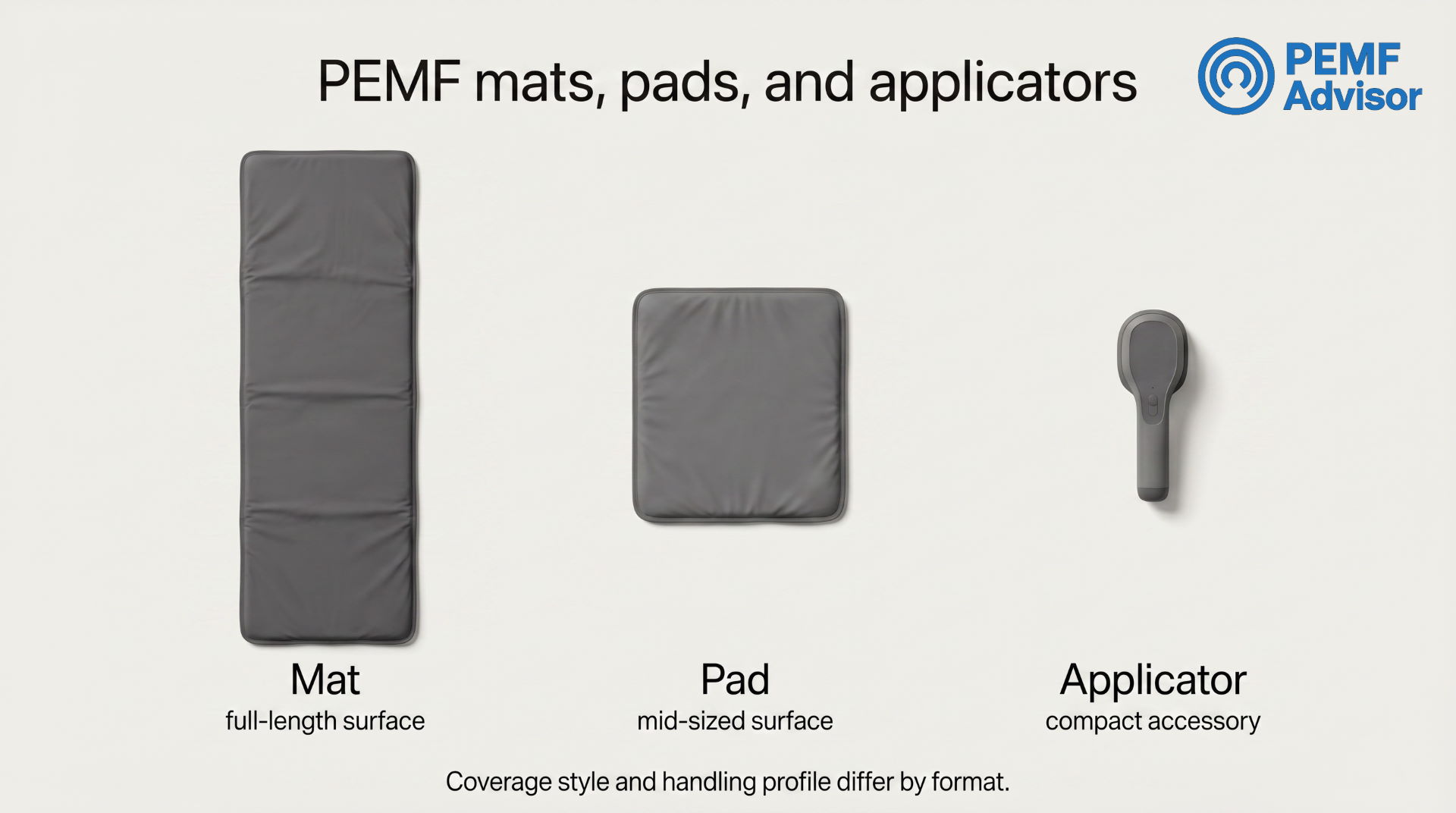
Side-by-side format overview
At a physical level, the three formats are easiest to understand as surfaces versus accessories:
- Mats function as full-length surfaces – they cover the whole body and require a larger placement area such as a bed or floor.
- Pads function as mid-sized surfaces – they cover a smaller zone and require less room than a full mat, which makes them easier to place on a chair or smaller surface.
- Applicators function as compact accessories or attachments – they have a minimal storage footprint and are wearable, wrapped, or held rather than laid on.
Another useful split: mats and pads are static surface formats that you lie or sit on, while applicators are wearable or held formats. That single distinction resolves most of the early confusion.
Comparison table
Use this table as the anchor for the rest of the article. Labels alone are not a reliable comparison signal, so naming confusion is treated here as a core column rather than a footnote.
| Form factor | Typical footprint | Primary use case | Storage profile | Common naming confusion |
| PEMF mat | Full-length surface; roughly body-sized; usually used on a bed or floor | Full-length static placement for whole-body coverage | Larger; rolls or folds; often needs a dedicated storage spot | Sometimes labeled a pad by brands; size varies by model |
| PEMF pad | Mid-sized surface; smaller than a mat; fits on a chair, seat, or lumbar surface | Mid-sized flexible placement for a localized surface area | Moderate; easier to fold or carry than a mat | Sometimes labeled a mat by brands; overlaps with larger applicators |
| PEMF applicator | Compact accessory or attachment; handheld probe, flexible wrap, or small add-on | Compact localized placement; wearable, wrapped, or held | Minimal; usually fits in a case or drawer | Term used both for handheld probes and for small flexible wraps, depending on brand |
The rows use buyer-facing language on purpose. Each category can still vary by brand, but the physical traits in these columns stay more stable than product names.
Early decision drivers for buyers
Before going deeper into mechanism or construction, there are a handful of filters that usually matter more for home-use ownership than anything else. These are screening criteria, not persona-based picks.
| Screening checklist
Coverage style – do you want a full-length surface, a mid-sized zone, or a compact accessory? Room fit – is there space to lay the device out, or does it need to tuck away between uses? Portability – does it need to travel, or sit in one spot? Controller relationship – does the format depend on a controller unit or a specific port configuration? Cable length – will the cable reach from controller to placement surface in your actual setup? Naming consistency risk – are you comparing by dimensions and build, or by the word on the label? |
Controller compatibility and cable length are worth noticing early because they shape how the device fits into daily routine. A long mat paired with a short cable, for example, constrains where it can realistically go in a room.
What defines each format category
A PEMF device has a format category rather than a clinically defined role. Mats, pads, and applicators differ by physical format and placement style, and labels can vary across brands even when physical dimensions are similar. The definitions below are intended to stabilize the three categories so you can read product listings with a more consistent lens.
PEMF mats as full-length surface formats
A PEMF mat is characterized by a rigid or semi-foldable full-body length. It is designed for full-length static placement – typically on a floor, bed, or any surface long enough to accommodate the body. Mats provide full-body coverage as a descriptive trait of the physical format, and they usually differ from smaller formats primarily by length and width.
Because of their size, mats are constrained by storage profile. Some roll, some fold in halves or thirds, and some are close to rigid. Foldability varies by model and directly affects where the mat can live when not in use – a mat that folds into three panels stores very differently from one that only rolls.
PEMF pads as mid-sized placement surfaces
A PEMF pad is a mid-sized placement surface rather than a separate medical class. It is built for mid-sized flexible placement – a seat, a chair back, a lumbar-height surface, or any area smaller than a full-body mat. Pads differ from mats mainly in length and width, and from applicators in that they are still surface formats you lay on or sit against, not accessories you wrap or hold.
Pads can be described as suitable for lumbar or local placement as a placement description only – meaning they fit a smaller physical zone. That is not the same as saying they target a specific area clinically. Foldability varies across pads too; some roll into a compact shape, others stay flat.
PEMF applicators as compact targeted accessories or attachments
Applicators are the most label-inconsistent category of the three. As a physical format, a PEMF applicator is a compact accessory or attachment – enabling compact localized placement through a wearable, wrapped, or handheld form. They differ from mats and pads most obviously by size, and they are typically constrained by controller compatibility, since they plug into or depend on a separate controller unit.
The real source of buyer confusion here is accessory-led format drift. Some brands use applicator to mean a handheld probe, essentially a small hardware wand. Others use the same word for small flexible wraps, cuffs, or pad-shaped accessories that attach to the controller. Both are legitimately applicators in their own brand vocabulary, but they behave differently in ownership terms – a probe has to be held, a wrap is worn.
| Category boundary to watch
The word applicator in PEMF marketing can describe both handheld probes and small flexible wraps or attachments. These two sub-types share a category label but have very different handling, storage, and use postures. When comparing applicators across brands, check whether the item is held, worn, or placed – that resolves most of the ambiguity. |
The main ownership differences that actually matter
Once the category labels are stable, the practical differences that shape day-to-day use come down to footprint, portability, placement flexibility, and the controller relationship. These are the variables that decide whether a device fits into a routine or becomes friction.
Typical footprint and room fit
Footprint is the easiest ownership variable to see and the easiest to underestimate. It determines not only where the device is used, but where it lives the rest of the time.
- Full-body mats require a larger placement area – a bed, a floor stretch, or a dedicated surface long enough to accept the full length.
- Medium pads require less room than full-body mats and can sit on a chair, seat, or compact placement surface.
- Targeted applicators require minimal storage footprint and can live in a drawer, shelf, or small case.
Worth noting: physical footprint and usable placement area are not always identical. A foldable mat has one footprint when stored and another when deployed, and the deployed footprint is what has to fit in the room. Placement environment – bed, floor, chair, desk, sofa, shelf, or closet – is usually the constraint, not raw dimensions on a spec sheet.
Portability and storage profile
Portability depends on design, not only category label. Two mats with similar external dimensions can behave very differently depending on construction style and included accessories. The variables that actually drive portability:
- Material and fabric type – softer fabrics roll and fold more easily; rigid panels do not.
- Foldability – some mats and pads fold in halves or thirds; others only roll, and the roll diameter matters.
- Storage case inclusion – a carry case changes transport convenience significantly, especially for mats.
- Weight – often overlooked next to size, but weight affects whether the device moves around a house easily.
The general pattern: applicators are easiest to pack away, pads are in the middle, and mats carry the biggest storage-planning burden. But design choices can compress that difference in either direction.
Placement flexibility and routine friction
Each format has a dominant surface contact style. Mats support a lay-on style, where the device stays in one place and the user comes to it. Pads support a place-on or drape-on style, typically on a seat or chair. Applicators support wrap-around, worn, or held-near styles, depending on whether they are wraps or handheld probes.
Routine friction comes from the handling involved, not from any outcome claim. A mat that has to be unfolded, positioned, and refolded every session creates more repetition than a compact applicator that stays plugged into a controller on a side table. Neither is objectively better – they just impose different amounts of setup effort per use.
Controller unit and cable-management differences
A PEMF device requires a controller unit, and the controller often matters as much as the surface format itself. Controllers can vary by multi-port versus single-port design – some allow a mat, a pad, and an applicator to connect to the same controller, either sequentially or simultaneously, while others restrict the device to one active accessory at a time.
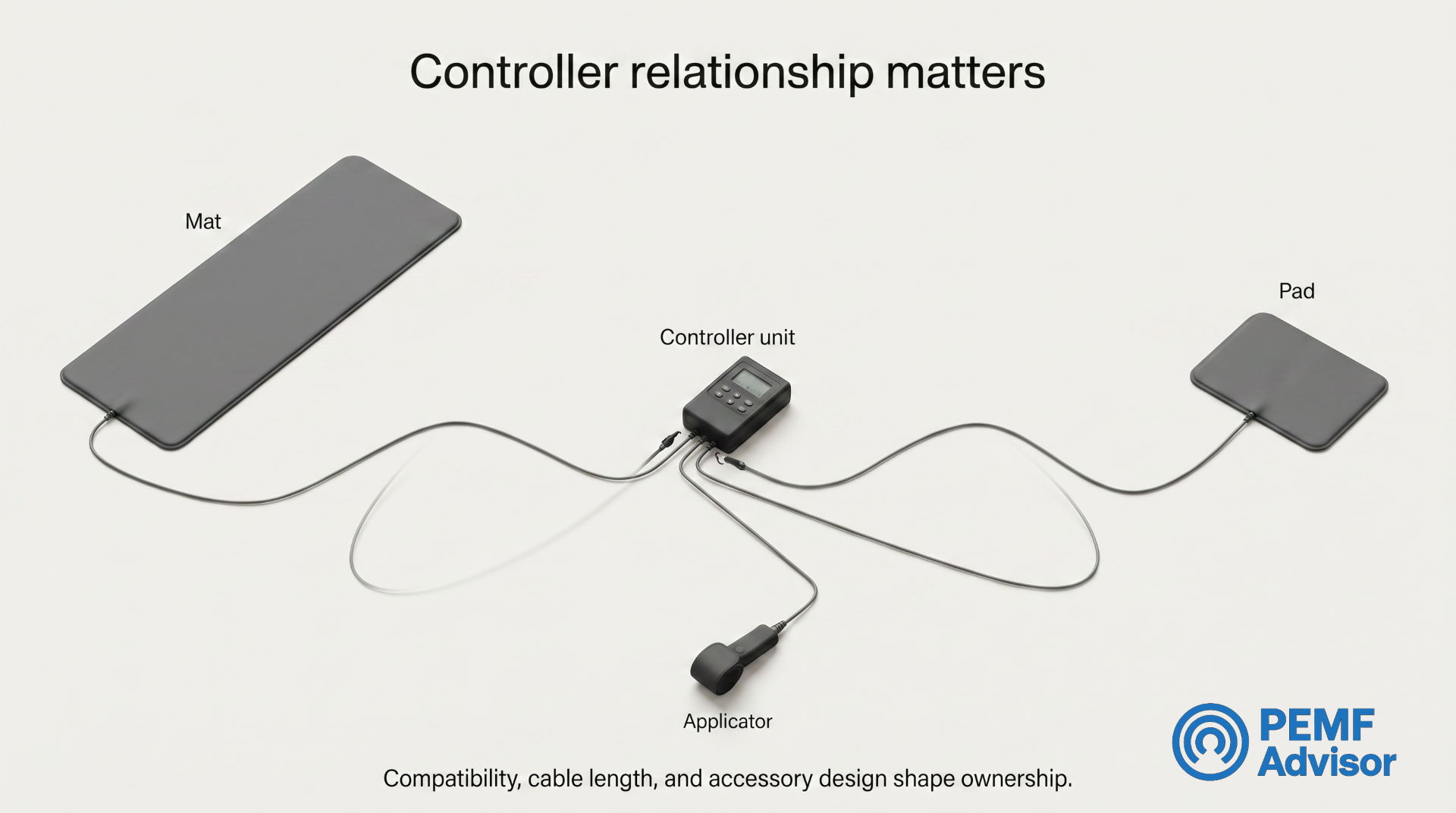
Pads and applicators in particular can be constrained by controller compatibility, because many of them are sold as accessories within a brand ecosystem. That means a pad from one brand frequently will not plug into another brand’s controller. Cable length adds another ownership constraint: a short cable forces the controller to sit close to the placement surface, which can limit where the device realistically lives.
Controller ecosystem boundaries are often invisible in product photos but very visible in daily use. It is worth treating controller compatibility as part of the format comparison, not as a separate topic.
Why naming alone is not a reliable comparison signal
Brand naming conventions for PEMF formats are low-stability. The word mat, pad, or applicator on a product page does not reliably tell you what shape, size, or accessory class you are looking at. This is the biggest single source of cross-brand confusion and it is worth addressing directly.
Brand overlap between ‘mat’ and ‘pad’
Product labels can vary even when physical footprint is similar. One brand may sell a roughly body-length surface as a mat while another sells something nearly the same size as a pad. The reverse also happens: mid-sized surfaces occasionally appear under mat branding when the company’s lineup does not include a full-length format.
Because these naming conventions are low-stability, they should not anchor category decisions. Dimensions are a much more reliable signal than label vocabulary.
When a small flexible wrap is called an applicator
The applicator category is where this instability gets most visible. Some brands reserve the word for handheld probe-style hardware. Others apply it to small flexible wraps, cuffs, or compact attachments that plug into the controller. A third group uses it for anything that is not mat-or-pad shaped, regardless of whether it is held, worn, or placed.
All three usages exist in the market. None of them is technically wrong – the word has simply drifted through brand vocabulary. The practical response is to look at the physical design rather than the label: is it held, is it worn, does it wrap, does it stay in place on its own?
Why dimensions and build style are stronger comparison signals than labels
If naming is unstable, something more concrete needs to anchor comparison. The following signals are far more reliable than brand vocabulary:
- Physical dimensions – length and width tell you whether the format is a full-body surface, a mid-sized surface, or a compact accessory.
- Build style – is it rigid, semi-foldable, soft-wrap, or probe-shaped?
- Controller dependency – is it sold as a standalone mat with a controller, or as an accessory to an existing controller?
- Storage behavior – does it roll, fold, pack into a case, or sit flat?
Comparing on these four axes normalizes most of the brand variation. A mat and a pad that are nearly the same size will behave similarly in ownership terms regardless of which label they carry.
Physical mechanism and design traits behind the format differences
The format differences come from design decisions about coil layout, surface area, and construction. This section stays proportional – it covers the why behind the categories without turning into a physics lecture and without making efficacy claims. The mechanism is the reason for the format variation; it is not the main event of the page.
Coil count and coil layout as physical-format variables
Electromagnetic coils are the components that enable field generation inside a PEMF device. The coils sit inside the mat, pad, or applicator, and the layout – how many coils, how they are distributed across the surface – is part of the physical design of the format.
As a general pattern, more surface area tends to involve more internal coil zones, simply because there is more space to distribute them. That makes coil count a differentiating design attribute across formats, but it is not a direct outcome claim. More coils does not automatically mean a better result, and fewer coils does not mean a worse one. Coil count is part of construction, not a performance ladder.
Surface area and field-distribution context
Surface area changes coverage style. A full-length mat distributes its coils across a large physical area, which spreads the field over a wider surface. A compact applicator concentrates its coils in a small physical area, which confines the field to a narrower zone. This is a physical-distribution concept – coverage style – not a potency claim.
The important framing: spatial density of coils is a design variable, not a strength measurement. Coverage style is not potency logic.
Soft-wrap, flat-pad, and full-length construction differences
Construction places each format on a rigidity spectrum. Mats, pads, and applicators can occupy different positions on that spectrum depending on how they are built:
- Rigid or semi-rigid construction – common in full-length mats; keeps the surface flat, affects how it folds or rolls.
- Flat-pad construction – common in mid-sized pads; sits flat, often foldable, sometimes semi-flexible.
- Soft-wrap construction – common in wrap-style applicators; flexible enough to conform to a surface or be worn.
Construction style influences handling and storage more directly than most other design traits. A rigid mat stores and moves differently from a mat of the same dimensions built with flexible panels.
Material, fabric, and structural flexibility
Material and fabric type are supporting attributes – they matter for feel and storage behavior, not for category definition. Softer fabrics generally roll and fold more easily, and structural flexibility affects how the device behaves during handling. These details are worth checking before buying, but they sit below dimensions and build style in the hierarchy of what actually decides the format.
Constraints and limits buyers should keep in mind
A few practical boundaries are worth keeping in view as you compare devices. These are not disclaimers – they are constraints that affect real ownership decisions.
Larger footprint means more placement planning
Larger physical formats require more planning for where they sit during use and where they live between uses. A full-length mat has to fit somewhere flat during a session and has to go somewhere tolerable afterwards. Compact accessories carry almost no planning burden by comparison, because they fit in a drawer or a small case.
This is worth thinking about before buying, not after. Placement environment and space planning burden are part of the real cost of a format.
Smaller form factors do not imply stronger outcomes
| Important distinction
Smaller form factors do not imply stronger outcomes. Coverage style does not create a medical-performance ladder. Marketing claims that small pads penetrate deeper or are more concentrated are low-trust and should not anchor a comparison. Coverage style is not potency logic – it is a physical-design trait describing how much surface area the device covers. |
This distinction is easy to miss because compact devices are often marketed with language that implies greater intensity. That framing conflates coverage style with potency, and the two are not the same.
Multi-port vs single-port compatibility limits
Controller units vary by multi-port versus single-port design, and this shapes how formats can be combined. Pads and applicators may be constrained by controller compatibility – not every accessory works with every controller, and many are locked to a specific brand ecosystem. Buying a pad or applicator without checking controller compatibility is one of the more common ownership mistakes in this category.
Storage case, cable length, and handling trade-offs
Storage case inclusion can shape transport convenience significantly, especially for mats and for wrap-style applicators that are awkward to stow loose. Cable length constrains handling and placement – a shorter cable forces the controller closer to the body or surface. These accessory details do not change the fundamental category of the device, but they do change the practical ownership trade-offs around it.
FAQ
What is the difference between a PEMF mat and a PEMF pad?
Mats and pads differ mainly by physical dimensions, coverage style, and ownership profile. Mats usually describe longer, full-surface formats intended for full-body placement, while pads usually describe mid-sized surfaces intended for a smaller zone like a seat or lumbar area. Naming can still overlap by brand, so dimensions are a more reliable comparison signal than the label.
What makes a PEMF applicator different from a mat or pad?
Applicators differ by compact format, accessory behavior, and a more frequent dependency on a specific controller. They may be handheld probes, flexible wraps, or small attachments, rather than surfaces you lay or sit on. An applicator is not simply a smaller pad by default – it is a separate category with its own handling and storage profile.
Does a larger PEMF device mean stronger output?
No. Larger size indicates a broader coverage style, not a guaranteed stronger output. This page does not treat size as a medical-potency signal. Marketing claims that small formats are deeper or more concentrated should not be treated as stable fact – they are low-trust and do not follow from coverage style alone.
Why do some brands call the same product a mat while others call it a pad?
Naming conventions in this category are low-stability and brand-dependent. Similar physical formats can receive different labels across brands, so buyers are better served by comparing dimensions and build style before trusting the label.
Are PEMF applicators always handheld?
No. Applicators are not always handheld. Some are flexible wraps or compact accessories that attach to a controller, rather than probe-style devices that have to be held. The category depends on brand classification and physical design, so it is worth checking whether a specific applicator is held, worn, or placed.
What does surface area change in practical ownership terms?
Surface area changes coverage style, footprint, storage burden, and placement behavior. Larger surfaces usually require more room and more handling planning, while smaller surfaces are easier to place and store. None of that implies that smaller surfaces produce stronger effects.
How do controller units differ across mats, pads, and applicators?
Some formats are more likely to involve accessory and controller relationships than others, and controllers can vary by single-port or multi-port setup. Compatibility should be checked as part of ownership evaluation, especially when buying pads or applicators as accessories to an existing controller.
Do mats, pads, and applicators usually use different numbers of coils?
Different formats can use different numbers and layouts of internal coils, and this belongs to design and construction differences. Coil count should not be converted into a direct outcome hierarchy – more coils does not automatically mean a better result, and fewer does not mean a worse one.
Which format is easier to store when not in use?
Compact formats are generally easier to store, but construction style and included accessories still matter. Mats tend to create more storage-planning burden than smaller formats. Portability and storage profile are worth checking together, because two devices of similar size can behave quite differently depending on whether they fold, roll, or come with a carry case.
What should buyers compare first if product naming is inconsistent?
Compare dimensions, shape, construction, controller dependency, and storage behavior before trusting the label. Naming is lower-stability than physical specs, and this method normalizes most of the brand variation you will run into.

The PEMF Advisor Editorial Team reviews consumer PEMF mats and related wellness devices. Our work focuses on verified specifications, documentation, usability, materials, warranty/returns, and ownership considerations. We do not provide medical advice or evaluate health outcomes. See our Review Methodology and Editorial Standards.