A full-body PEMF mat is a long home-use electronic mat, often around 180 cm x 60 cm (72″ x 24″), designed to provide head-to-toe coverage while the user lies on one surface. The buyer-side question is not whether the format is “better,” but whether its footprint, weight, power dependence, and setup routine fit your home and lifestyle.
This guide explains what the full-body format actually is as a home product, how it works in practical terms, and where it tends to fit naturally versus where it tends to create friction. The focus stays on size, coverage style, hardware, and ownership routine – not on medical claims or superiority over smaller PEMF formats.
PEMF Advisor publishes buyer-oriented reviews, comparisons, and educational content for home-use PEMF mats and devices. This page is a constrained format explainer within that system: it focuses only on what defines the full-body PEMF mat category and which ownership situations it tends to fit, not on treatment guidance, diagnosis, or condition-based product matching.
If you want the broader category context before focusing on this one format, use our Types of PEMF Mats guide. That page compares full-body mats against smaller, portable, localized, and hybrid formats so you can place this category inside the wider market before comparing specific products.
Full-body PEMF mat attributes at a glance
Before going deep, it helps to see the category through the attributes that actually shape ownership. A full-body PEMF mat is a full-length, home-use device with a head-to-toe coverage style. It differs from a local applicator or small pad in physical dimensions, weight and handling effort, and storage footprint. Larger format changes coverage area; it does not, on its own, prove a stronger field or a better outcome.
Some sources frame full-body coverage as a path to “total body wellness” or systemic recovery. Those are observed marketing claims rather than stable facts, and this page treats them as out of scope.
Table – category boundaries and ownership meaning
The table below converts category-defining attributes into buyer-facing ownership meaning. Each row also notes what the attribute does not prove, so format traits are not read as efficacy claims.
| Full-Body Mat Attribute | What It Means | Ownership Effect | What It Does Not Prove |
| Physical dimensions | Long mat, often around 180 cm x 60 cm (72″ x 24″). | Needs floor or surface space at full length during use. | Larger size does not prove a stronger field or better result. |
| Coverage style | Head-to-toe surface; user lies on one mat without repositioning. | Removes the need to move a small applicator between body areas. | Wider physical span is not medical scope or validated benefit. |
| Portability status | Fixed-use home product tied to a controller and outlet. | Tends to live in one room; not designed for daily transport. | “Portable” options do not turn it into a travel device. |
| Weight and handling effort | Often around 15–30 lbs as a category estimate. | Affects whether the mat is left in place or moved each session. | Heavier build does not imply higher quality or better output. |
| Foldability and storage profile | Some constructions fold; others should not. | Drives stored footprint, closet fit, and setup speed. | Foldable does not mean fold-anywhere; varies by construction. |
| Controller and cable configuration | External control box plus cable to the mat and the outlet. | Adds cable routing and a place to keep the controller. | Controller features are not equal to clinical capability. |
Quick read
The full-body format trades portability for one continuous use surface. Almost every ownership question – storage, setup, room fit, cable routing – follows from that single trade. None of those format traits, on their own, says anything about medical effect.
The Fastest Way to Decide Whether This Format Is Even Worth Considering
A full-body PEMF mat is worth considering only if three ownership conditions are realistic at the same time: you have enough space to use it at full length, enough storage tolerance to live with its size when it is not in use, and enough routine stability that repeated setup or fixed placement will not become friction. If one of those conditions breaks, the format may still be possible, but it becomes harder to live with honestly.
This matters because buyers often start with coverage interest and only later notice the room, weight, and cable realities. The faster way to evaluate the format is to test ownership fit first and treat coverage size as a secondary question.
The shortest definition buyers should keep in mind
A full-body PEMF mat is a long, home-use electronic mat designed for one extended, body-length use surface. Head-to-toe coverage describes that physical span; it is not a claim about output strength or outcome. The buyer-side decision is ownership fit – whether the room, routine, and storage tolerate a fixed-use device of this size – not format prestige.
| Definition
Full-body PEMF mat = a full-length home-use mat, typically around 180 cm x 60 cm, with a controller and a power cable, intended to be used while lying on one surface. Nothing in this definition speaks to medical effect. |
Why this format is usually treated as a fixed-use home product
Full-body mats sit on the fixed-use side of home electronics for a few practical reasons. The mat needs a controller. The controller needs a power outlet. The mat needs a placement surface long enough to lie on, plus storage space for when it is not in use. Those constraints are room-layout constraints before they are health-style ones.
In ownership terms, this means the mat tends to live in one spot – often a bedroom, a quiet floor area, or a dedicated room corner – close to an outlet and out of high-traffic zones. None of that automatically makes the format inconvenient. It just means the device is selected, placed, and moved differently from a small pad.
What a full-body PEMF mat is
Defined cleanly, a full-body PEMF mat is a full-length, home-use device with a head-to-toe coverage style. The format enables passive full-length use – the user lies on one surface – instead of repositioning a smaller applicator across body areas. It differs from local applicators primarily by use-surface size and coverage span, not by any built-in claim about output.
Category definition through size and coverage style
Across the category, full-body mats commonly land near 180 cm x 60 cm (about 72″ x 24″). That benchmark is high-stability – it shows up consistently as a useful anchor for the category, although individual products vary. “Head-to-toe” refers to the physical span of the use surface, not to medical scope or validated reach.
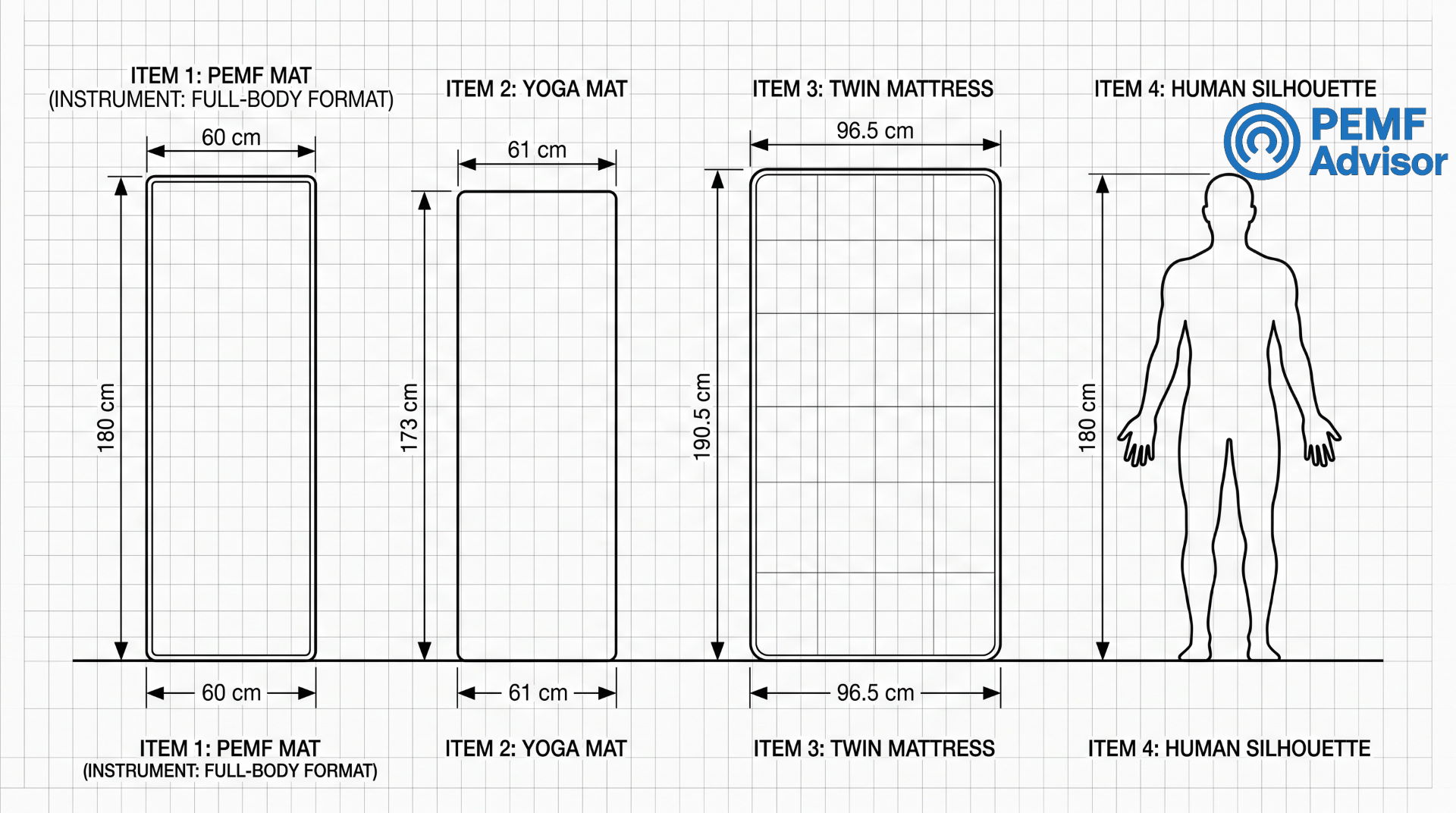
The most reliable distinction from a targeted pad is therefore physical: a full-body mat is long enough to lie on; a local applicator is small enough to place over a single area. Everything else – weight, foldability, materials – follows from that size choice.
The Full-Body Format Is a Space Choice Before It Is a Product Choice
The first real decision in this category is spatial, not technical. A full-body PEMF mat asks the buyer to accept a body-length use surface inside the home before any controller features, material choices, or bundled layers become relevant. That is why this format works best when buyers evaluate it as a room-and-routine commitment first.
This is not a downgrade of the format. It is the clearest reading rule for it. Once the space commitment makes sense, the rest of the comparison becomes easier. If the space commitment does not make sense, the rest of the product details matter much less.
The main product parts: mat surface, internal coil layout, controller, and cables
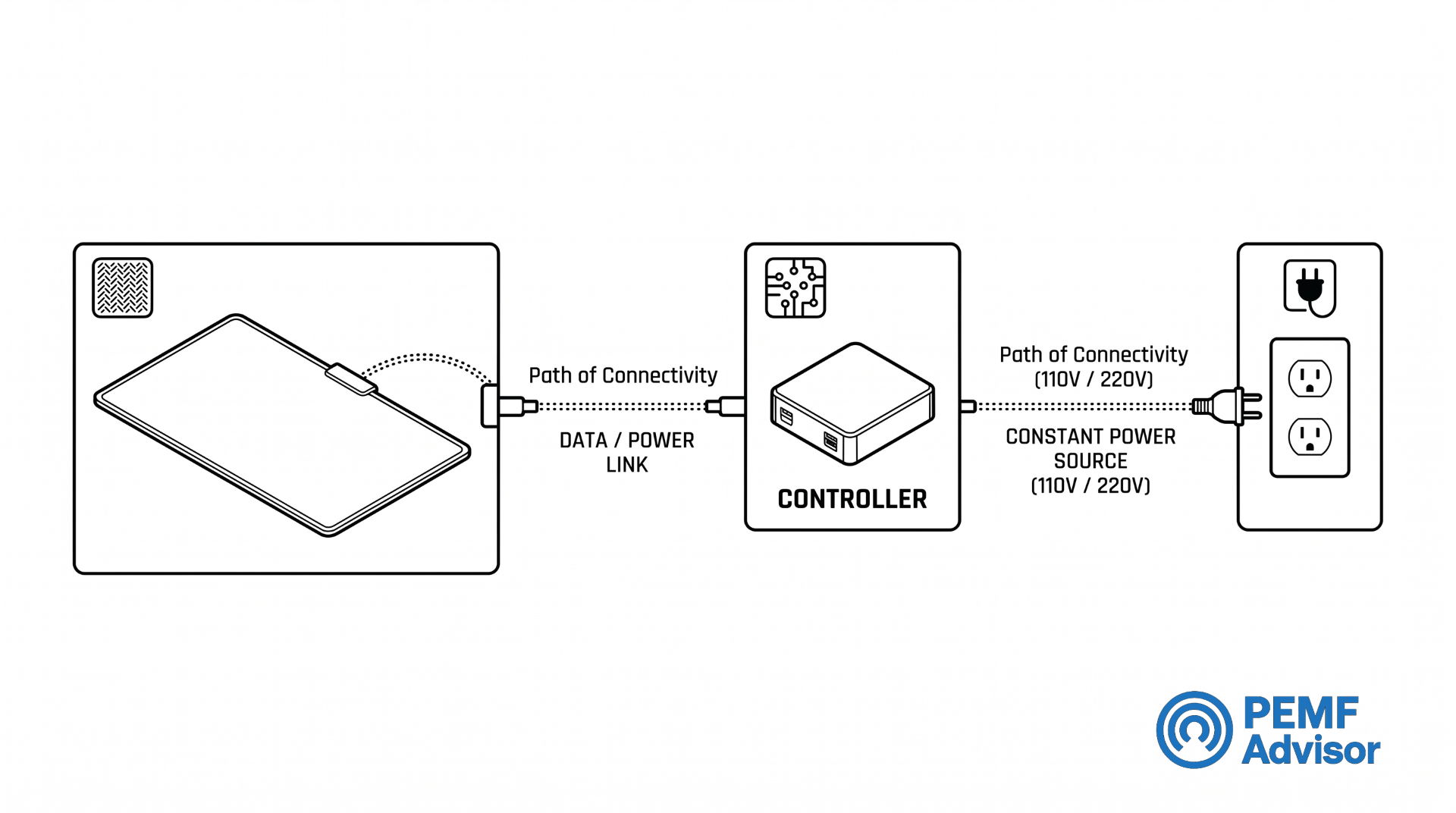
At a product-design level, a full-body mat has four parts that matter for ownership: the mat surface, an internal coil layout, an external controller (control box), and the cables that connect them and reach the outlet.
| Component | Role in the product | Why it matters for ownership |
| Mat surface | The padded, body-length layer the user lies on. | Drives feel, stiffness, and how the mat handles when moved. |
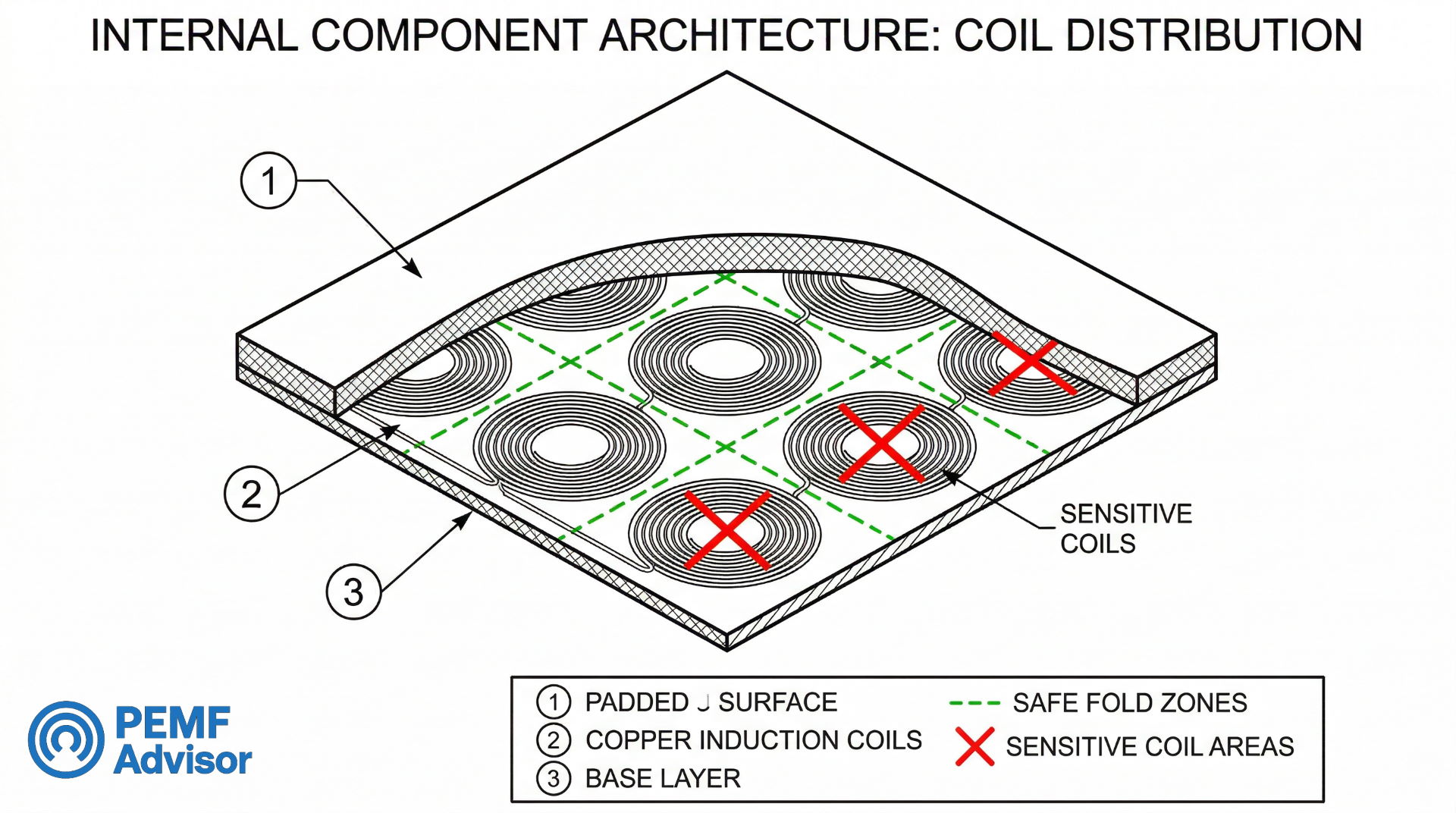
| Internal coil layout | Coils distributed inside the mat to deliver coverage across its length. | Often the reason manufacturers limit folding or rough handling. |
| Controller / control box | External unit that powers and operates the mat. | Needs a place to sit; affects setup ease and reach to the outlet. |
| Cables | Connect controller to mat and to the wall outlet. | Determine practical room placement and cable routing path. |
The controller and cables are part of the real product, not afterthoughts. Where the controller sits and how the cable runs to the outlet directly shape whether the device feels easy or annoying to live with.
What passive head-to-toe coverage means in product terms
“Passive head-to-toe coverage” is a form-factor description. The user lies down once on a single, long use surface instead of moving a smaller device around the body. That is a convenience point about handling and routine.
It is not, in itself, evidence of stronger output or a better outcome compared with a smaller, repositioned applicator. Some sources describe systemic wellness implications from full-body coverage; those are observed claims and are out of scope as stable facts here. The fair comparison is one long use surface versus several targeted placements – a difference in handling, not in proven effect.
What the full-body format does not prove
| Format boundary
Larger format does not prove a stronger field. Head-to-toe physical span does not equal medical validation. Bigger device does not equal better outcome. “Full-body is the serious upgrade” is observed marketing rhetoric, not a stable conclusion of this page. |
This boundary matters because it keeps the rest of the explanation honest. A long mat covers more of the body geometrically. That is a real, useful description. It is not a license to read coverage area as a proxy for effect.
How the format works as a home-use product
As a home-use product, a full-body PEMF mat depends on a few stable conditions: hardware components in working order, a power source, and a stable placement surface. The mat surface plus internal coil layout sits where the user lies; the controller drives the mat and connects to the outlet; cables route between them.
Beyond that baseline, two things vary meaningfully across the category: construction (which affects whether the mat folds and how it is stored) and intended placement surface (floor, platform, or softer support). Both are product-dependent and worth verifying before purchase rather than assuming a category-wide rule.
Internal copper coils and coverage distribution at a high level
Many full-body mats use internal copper coil layouts to distribute coverage across the surface. At a high level, that is what enables the mat to function as a single long use area rather than a single point. The exact coil arrangement is a product-design detail that varies between manufacturers.
The practical ownership consequence is handling caution: where a manufacturer limits folding or sharp bending, that limit usually traces back to protecting the internal coil layout. Folding behavior should be treated as construction-dependent, not as a category-wide rule.
Surface materials, padding, and construction differences
Surface materials vary across the category. Some constructions are fabric-oriented and softer; others incorporate gemstone layers, more padding, or stiffer support panels. These choices affect three ownership-relevant traits: how the mat feels under the body, how easily it folds or rolls, and how compact it is when stored.
| Construction style | Typical handling profile | Storage profile |
| Fabric-oriented, lighter padding | More flexible; often easier to roll or fold (per manufacturer guidance). | Smaller stored profile, but may still need a dedicated storage zone. |
| Gemstone-oriented or denser construction | Stiffer, heavier; folding may be limited or not advised. | Larger stored footprint; may require a flat or low-bend storage spot. |
Material choice is a supporting attribute. It shapes feel, weight, and storage – it does not, on its own, indicate a better or worse outcome.
Why outlet dependence changes where the mat can realistically live
A full-body PEMF mat is typically tied to a constant power source through its controller. That dependence is not just an electrical detail; it constrains where the mat can realistically live in the home. The placement spot has to be near an accessible outlet, with a cable path that does not cross high-traffic zones.
In practice, this often means a bedroom wall outlet, a quiet office floor near a power strip, or a dedicated corner with extension capacity. Outlet dependence is a meaningful part of why this format behaves as fixed-use rather than mobile.
Full-Length Convenience and Full-Length Friction Arrive Together
The same format trait that makes a full-body mat attractive during use – one continuous, body-length surface – is also the trait that creates most of its ownership friction outside the session. A larger device reduces repositioning while you are on it, but it increases placement demands, storage demands, and handling demands the rest of the time.
This is why the full-body format should not be described as purely convenient or purely cumbersome. Its convenience is concentrated during use. Its friction is concentrated before and after use. Buyers who understand both sides usually classify the format more accurately.
Foldable versus rigid construction
Foldability is one of the more contradicted attributes in this category. Some products are designed to fold for storage. Others, due to their internal coil layout or construction, should not be folded – or only folded in specific ways defined by the manufacturer.
| Construction approach | Storage profile | Verification point |
| Foldable construction | Can be reduced to a smaller stored footprint when not in use. | Confirm allowed fold pattern and whether folding affects internal components. |
| Rigid or fold-limited construction | Stays at full or near-full length; may be rolled instead. | Confirm whether rolling is acceptable and how the mat should be stored. |
Foldability is therefore product-specific, not category-wide. Treat any folding statement as a question to verify against the manufacturer rather than a default behavior of “all full-body mats.”
Placement conditions: floor, platform, or softer surfaces as product-dependent questions
Placement is the second main contradiction. Some full-body mats are intended to sit on a firm surface like the floor or a flat platform. Others may be acceptable on a bed or mattress. The deciding factors are construction, support stability, and manufacturer guidance – not a universal preference for one surface.
Soft-surface placement, in particular, depends on how the mat behaves without rigid support underneath. Some constructions need a firmer base to stay flat and stable; others tolerate softer surfaces. The safe interpretation: bed or mattress use should not be generalized across the category, and floor use should not be treated as a universal rule either. Both are product-dependent decisions to verify.
What ownership changes when the device is full-length
Once the format crosses into full-length, ownership changes in concrete ways. The mat takes more space when in use and when stored. The hardware adds weight and cable handling. Setup and teardown become real, repeated steps in the routine. Passive coverage reduces repositioning during use, but it does not remove the friction around using the device in the first place.
Physical footprint and storage profile
A full-body PEMF mat occupies space twice over: at full length while in use, and again – at a smaller but still meaningful size – when stored. That “stored footprint” is the part most easily underestimated at the buying stage.
| Footprint type | What it looks like in practice | Planning consideration |
| In-use footprint | Roughly 180 cm x 60 cm of clear floor or surface area while the mat is open. | Need a stable, mostly empty zone large enough to lie on. |
| Stored footprint | Folded or rolled bundle, often plus a separate controller and cables. | Need a closet shelf, corner, or under-bed zone that fits the rolled or folded size. |
A carrying case can make the stored bundle easier to manage, but it does not erase the volume. In a small studio, for example, a full-body mat can comfortably be in the home and still feel intrusive if there is no dedicated storage spot – because the device exists physically even when not in use.
Stored Size Matters Almost as Much as In-Use Size
Many buyers think about the full-body format only in terms of lying down on it, but the more persistent ownership issue is often what the device becomes when the session ends. A mat that feels reasonable at full length can still create friction if the folded or rolled bundle has no natural home in the room, closet, or under-bed zone available.
That is why the stored profile should be treated as a first-order ownership attribute rather than an afterthought. A product can fit the use moment and still mismatch the home once storage becomes part of the routine.
Weight and handling effort
Full-body mats often fall around 15–30 lbs as a general category estimate, depending on construction. That weight is meaningful in two ways. First, it changes whether the mat is left in place between uses or moved each time. Second, it changes how realistic it is for one person to handle the mat alone, especially over stairs or into tight storage.
A small pad weighs a few pounds and slides into a drawer; a full-body mat is closer in feel to a rolled-up rug or a heavy yoga mat with hardware attached. “Portability” in this context usually means “movable with effort,” not “easy to carry around the house.”
Setup and teardown burden
Setup burden is the routine cost of using the device. For a full-body mat, a single use cycle typically involves laying the mat out, connecting the controller, plugging into the outlet, lying down for the session, and then disconnecting and putting the mat away. None of those steps is hard in isolation; together, repeated daily, they form a routine.
| Setup step | What it adds to the routine |
| Unrolling or unfolding the mat | Clearing space and laying out the full length each time. |
| Connecting controller and cables | Routing the cable to the outlet and placing the controller within reach. |
| Using the mat | The passive part – lying on one surface without repositioning. |
| Disconnecting hardware | Coiling cables, returning the controller to its storage spot. |
| Storing the mat | Folding or rolling and placing the mat back in its storage zone. |
The larger the mat, the more friction each step can create – especially the unroll/store steps and the cable handling. This is the ghost-node “setup friction” that separates a mat that gets used daily from one that quietly stops being used.
Ownership Friction Usually Comes from Repetition, Not from One Hard Task
Most buyers do not reject the full-body format because one step is impossible. They reject it when several manageable steps repeat often enough to feel heavier over time: lifting the mat, clearing space, routing cables, placing the controller, and storing everything again after the session. The burden is cumulative rather than dramatic.
This is important because a format can feel completely manageable during product research and still create more routine friction than expected after weeks of use. The repeated pattern matters more than the one-time effort.
Controller placement, cable routing, and room-use practicality
Controller placement and cable routing sound minor on the spec sheet, and dominate the experience in the room. A controller that sits comfortably within reach while lying on the mat feels almost invisible. A controller that needs to be propped up, or a cable that pulls because the outlet is awkward, feels like a daily annoyance.
Practical room-use therefore depends on a small layout question: where is the outlet, where will the controller sit, and what path does the cable take to reach the mat without crossing walking space? Answering that question before buying is more useful than any spec on the controller itself.
Why “passive use” can reduce repositioning but not eliminate ownership friction
Passive full-length use is a real convenience. Compared with moving a small applicator from spot to spot during a session, lying once on a long mat is genuinely less fiddly while in use. That part of the format is not in dispute.
What passive use does not do is remove the need to place, connect, store, or move the device around the rest of the day. Fixed-use behavior – the mat lives somewhere, plugged into something, occupying space – is the trade-off that sits behind the convenience of passive coverage. Both are true at once.
Where this format fits well and where it creates friction
Whether a full-body PEMF mat is a good fit is mostly a question of room layout, routine, storage, and portability expectations – not a question of which user “deserves” the larger format. Smaller spaces, frequent moving, and shared rooms tend to amplify mismatch risk; stable home layouts with a dedicated zone tend to reduce it.
Nothing in this section attempts to match the format to medical conditions or outcomes. Fit here means whether the device can live comfortably in your home and routine.
Fit Here Means Ownership Fit, Not Outcome Fit
This page uses the word “fit” in a narrow and deliberate way. It refers to room layout, setup tolerance, storage capacity, cable practicality, and how realistic the format feels inside a normal ownership routine. It does not refer to treatment suitability, symptom targeting, or any claim about what the device may do biologically.
That distinction matters because the phrase “who it fits” can easily drift into condition-led logic if the boundary is not stated clearly. On this page, fit means whether the format belongs comfortably in the buyer’s home and routine. Nothing more.
Homes with stable floor space or a dedicated place for the device
Full-body mats fit more naturally in homes with stable floor space or a dedicated location for the device. A bedroom corner, a spare room, a quiet office floor, or a dedicated wellness area all work well because the mat can stay set up or be stored close by. A dedicated storage or placement zone is one of the strongest reducers of repeated setup friction.
The pattern is simple: the closer “where the mat lives” is to “where the mat is used,” the easier the device is to own.
Users comfortable with a fixed-use routine
A fixed-use routine – where the device generally stays in one room and is not moved often – suits the format well. If frequent relocation is not required, the trade-offs of size and weight matter much less, and the convenience of passive use shows through more clearly.
Routine fit comes down to two things: tolerance for the setup burden each session, and tolerance for the space commitment the device makes in the room. Both are personal lifestyle questions, not protocol questions.
Smaller spaces, shared rooms, and frequent moving as mismatch risks
Smaller spaces, shared rooms, and frequent moves tend to make the format harder to live with. In a small apartment, the in-use footprint can dominate the only usable floor area. In a shared room, repeated setup and teardown can collide with another person’s routine. In a household that moves often, a 15–30 lb mat with a controller and cables is meaningful luggage, not luggage you forget about.
| Living situation | Likely friction | What changes the picture |
| Studio or one-room apartment | In-use footprint blocks the main floor area; storage volume is hard to absorb. | A dedicated corner or under-bed storage with reliable folding policy. |
| Shared bedroom or living space | Setup/teardown competes with another person’s routine. | A predictable fixed location and a tolerant household routine. |
| Frequent movers (renters, relocations) | Mat plus controller plus cables is a real packing item. | Weight and folding behavior of the specific product, plus a carrying case. |
| Stable home with dedicated zone | Lower friction overall – the mat lives where it is used. | Having an outlet, a flat surface, and storage in the same area. |
Travel expectations versus realistic portability
“Portable” is a relative word in this category. A full-body mat may be movable with effort – across rooms, into a car, occasionally to another home – without being travel-friendly in the way a small pad or compact device is. Carrying case availability helps with handling and protection, but it does not change the underlying size, weight, or hardware count.
| Portability, plainly
Treat “portable” in this category as “movable with effort,” not “travel-friendly.” If routine portability is essential, a full-body mat is usually the wrong format – not because it is bad, but because the format is not optimized for that use. |
Why Buyers Still Choose This Format Despite the Friction
Buyers usually choose full-body mats because they want one continuous use surface and do not want to reposition a smaller device during a session. That preference is real and easy to understand in practical terms. It does not need to be translated into treatment language to make sense.
In other words, the format often wins because it reduces in-session handling, not because it proves stronger output or more serious use. That is the most stable buyer-side explanation for why the category remains attractive despite its size and setup demands.
What buyers should verify before assuming easy storage or easy placement
Before assuming a specific full-body mat will fit easily into a home, a short verification list helps. The point is not to grade products; it is to convert format-level assumptions into product-specific facts.
| Verify | Why it matters |
| Exact dimensions and weight | Confirms the in-use footprint and the realistic handling burden. |
| Foldability and allowed fold pattern | Determines stored footprint and whether folding is even permitted. |
| Placement guidance (floor, platform, mattress) | Tells you what surfaces the manufacturer supports. |
| Power outlet and cable length | Confirms whether the mat can reach where you intend to use it. |
| Controller placement and cable routing | Determines daily ease of use in the room. |
| Stored profile and carrying case | Sets expectations for closet, corner, or under-bed storage. |
How full-body mats differ from smaller PEMF formats
Comparison helps frame the format, but it should not dominate the page. Full-body mats and smaller PEMF formats (local applicators, small pads) differ in physical dimensions, coverage area, storage footprint, and handling effort. Those differences are ownership trade-offs – not superiority claims.
Coverage style: one long surface versus targeted placement
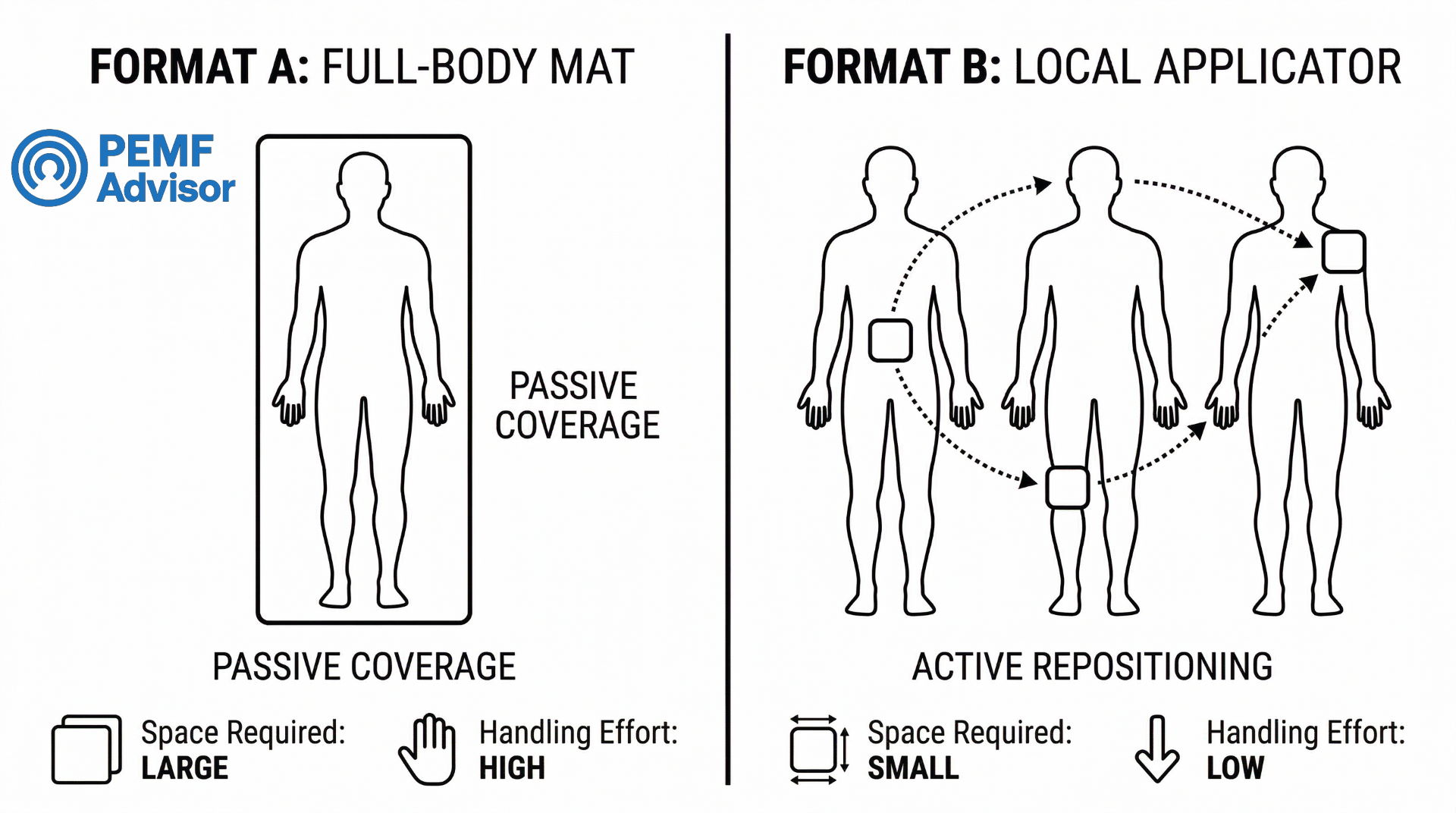
The clearest difference is use surface. A full-body mat presents one long surface; the user lies on it once. A local applicator is targeted – it is placed on a specific area and may be moved during a session. That difference changes convenience and repositioning behavior. It does not, by itself, change validated outcome level.
| Format | Use surface | Repositioning behavior |
| Full-body PEMF mat | One long mat sized for head-to-toe use. | Minimal during use; the user stays in one position on the mat. |
| Local applicator / small pad | Compact pad placed over a specific area. | May be moved between areas during a session. |
Setup model: lay out once versus move a smaller applicator around
The setup models follow from the use surface. A full-body mat is laid out once at the start of a session; the user does not handle the device much during use. A smaller applicator is easier to pick up, position, and move, and is generally easier to put away between uses.
Neither model is universally easier. A full-body mat reduces in-session handling but adds setup and storage friction around the session. A small pad reduces storage and transport burden but adds in-session handling. Which model fits better is a routine question, not a format-quality question.
Storage and portability differences
Storage and transport differ meaningfully across formats. A small pad fits into a drawer or a small bag; a full-body mat needs a shelf, corner, or under-bed zone, plus a place for the controller. Carrying case availability helps with management for the larger format but does not erase its size and weight.
| Aspect | Full-body PEMF mat | Local applicator / small pad |
| Stored footprint | Folded or rolled bundle plus controller; typically needs a dedicated zone. | Compact; often fits a drawer, shelf, or small case. |
| Transport effort | Movable with effort; not designed for routine travel. | Easy to carry, even in a daypack for some products. |
| Setup time | Multi-step (lay out, connect, route cable, store after use). | Few steps; place, use, put away. |
Full-Body Format Should Not Be Treated as the “Serious User” Tier
Some market language frames full-body mats as the upgrade path for more committed or more serious buyers. That framing is usually prestige language built on size and visibility rather than a stable technical hierarchy. A larger format can create a better ownership fit for one buyer and a worse one for another without making either buyer more or less serious.
This matters because format prestige is one of the easiest ways for outcome logic to slip into a buyer comparison. The full-body category should be read as one ownership pattern among several, not as the default top tier.
Ownership trade-offs without turning format into superiority
Larger format changes coverage style and ownership burden. It does not change proven efficacy level. Buyer fit should rest on room, storage, weight, and setup tolerance – not on the assumption that bigger is automatically better. Some sources position full-body format as a necessary upgrade for serious users; that framing is observed marketing and is out of scope as a stable conclusion here.
Why larger format should not be read as stronger field or better result
| Do not infer
Larger surface area → not proof of stronger field. Head-to-toe physical span → not proof of medical effect. Bigger device → not proof of better sleep, recovery, or circulation results. Higher price tag → not proof of higher output capability. |
Some sources claim sleep, blood-flow, or recovery superiority for full-body mats over smaller pads. Those are observed claims, not stable conclusions. Keep the format explanation in buyer and ownership language; the medical interpretation is a separate, governance-restricted question.
The Minimum Ownership Standard Before a Full-Body Mat Makes Sense
A full-body PEMF mat makes sense only when the buyer can answer four practical questions clearly: where it will be used, where it will be stored, how often it will need to be moved, and whether the controller and cable layout will stay manageable in the room. If those four answers are still fuzzy, the format may still sound appealing, but the ownership fit is not actually resolved yet.
This is not a verdict on product quality. It is a format-fit rule. The clearer the room and routine picture becomes, the less likely the buyer is to confuse larger coverage with automatic suitability.
FAQ
What size is a full-body PEMF mat?
Full-body PEMF mats are commonly around 180 cm x 60 cm (about 72″ x 24″) as a typical category benchmark. Exact dimensions vary by product. Size matters mainly for in-use footprint and storage planning.
How much does a full-body PEMF mat usually weigh?
Full-body mats often fall around 15 to 30 lbs as a general category estimate, with exact weight varying by product. Weight matters for moving the device, storing it, and the daily setup burden.
Does a full-body PEMF mat need to stay plugged into a wall outlet?
Most full-body PEMF mats require a constant power source during use. That outlet dependence shapes room placement and cable routing. Specific power behavior can vary, so individual product details should be verified.
What does head-to-toe coverage mean in product terms?
Head-to-toe coverage refers to the physical length of the use surface. It means the user can lie on one longer mat instead of repositioning a smaller applicator. It does not prove a stronger output or a better result.
Does a full-body PEMF mat have internal copper coils?
Many full-body mats use internal copper coil layouts or similar internal construction components to distribute coverage. Internal design is best described at a high level unless product-specific documentation is available, and it can affect handling guidance such as folding limits.
Can a full-body PEMF mat be folded for storage?
Some full-body mats can be folded; others should not be. Foldability depends on construction and manufacturer guidance. The folding policy should be verified for the specific product before purchase.
Can folding damage the internal coil layout?
Folding can be a concern for some products, depending on internal construction. Where the manufacturer limits folding, that limit usually exists to protect the internal coil layout. This is a product-specific verification issue rather than a category-wide rule.
Can a full-body PEMF mat be used on a bed or mattress?
Bed or mattress use may be acceptable for some full-body mats but should not be generalized across the category. Construction, support stability, and manufacturer guidance all matter. Placement guidance should be verified before assuming mattress suitability.
Is a hard floor a safer placement surface for some full-body mats?
Firmer surfaces may be preferable for some products, depending on construction and support needs. A hard floor should not be treated as a universal rule for all full-body mats. Manufacturer guidance should control the final placement decision.
Are full-body PEMF mats portable?
Portability is relative in this category. Some mats are movable with effort but are not especially travel-friendly. Size, weight, folding design, and carrying case availability all factor into how realistic transport is.
What makes a full-body mat harder to move than a small pad?
Longer dimensions, heavier weight, the controller hardware, and cable handling all add movement friction. Storage footprint and setup burden are part of the same picture. The format simply involves more pieces and more space than a small pad.
Does full-body format prove stronger output or better results?
No. Full-body format does not prove stronger output or better results. Larger size should not be treated as evidence of superiority. Some sources claim otherwise; those claims are observations, not stable conclusions.
What is the difference between a full-body PEMF mat and a local applicator?
A full-body mat uses one long surface for head-to-toe use; a local applicator is smaller and targeted to a specific area. The two formats differ in coverage style, portability, storage profile, and repositioning needs. The difference is format-based, not outcome-based.
Is setup burden a real ownership factor with full-body mats?
Yes. Setup burden is a real ownership factor because size, weight, controller handling, and storage all affect ease of use. It matters most when the device is moved or stored often, where small frictions repeat each session.
What should buyers verify before choosing a full-body PEMF mat?
Before choosing a full-body mat, it helps to verify: exact dimensions, weight, foldability and allowed fold pattern, placement guidance (floor, platform, mattress), outlet needs, controller and cable layout, and stored profile. Mattress suitability and folding safety, in particular, should be confirmed product by product rather than assumed from the category.

The PEMF Advisor Editorial Team reviews consumer PEMF mats and related wellness devices. Our work focuses on verified specifications, documentation, usability, materials, warranty/returns, and ownership considerations. We do not provide medical advice or evaluate health outcomes. See our Review Methodology and Editorial Standards.