Quick answer: The HigherDOSE Infrared PEMF Pro Mat is a large multi-layer home-use mat built from a PU leather-style exterior, crystal-containing upper layers, embedded PEMF and heating components, and internal insulation and shielding layers. For buyers, the key question is how those materials shape construction, comfort, portability, maintenance, and claim interpretation – not whether they prove medical outcomes.
This guide walks through what the mat is physically made of, how those parts are organized, what the build changes for day-to-day ownership, and where material language stops being a stable fact and starts becoming marketing interpretation. The goal is to help you read the product accurately, not to evaluate therapeutic claims.
PEMF Advisor publishes buyer-oriented reviews, comparisons, and educational content for home-use PEMF mats and devices. This page is a product-support explainer within that system: it focuses only on the materials and physical design of the HigherDOSE Infrared PEMF Pro Mat in practical buyer language, not on diagnosis, treatment guidance, or clinical protocol advice.
If you want the full product-level review before focusing on build details, use our HigherDOSE Infrared PEMF Pro Mat Review. That page looks at the mat as a complete home-use product, including feature stacking, specs, controls, ownership trade-offs, and the broader buyer context around the HigherDOSE Infrared PEMF Pro.
Material and layer comparison at a glance
The HigherDOSE Pro Mat is a PEMF and far-infrared home-use mat in a rectangular full-body floor-mat format. Its defining physical trait is multi-layer construction: stacked materials that house crystals, separate insulation, position shielding, and support embedded PEMF coils. The table below summarizes each layer, what it physically does, and where buyer interpretation should stop.
| Layer / Material | What it physically is | Buyer interpretation boundary |
| PU leather surface | Non-toxic, heat-resistant outer shell that forms the visible exterior of the mat. | Supports wipe-down care. A premium feel does not prove therapeutic performance. |
| Top mesh / crystal-containing upper layer | Upper zone that houses or covers embedded crystal material such as Amethyst and Tourmaline. | Structural housing for crystals. Claims that crystals generate negative ions are governance-restricted and low-stability here. |
| Embedded PEMF coils | Internal coil array positioned within the stack, operated through an external controller. | Describes hardware layout only. Coil count or frequency range does not itself prove outcomes. |
| Heating elements | Far-infrared heating components co-located with the coil zone. | Heat and PEMF are separate systems sharing one product. Not a combined mechanism claim. |
| Insulation layers | Internal layers separating the active components from the outer surfaces. | Enable thermal separation. Do not convert to efficacy claims. |
| Shielding layers (aluminum / copper) | Conductive layers positioned to support low-EMF claims around the active components. | Low EMF means reduction, not elimination. Low EMF is not zero EMF. |
| Charcoal / clay layers (where referenced) | Additional material layers referenced in some product descriptions. | Sources that tie these layers to detoxification are governance-restricted and low-stability here. |
| Support / backing layers | Lower-stack layers that stabilize the mat and support the embedded hardware. | Structural role only; they do not imply deeper therapeutic reach. |
| Read this table as a decoder, not a verdict
Each layer has a real physical job: housing, insulation, shielding, or support. Luxury cues (PU leather, crystals, shielding) describe construction. They do not prove outcomes. Where a row points to a claim such as negative ions, detoxification, or healing acceleration, treat that as an observed source claim – not as a settled fact under this page’s constraints. |
Layer and material roles in plain language
Stripping the marketing vocabulary away, each layer category is doing one of a few straightforward physical jobs:
- Housing – the top mesh zone holds crystal material in place so it stays positioned under the user without floating around inside the mat.
- Separation – insulation layers keep heating and PEMF components from sitting directly against the outer surfaces.
- Positioning – shielding layers (aluminum or copper) sit between the electronics and the body-facing surface to support low-EMF positioning.
- Support – backing and support layers give the mat enough structure to keep embedded coils flat and usable.
- Surface – the PU leather shell is the exterior you actually touch, and the crystal mesh is the upper zone you lie on during use.
None of these roles are unusual for a multi-layer thermal device. What changes between products is how layers are counted, named, and marketed – not whether layering itself is remarkable.
Buyer-impact interpretation by layer category
Once you see each layer as a physical job, the ownership implications get easier to predict:
- PU leather surface: compatible with wipe-down care, which matters for a mat that will see skin contact over time.
- Crystal mesh top layer: more sensitive than the shell because embedded materials cannot tolerate aggressive cleaning methods.
- Embedded PEMF coils: constrain how flexible and how soft the mat can feel; a coil array is harder to bend than a plain pad.
- Dimensions and weight: feed directly into where the mat lives and how easily it moves between rooms.
- Accessories (cover, travel bag): align with practical storage and transport expectations for a large layered device.
Governance boundary for each layer and material claim
Some language around these layers is stable. Some is not. The distinction matters for how confidently a buyer should read each claim.
| Stable, descriptive | Governance-restricted, low-stability |
| Multi-layer construction with stacked materials.
Non-toxic, heat-resistant PU leather shell. Embedded PEMF coil array with an external controller. Shielding layers positioned to support low-EMF language. |
Crystal layers generating measurable negative ions.
Charcoal or clay layers driving detoxification effects. Layer stack depth producing healing acceleration. “No EMF” claims stronger than what low-EMF shielding supports. |
Low-EMF disclosure is a reduction claim, not an elimination claim. Treat the difference between reduction and elimination as a boundary that never collapses, regardless of how a given source phrases it.
What the HigherDOSE Infrared PEMF Pro Mat is physically made of
The Pro Mat is a PEMF and far-infrared home-use product with an external-controller layout. From the outside in, you are looking at a PU leather shell, a crystal-containing upper zone, an embedded coil and heating region, internal insulation and shielding, and a supporting backing. Physical specs center on roughly 73 × 29 inches and about 30 pounds, operated through a detachable control unit that manages heat and PEMF settings.
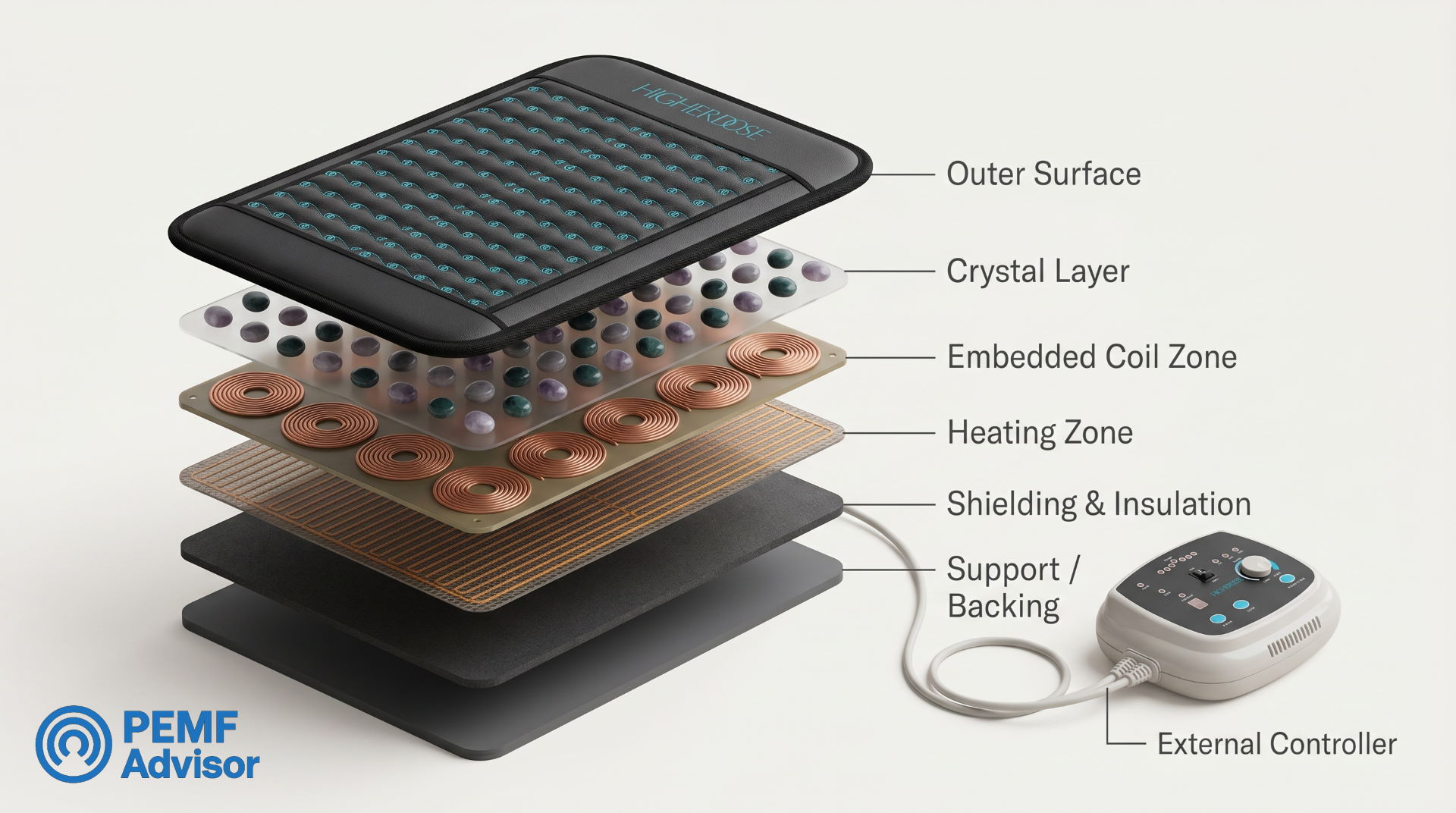
Surface materials: PU leather, top mesh, and crystal housing
The exterior shell is described as non-toxic, heat-resistant PU leather. Functionally, this is the part you touch and clean. It is built to handle body contact plus infrared heat cycles without breaking down quickly.
Above the shell – in the zone the user actually lies on – is a mesh or crystal-containing upper layer that houses embedded crystal material such as Amethyst and Tourmaline. This is a distinct zone from the outer shell. The shell is there to protect and enclose; the top mesh is there to hold the crystals in a fixed position under the user.
Internal stack: crystals, insulation, shielding, and support layers
The internal stack is best understood as stacked jobs rather than a list of buzzwords. Crystals are positioned in the upper housing. Insulation layers separate active components from the outer surfaces. Shielding layers, built with aluminum and/or copper, sit between the electronics and the user-facing side to support low-EMF positioning. Support layers stabilize the whole stack so embedded coils stay flat and uniform.
Public descriptions sometimes reference 17 layers and sometimes 21. Those numbers should be read as source or model-version variance rather than as proof of a specific performance tier. Layer counting is a marketing-language pattern that shifts between product generations and between third-party summaries.
Embedded electronics: PEMF coils, heating elements, and controller connection
The PEMF system is an embedded internal component array – the coils sit inside the stack, not on a detachable accessory. Under our metadata, coil count falls in the approximate 4–6 range and operating frequency lands in the approximate 0.5 Hz–30 Hz range. Heat is provided by far-infrared heating components that share internal space with the coil zone.
An external controller runs the whole thing. The controller is a separate hardware unit connected by cable, responsible for adjusting heat level and PEMF settings. That is a physical design choice, not a convenience claim.
Physical specs: dimensions, weight, and visible format
| Size and weight at a glance
Format: rectangular full-body floor mat. Dimensions: approximately 73 × 29 inches. Weight: approximately 30 pounds. Control layout: external controller connected by cable. |
Practically, that is full-adult length, narrower than a single bed, and heavier than any yoga mat or simple heated pad. Plan for a dedicated surface rather than frequent room-to-room movement.
How the mat’s physical design is organized
The mat combines two co-located active systems – heat and PEMF – inside one layered body, controlled from outside by a separate unit. The way those parts fit together shapes how flexible the mat feels, how much room it needs, and how far the control can sit from it.

Surface-to-core layout of the mat
Walking from the outside inward, the arrangement reads: PU leather shell → crystal mesh upper layer → embedded coil and heat zone → insulation and shielding layers → support backing. Multi-layer construction is what makes that sequence possible: crystals get a housing, electronics get separation, shielding gets a defined position, and support layers hold everything flat.
Coil placement and rigidity implications
| What embedded coils allow | What embedded coils trade off |
| A flat, uniform full-body surface.
Predictable coil positioning under the user. Shared internal space with heating elements. |
Less flexibility than a coil-free pad.
A firmer overall feel than plain fabric mats. Folding and rolling limits compared to soft mats. |
Exact firmness is not disclosed as a number. The practical takeaway is directional: a mat with embedded coils and roughly 30 pounds of mass will feel less pliable than a thin fabric pad, even if the top layer is soft to the touch.
External controller, cord length, and interface design
The controller is a physically separate box connected to the mat by cable. It is how the user sets heat level and PEMF parameters. Because it is external, the placement of the mat and the placement of the controller are linked: the controller needs to sit somewhere within cable reach, within easy hand-reach for the user during a session.
Treat this as a setup condition more than a feature. A separate controller adds a second item to store, a cable to manage, and a small footprint beside the mat during use.
Heat and PEMF components as separate but co-located systems
Heat and PEMF share the same product, but they are different systems. Heat comes from far-infrared heating elements. PEMF comes from the embedded coil array. Both are adjusted from the same external controller, which is why they are easy to confuse. For accurate interpretation, it helps to picture them as two neighbors inside one layered body, not as a single combined mechanism.
What the build changes for ownership and handling
A 30-pound, 73 × 29-inch layered mat with embedded electronics is a committed piece of home equipment. That shapes where it lives, how it gets moved, how it gets cleaned, and what counts as a useful accessory.
Portability and storage realities for a roughly 30 lb mat
Movable is not the same as lightweight. The mat can be rolled, relocated, and stored, but it is not a casual grab-and-go item. Plan for something closer to a large piece of home fitness gear than a travel mat.
- Think in terms of a dedicated home spot rather than daily relocation.
- Rolling it up is feasible, but two-handed and deliberate, not snappy.
- Storage needs a surface or corner roughly the size of a rolled-up yoga mat, but bulkier and heavier.
- Travel is possible with a bag, but it is not an everyday travel product.
Comfort vs rigidity trade-off
Embedded hardware and a multi-layer stack affect how soft and how flexible the mat feels. The surface can still read as padded, but the underlying structure is firmer than a plain fabric mat because coils and support layers resist bending. Readers who expect memory-foam-level softness should recalibrate: this is a structured therapy-format mat, not a cushion.
Cleaning and maintenance constraints for the top layer
Care is less about protocol and more about materials stewardship. The PU leather shell is built to handle wipe-down care; the crystal-containing upper layer is not.
- Wipe-down care is appropriate for PU leather surfaces the user routinely touches.
- Avoid soaking, flooding, or immersing any part of the mat.
- Treat the top mesh / crystal zone as sensitive: gentle contact only, no abrasive scrubbing.
- Let the mat air out after heated sessions before rolling and storing.
- Keep cleaning products away from the controller, cable, and any connector points.
Accessories, cover, and travel / logistics considerations
Covers, travel bags, and the controller hardware itself are less about hype and more about logistics. A cover protects the top layer during storage and reduces direct soil pickup. A travel or carry bag matters because the mat is heavy enough that loose transport is inconvenient. The controller and cable are part of the setup footprint and need a storage home of their own. Warranty and return-window considerations are worth reading in physical-handling terms: how the mat is packaged, moved, and returned matters more here than it does for small electronics.
What the materials and design do not prove
Build description is not the same as outcome evidence. The mat’s governance boundary is simple: material choices explain what is physically present, not what is therapeutically promised.
Why premium materials are not the same as medical outcomes
A PU leather shell, embedded crystals, and a visible layered stack all support the impression of a premium product. They do not, by themselves, translate into medical outcomes. Premium materials are interpretive cues about quality and handling – they sit upstream of any outcome claim and must stay there.
Why crystal and shielding language should stay descriptive
Shielding layers support low-EMF positioning, which is a reduction claim. Crystal language should stay at the level of materials that are present and housed – not outcomes such as measurable negative ion generation. Sources that treat crystals as active emitters are making a claim that is governance-restricted and low-stability under our constraints. The same care applies to any language that sounds like shielding eliminates rather than reduces EMF.
Why visible construction choices do not equal stronger therapeutic value
A more elaborate layer stack is not automatic proof of a stronger effect. More layers can mean better structural separation, better housing for embedded components, or more marketing surface area. None of those things is the same as stronger therapeutic value. When a description leans heavily on layer count as the main selling point, that is a cue to read the rest of the spec sheet, not a shortcut to a verdict.
How to read conflicting public claims about layers and EMF language
Two contradictions come up often enough to be worth resolving directly: the 17-layer vs 21-layer question, and the “no EMF” vs “low EMF” question. Both are better handled as claim-stability problems than as factual debates.
17-layer vs 21-layer references
You will see the mat described as a 17-layer design and, in other sources, as a 21-layer design. Without direct in-source corroboration, the cleanest read is that these numbers reflect model version variation or source variance – not a hidden contradiction that needs to be decided.
Layer counts are marketing-language artifacts. They can shift between product generations, between brand copy and affiliate copy, and between summary descriptions written at different times. Treat the count as a descriptive shorthand for multi-layer construction, not as a precision spec.
“No EMF” marketing vs “low EMF” technical disclosure
Low EMF is a reduction claim supported by shielding layers. “No EMF” is an elimination claim. These are different claim types, and they should not be treated as interchangeable regardless of how a given source phrases them. When shielding is doing its job, EMF is lower – not absent. Reading the difference precisely is the whole point of the distinction.
High-stability facts vs low-stability marketing claims
| Higher-stability (treat as reliable) | Lower-stability (treat as claim, not fact) |
| Dimensions (~73 × 29 inches).
Weight (~30 pounds). Non-toxic heat-resistant PU leather shell. External controller for heat and PEMF. Multi-layer construction with embedded coils. Coil count range (~4–6 coils). PEMF frequency range (~0.5 Hz–30 Hz). |
Exact negative ion counts from crystals.
Exact shielding thickness or attenuation figures. Strong interpretive claims about charcoal / clay layers. “No EMF” phrased as equivalent to low EMF. Layer-count precision (e.g., strict 17 vs 21). Claims that more layers prove stronger therapeutic value. |
The left column is where to anchor ownership decisions. The right column is where to stay neutral and observational.
Trust and corroboration for physical specifications
Different sources carry different weights for different parts of the spec sheet. A short hierarchy keeps interpretation honest.
Manufacturer-disclosed facts that are stable enough to use
Manufacturer-disclosed specs – dimensions, approximate weight, non-toxic PU leather, external controller presence, and multi-layer construction – are stable enough to use as-is. The PEMF coil count range and the 0.5 Hz–30 Hz operating range are treated as high-trust facts here. These are the anchors for any ownership-fit decision.
What affiliate and reviewer descriptions can clarify
Affiliate and reviewer descriptions are useful for ownership handling, comparison context, and common buyer questions – not for validating low-stability claims. A reviewer noticing that the mat feels firm, weighs a lot, or is awkward to fold is useful ownership information. A reviewer asserting negative ion output or detox effects is not, by itself, proof of those claims.
What regulators can and cannot confirm for this topic
Regulators can confirm certain device, disclosure, or registration categories where applicable. They do not confirm broad therapeutic or outcome claims for the material layers within this page’s scope. Regulatory presence is a procedural signal, not an efficacy endorsement.
FAQ
What materials are used in the HigherDOSE Infrared PEMF Pro Mat?
The mat uses a PU leather-style surface, crystal-containing upper layers, internal support, insulation, and shielding layers, and embedded active components including PEMF coils and heating elements.
What does the 17-layer design refer to?
It refers to the brand’s multi-layer construction language – stacked materials and embedded components described as a defined number of layers. Read it as a structural description, not as proof of outcomes.
Why do some sources mention 21 layers instead of 17?
Public layer-count language varies between sources and product versions. Unless directly corroborated, treat 21-layer references as source or version variance rather than a settled contradiction.
Is the HigherDOSE Pro Mat made with PU leather?
Yes. The surface is described as non-toxic, heat-resistant PU leather under this page’s stable physical facts.
What is the difference between the PU leather surface and the crystal mesh layer?
PU leather is the outer shell – the exterior you touch and clean. The crystal mesh layer is the upper zone that houses or covers embedded crystal material. They serve different physical roles and should not be conflated.
Which crystals are included in the mat?
Amethyst and Tourmaline are the crystal entities surfaced in the metadata for this product context.
Where are the PEMF coils placed inside the mat?
The PEMF coils are embedded within the internal layers of the mat rather than sitting as a separate external element.
Does the mat’s internal coil layout affect softness or flexibility?
Yes. Embedded hardware can influence feel and flexibility, so the mat is firmer and less pliable than a coil-free pad, even though exact firmness values are not disclosed.
How large and heavy is the HigherDOSE Pro Mat?
The mat measures approximately 73 × 29 inches and weighs about 30 pounds.
Does the mat use an external controller?
Yes. The mat uses a separate external controller to adjust heat and PEMF settings.
What does low EMF mean in this product context?
Low EMF refers to reduction-oriented positioning supported by shielding layers, not a blanket elimination claim.
Does low EMF mean the same thing as no EMF?
No. Low EMF is a reduction claim; no EMF is an elimination claim. Reduction and elimination are different claim types and should not be treated as interchangeable.
Do the material layers prove stronger therapeutic value?
No. Material layers and visible build choices do not, by themselves, prove stronger therapeutic value under this page’s constraints.
Are charcoal or clay layers evidence of detoxification?
Some sources claim charcoal or clay layers affect detoxification, but that interpretation is governance-restricted and low-stability here. These layers should be described as present materials, not as proof of detox effects.
How should buyers interpret negative ion claims for this mat?
Some sources claim crystal layers generate negative ions, but that claim is governance-restricted and low-stability here. Treat negative ion language as a marketing or observed claim rather than a settled physical performance fact.
Is the mat easy to move, store, or travel with?
The mat is movable but not especially lightweight. Ease of movement and travel depends on the buyer’s storage space and handling expectations for a roughly 30-pound device.
How should the top layer be cleaned without damaging embedded materials?
The visible PU leather surface supports wipe-down style care. Crystal-containing or mesh upper layers require more careful handling because of embedded materials, and should not be scrubbed or soaked.
What accessories affect ownership and setup?
Covers, travel bags, and controller hardware affect storage, transport, setup, and handling expectations. Treat them as ownership logistics rather than bonus features.

The PEMF Advisor Editorial Team reviews consumer PEMF mats and related wellness devices. Our work focuses on verified specifications, documentation, usability, materials, warranty/returns, and ownership considerations. We do not provide medical advice or evaluate health outcomes. See our Review Methodology and Editorial Standards.