Quick answer: A PEMF mat uses electricity from a controller to send repeating signals through internal coils, which creates a measurable magnetic field across the mat surface. These specs help a buyer compare field delivery and control behavior, but they do not by themselves prove health outcomes.
PEMF mats are marketed with a lot of technical-sounding language: frequency, Gauss, waveform, coil count, solenoids, inductive fields. Most of that language describes one simple chain: a controller powers internal coils, and those coils generate a pulsed electromagnetic field above the mat surface. This article explains that chain in plain terms so you can read a spec sheet with realistic expectations, without treating any of the numbers as proof of a health outcome.
PEMF Advisor publishes buyer-oriented reviews, comparisons, and educational content for home-use PEMF mats and devices. This page is a constrained mechanism explainer within that system: it focuses only on how PEMF mats work in plain buyer language, not on diagnosis, treatment guidance, protocol recommendations, or condition-based use claims.
If you want the broader category context around PEMF mats before focusing on mechanism, use our What PEMF Mats Are guide. That page explains PEMF mats as a product class, how they fit into the wider home-use category, and which product features and comparisons matter before you go deeper into how the device works.
What Changes vs. What Does Not Change When a PEMF Mat Runs
Before breaking down any spec, it helps to separate what physically happens when a PEMF mat is switched on from what does not happen. Most buyer confusion comes from mixing the two.
What changes
When the mat is powered and running, several things shift simultaneously:
- The controller sends a repeating electrical signal into the mat.
- Copper coils or solenoids inside the mat generate a changing magnetic field while current is flowing.
- Frequency (how often the signal repeats) can change based on the controller setting.
- Intensity can change depending on the model and the chosen program.
- Pulse timing cycles on and off in a repeating pattern, rather than staying fixed.
In other words, the signal is not static. It changes over time, which is the defining trait of a pulsed field.
What does not change
Other things stay the same no matter which mat you buy or how advanced the marketing language sounds:
- The basic physical chain is always controller plus coils plus a generated field. That is the whole mechanism.
- The term non-ionizing describes the signal type. It is a technical classification, not a claim about what the mat does for a person.
- The mat does not store a treatment effect. Once it is switched off, the field is gone.
- A running field, on its own, does not validate marketing claims. Measurable output is not the same thing as proven buying proof.
Core Distinction Table: Component, Spec, Buyer Meaning, and Limit
This table is the scan anchor for the rest of the article. Each row translates a component or spec into what it tells a buyer, and where that reading stops.
| Element | What it physically is | What a buyer can read into it | Where the reading stops |
| Controller | The powered unit that regulates the signal sent into the mat. | Indicates how much control you have over settings such as frequency and intensity. | Control range is a design choice, not outcome proof. |
| Copper coils / solenoids | Internal conductors that convert electrical current into a magnetic field. | Confirm that the mat actually generates a field rather than being a passive product. | Presence of coils does not say how the field is distributed. |
| Pulsed electromagnetic field | The measurable output above the mat surface when the system is running. | Can be verified with a Gauss meter at a specific point. | A reading at one point does not describe the full surface or distance profile. |
| Coil count | How many coils are built into the mat. | Hints at coverage potential across the mat area. | More coils do not automatically mean deeper or stronger delivery. |
| Coil layout | The geometric arrangement of coils inside the mat. | Affects the coverage pattern across the mat surface. | Layout interacts with intensity and distance; it is not a standalone quality score. |
| Signal type / waveform | The shape of the repeating pulse (for example square or sawtooth). | Tells you the signal pattern the mat uses. | Shape alone does not prove one mat works better than another. |
| Frequency | How often the pulse repeats, measured in Hertz. | Useful for comparing program ranges across models. | Higher or lower Hertz is not inherently better; it is a timing attribute. |
| Intensity / Gauss | Field strength at a specific measured point. | Gives a physical number you can compare if measurement conditions are similar. | Gauss drops with distance, and brands measure differently; raw numbers can mislead. |
| Material layers | Padding such as amethyst, tourmaline, or foam, sitting above the coil layer. | Affect comfort and positioning on the mat. | These layers are not the source of the field and do not replace the coil system. |
How the Controller, Coils, and Pulses Create Field Delivery
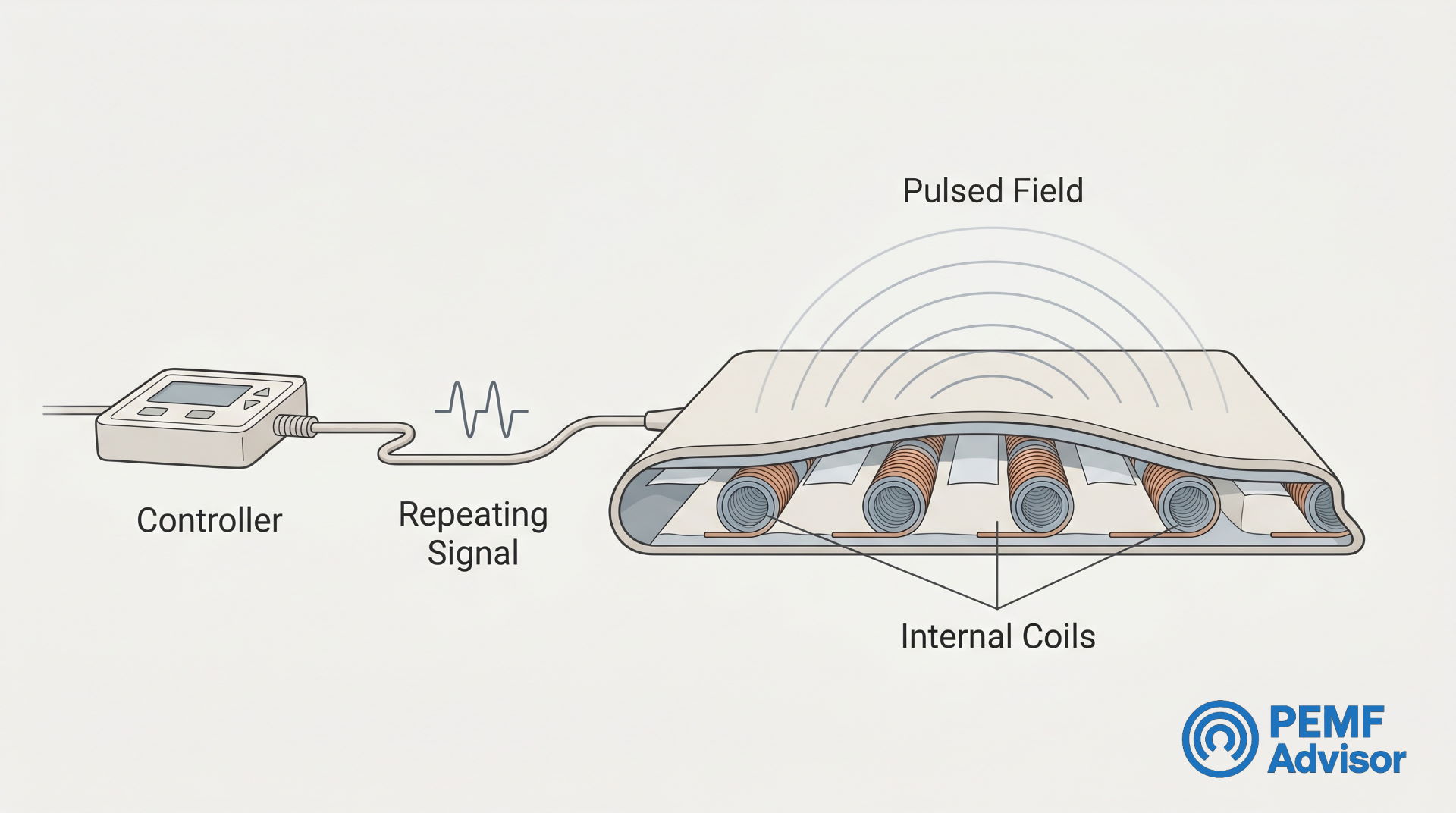
The mechanism of a PEMF mat sits in a short chain: power enters the controller, the controller sends a regulated electrical signal to copper coils or solenoids inside the mat, and current moving through those coils generates a changing magnetic field at the mat surface. That chain is the whole story. Everything else on a spec sheet describes a variable inside that chain.
A useful mental picture: think of the controller as the conductor setting the tempo, the coils as the instruments producing the sound, and the pulsed field as the sound filling the room. Turn off the controller and the room goes quiet; the instruments cannot play on their own.
The controller starts the process
The controller is the starting point of the system. It needs external power input to operate and does two jobs at once.
- It supplies the electrical signal that drives the coils.
- It regulates the settings that define that signal, which can include frequency and, on some models, intensity and program selection.
Some mats offer adjustable settings across a wide range, while others run on fixed programs with limited user control. That difference is a product-design choice and is worth comparing directly when reading spec sheets.
The coils turn electrical activity into a magnetic field
Copper coils, or solenoids built from coiled copper wire, are where the physics happens. When the controller pushes electrical current through them, a magnetic field forms around the coils. This is electromagnetic induction stated in its simplest form: current moving through a coil generates a surrounding magnetic field.
That induction is the physical basis for how every PEMF mat works, regardless of brand, price, or packaging. It is also where the explanation should stop. Understanding how the field is created tells you that the product produces a real, measurable output. It does not, on its own, tell you what that output does for a person. Material layers like amethyst or tourmaline sit above the coils and affect comfort or positioning; they are not the field generator.
What “pulsed” means in PEMF
The P in PEMF stands for pulsed. The signal is not a steady, unchanging field; it cycles on and off in a repeating pattern. Frequency describes how often that pattern repeats per second.
This is the clearest way PEMF mats differ from static magnetic products. A static magnet produces a fixed field with no power source and no pulse. A PEMF mat produces an actively generated, changing field that only exists while the system is powered and running. Those are two different categories of product, not two versions of the same idea.
How coil layout affects field delivery across the mat
Coil count and coil layout both differ by model. Coil count is how many coils are inside the mat; coil layout is how those coils are arranged. Layout matters because it shapes how the field is distributed across the mat surface.
A common marketing shortcut says more coils equal better delivery. That is not automatically true. A mat with more coils arranged poorly can deliver less useful coverage than a mat with fewer coils placed with intent. Coverage pattern and field depth are two different attributes, and neither is settled by the coil count alone.
Which Specs Buyers Are Actually Looking At
Most PEMF spec sheets list the same handful of numbers. This section walks through each one in plain buyer language and flags where interpretation should stop. Treat this as a glossary with judgment, not a ranking system.
Frequency range
Frequency is how often the pulse repeats per second, shown in Hertz (Hz). A lower frequency means the pulses repeat less often; a higher frequency means they repeat more often. Controllers with adjustable frequency let you step through that range.
It is tempting to treat higher Hz as more advanced or lower Hz as more gentle. Neither framing is accurate on its own. Frequency is a timing attribute. It tells you how the mat paces its signal, not whether the signal produces a specific result.
Intensity and Gauss
Intensity describes how strong the field is at a measured point, usually expressed in Gauss or microTesla. This number is a physical reading, not a summary of the mat’s quality.
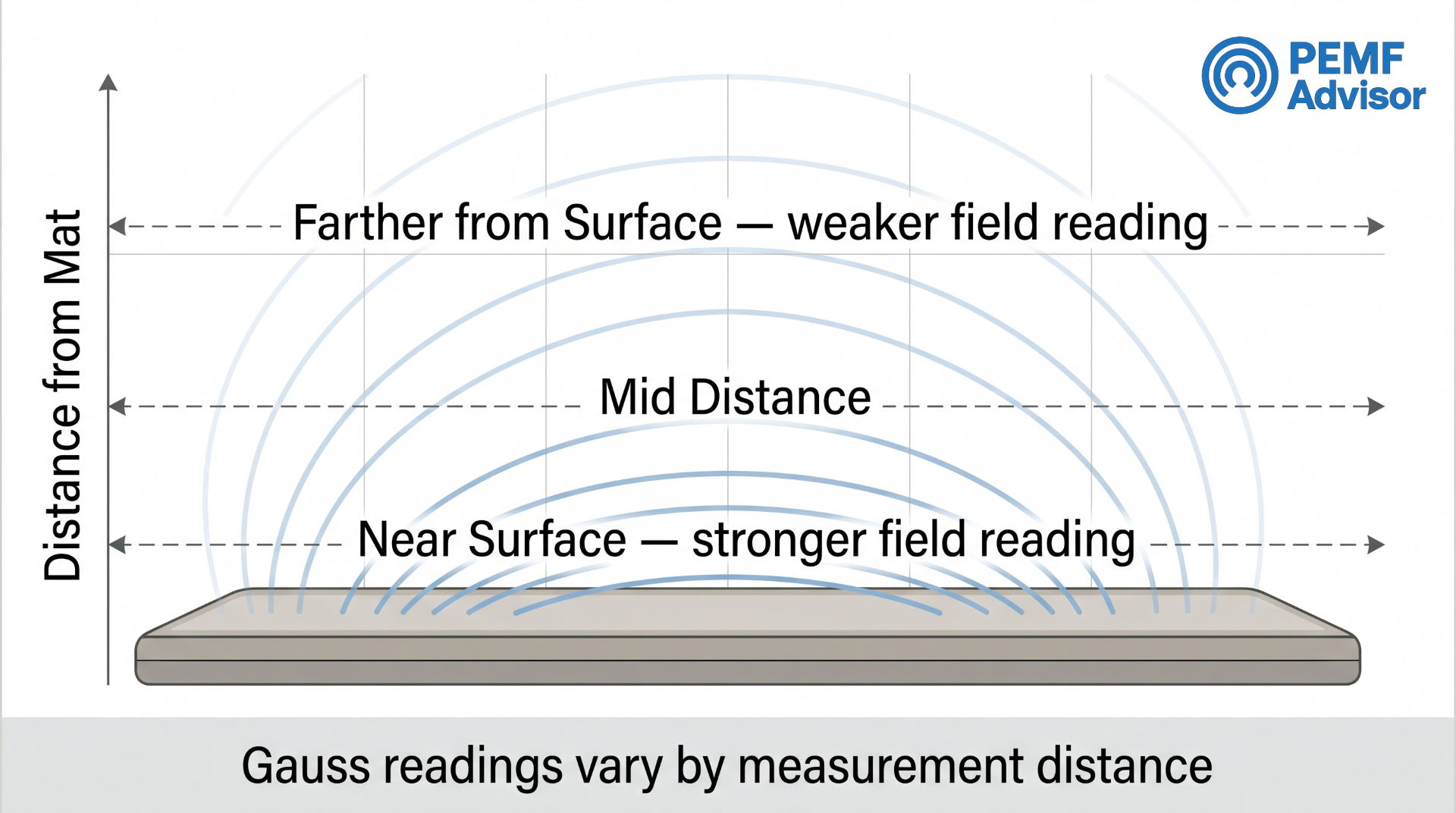
Two important realities shape how to read Gauss numbers:
- Field strength drops with distance. A reading taken right at the mat surface will be higher than a reading taken a few inches above it. Near-surface numbers are not a description of what happens further away.
- Measurement context is not standardized. Brands may measure at different distances, with different probes, and under different conditions. A higher Gauss number from one brand is not directly comparable to a lower number from another brand unless the measurement conditions match.
This is why intensity is best treated as a data point that has to be read with its context, not as a leaderboard position.
Waveform shape
Waveform is the shape of the pulse over time: square, sawtooth, sinusoidal, trapezoidal, and variations of these. It is a descriptive spec that tells you what pattern the signal follows. Different brands use different waveforms, and some brands present their chosen waveform as uniquely effective. Under the constraints of this page, those superiority claims are not treated as settled. Read waveform as a descriptor of signal design, not as buying proof.
Coil count and coil layout
Coil count and coil layout were introduced in the mechanism section. In spec sheet terms, both differ by model, and both interact. Coil count tells you how many coils exist. Coil layout tells you how they are distributed across the mat.
When comparing spec sheets, it is more useful to ask whether the layout supports the coverage you care about than to compare coil counts in isolation. Coverage pattern and field depth are shaped by the combination of layout, intensity, and measurement distance, not by any one of those numbers alone.
Signal controls and model variation
What varies most visibly between models is the controller and how it exposes settings. Signal type, frequency, intensity, and program options differ from brand to brand. Some controllers allow fine user adjustment; others run on fixed programs. That is a practical comparison point you can actually read from a spec sheet.
Model variation is a product-design difference. It tells you what the mat is capable of producing and how much control you have over it. It does not, on its own, prove that any given configuration will produce a specific outcome.
What the Mechanism Does Not Prove
Everything above explains how a PEMF mat produces a real, measurable field. That explanation is useful for product understanding and spec comparison. It is not a claim about therapeutic outcomes. Keeping that boundary visible is what makes the mechanism explanation trustworthy.
| The key boundary
Understanding induction explains how the mat works. It does not prove what the mat does for a person. Those are two different questions, and only the first one is answered by a mechanism explanation. |
Understanding induction is not the same as proving results
Electricity moving through coils creates a field. That statement describes physics, and physics supports product understanding and product comparison. It does not validate any particular therapeutic outcome. Citing the mechanism, or citing that research exists on PEMF, is not the same as demonstrating that a specific mat produces a specific result for a specific user. Treat these as separate jobs and the rest of the article holds together.
A measurable field is still only one part of product understanding
A Gauss meter can confirm that a mat produces a field, and at what strength at a specific point. That is a real measurement with real value for comparison. It is still only one slice of product understanding. A measurement does not describe the full surface profile, it does not account for distance dissipation, and it does not standardize across brands unless the measurement conditions match. A measurable field is evidence of a working product, not a substitute for buying proof.
Why “non-ionizing” belongs in the description, not as a selling shortcut
Non-ionizing is a technical classification of the signal type. It is accurate and appropriate as a descriptor of what kind of field the mat produces. It is not an effectiveness claim. Treating it as reassurance shorthand, or using it to imply that a mat must therefore do something beneficial, stretches the term past its actual meaning. Read non-ionizing the way you would read any other technical descriptor: useful for context, insufficient as a headline.
Limits, Contradictions, and Marketing Overreads
Some areas of PEMF marketing are less stable than others. This section classifies them so you can recognize them when you see them, without giving them the weight of settled buying proof.
Field strength drops with distance from the mat surface
Field delivery is limited by how far you are from the coils. Strength is highest near the mat surface and drops off with distance. This is standard physics, not a flaw of any particular product. It does mean near-surface Gauss readings should not be generalized to describe what happens further from the mat. When a brand quotes a strong Gauss number, the question that follows is always: measured where?
Waveform superiority claims remain unsettled
Some brands build their positioning around a specific waveform, presenting square, sawtooth, or proprietary shapes as uniquely effective. Under the constraints of this page, those superiority claims are not treated as resolved. Waveform is a real spec; framing any one shape as the proven best waveform is a marketing position, not a settled fact.
Coil material claims can outrun practical buyer value
Most PEMF mats use copper coils or copper solenoids. Some brands describe specialized alloys, nano-materials, or exotic coil constructions. Those descriptions may be accurate, but they often do not clearly change what a buyer can actually read from a spec sheet. The controller, the layout, and the intensity-at-distance behavior usually tell you more about what the mat does than the coil material does.
“Clinical” vs. “home-use” power framing should be read carefully
Distinctions between clinical-grade and home-use power levels are often interpreted more confidently than they should be. Under the constraints of this page, this is treated as a volatile comparison area. Higher power is a spec difference; it is not a shortcut to an expected result, and the labels brands use around it are not standardized.
Observed claims to classify, not trust
Across PEMF marketing and adjacent content, some claims appear often enough to be worth naming, but they do not belong inside the mechanism explanation. Classify them as observations, not facts:
- Some sources claim that PEMF recharges human cells like a battery. Under the constraints of this page, this is treated as a low-stability, governance-restricted claim, not as part of the mechanism.
- Some sources claim that a PEMF mat heals chronic pain instantly. Under the constraints of this page, this is treated as a low-stability, governance-restricted claim.
- Some sources claim that PEMF mechanisms align with the Earth’s heartbeat or Schumann resonance. Under the constraints of this page, this is treated as a low-stability, governance-restricted claim.
These statements belong in the overread category, separate from the controller-coils-field explanation above.
FAQ
A short set of residual questions that often come up after the main explanation is clear.
What does PEMF stand for?
PEMF stands for Pulsed Electromagnetic Field. “Pulsed” refers to the fact that the signal repeats in a pattern over time rather than staying static.
What does the controller do on a PEMF mat?
The controller requires external power input, regulates settings such as frequency and, on some models, intensity, and sends the electrical signal into the coils inside the mat.
What do copper coils do inside a PEMF mat?
Copper coils, or solenoids, convert the electrical current from the controller into a magnetic field. They are the part of the mat that enables field delivery.
What does frequency mean on a PEMF mat?
Frequency describes how often the pulse repeats per second, measured in Hertz. It is a timing attribute of the signal, not a quality score.
What does Gauss mean on a PEMF mat?
Gauss refers to magnetic field strength at a specific measured point. The reading only makes sense with measurement context, including distance from the mat surface and the measurement conditions used.
Does a higher coil count mean a better PEMF mat?
No. Coil count differs by model, but more coils do not automatically mean deeper or better field delivery. Coil layout and measurement context matter as well.
Does waveform shape prove one PEMF mat works better than another?
No. Waveform varies by brand and describes the shape of the signal. Under the constraints of this page, waveform alone is not treated as proof that one mat works better than another.
Are PEMF mats the same as static magnetic mats?
No. PEMF mats use powered, repeating signals to actively generate a field. Static magnetic mats are passive products and do not operate the same way.
Is the field from a PEMF mat measurable?
Yes. The field is a real, measurable physical output, and it can be checked with a Gauss meter. A measurement confirms the field exists; it does not guarantee a specific result for a person.
Does understanding how a PEMF mat works prove what results it will produce?
No. Understanding the mechanism supports product understanding and comparison. It does not prove outcomes. Mechanism explanation and outcome proof are two different jobs.
Why does field strength matter more near the mat surface?
Field delivery is limited by distance. Strength is greatest near the coils and drops as distance from the mat surface increases, which is why near-surface and far-from-surface readings are not interchangeable.

The PEMF Advisor Editorial Team reviews consumer PEMF mats and related wellness devices. Our work focuses on verified specifications, documentation, usability, materials, warranty/returns, and ownership considerations. We do not provide medical advice or evaluate health outcomes. See our Review Methodology and Editorial Standards.