PEMF mats differ from other wellness mats because they use a powered electromagnetic system with internal coils and a controller that manages technical settings such as frequency and intensity. Infrared, heated, and gemstone mats may appear in the same product stack, but they follow different operating logic, and those differences help buyers compare design and function rather than prove health superiority.
Wellness mat product pages often blur categories together, listing infrared, PEMF, gemstone layers, and heat settings as if they were the same thing. They are not. Each category runs on a different operating mechanism, and the fastest way to cut through the confusion is to compare mats by how they actually work before looking at anything else. This article walks through those mechanism-level differences in buyer language, shows where the categories overlap, and points out where marketing language becomes unreliable.
PEMF Advisor publishes buyer-oriented reviews, comparisons, and educational content for home-use PEMF mats and devices. This page is a constrained category-comparison explainer within that system: it focuses only on how PEMF mats differ from other wellness mats in practical buyer language, not on diagnosis, treatment guidance, protocol recommendations, or condition-based product matching.
If you want the broader category context before comparing PEMF mats with adjacent wellness products, use our What PEMF Mats Are guide. That page explains PEMF mats as a product class, how they work in buyer language, and which core features matter before you start separating PEMF mats from infrared, heated, and other wellness mat types.
How PEMF mats differ from other wellness mats at a glance
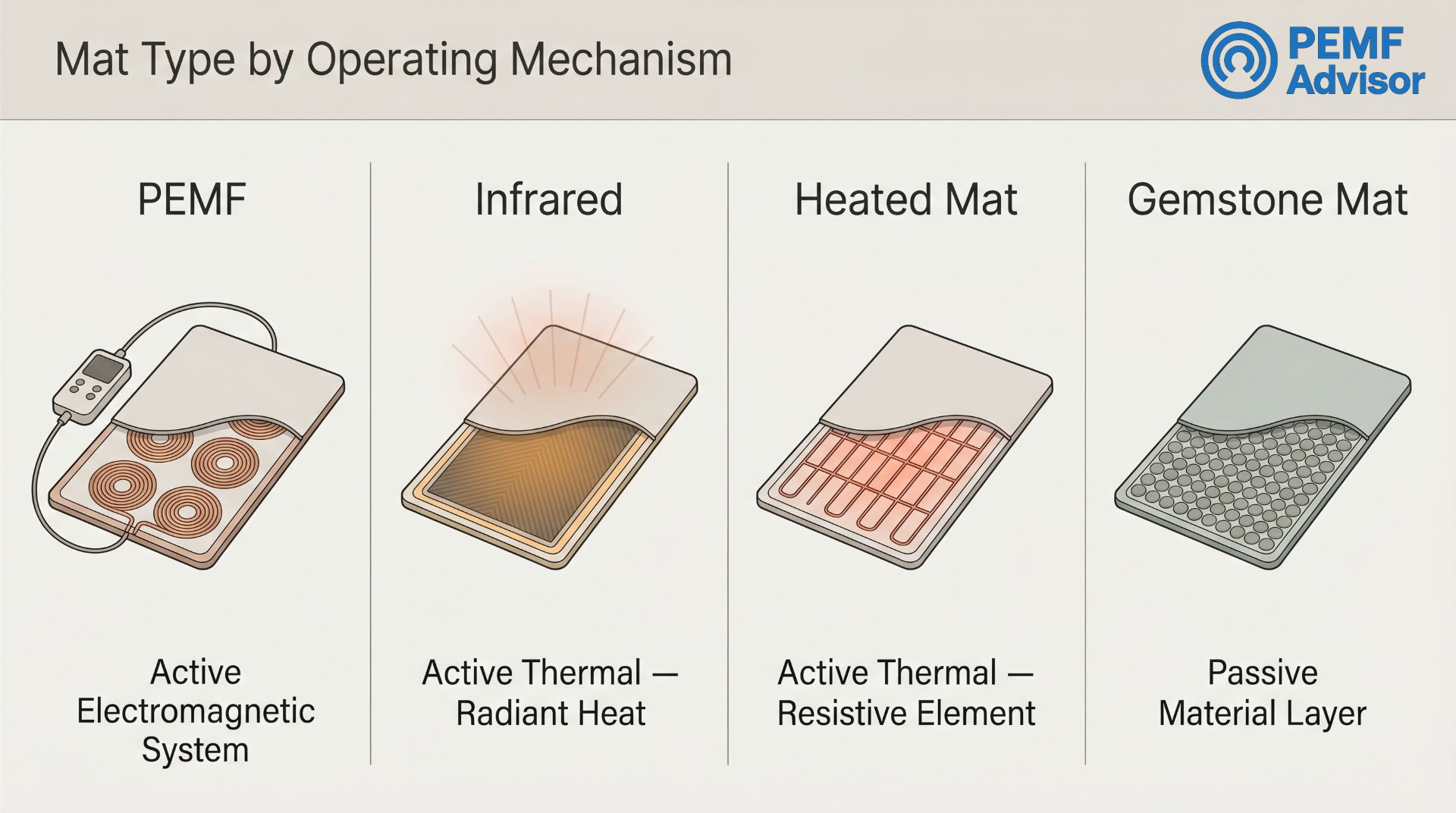
The cleanest way to separate PEMF mats from infrared, heated, and gemstone mats is to ask one question first: what is the primary mechanism doing? A PEMF mat generates a pulsed electromagnetic field through internal copper coils, driven by a controller that sets frequency and intensity. Heat, if present, is secondary. Other wellness mats are usually built around heat, light, or material layering instead.
Comparing wellness mats by bundled features (how many “modes” they list, whether they include stones, whether they glow red) tends to collapse real differences into one therapeutic story. Comparing them by operating logic keeps the categories separate, which is what a buyer actually needs when deciding what the product is.
| Key distinction
PEMF mats are active systems: they generate a field using powered hardware. Infrared, heated, and gemstone mats typically rely on heat, light, or passive material layers. A mechanism difference is a design difference, not a health-outcome claim. |
The shortest buyer-level distinction
In one line: PEMF mats use a powered electromagnetic system; the other mats do not. Infrared mats work through thermal radiation from heating elements. Heated mats use resistive or direct heat. Gemstone mats are defined by their material stack, usually stones embedded under a fabric surface. If a buyer only has time for one distinction, this is the one that matters, because it determines what kind of product is actually in front of them.
What changes across categories and what does not
All four product types share a mat-like form factor. That shared shape is a large part of why buyers get confused. What changes across categories is the control architecture, the power requirement for the primary function, and whether the defining mechanism is active or passive.
- Power source: PEMF, infrared, and heated mats all plug in, but they use that power for very different purposes. Gemstone layers alone do not require power.
- Control architecture: PEMF mats typically rely on a programmable controller for frequency and intensity; heat-led mats usually offer simpler on/off or temperature dials.
- Format range: Portable pads and professional-format mats exist in several categories, but the reason for the size and complexity differs by mechanism.
Sharing a shape does not make the mechanisms equivalent. This is the quiet trap in most wellness mat comparisons.
Why different operating logic does not prove better outcomes
A different mechanism is not a better mechanism. Some sources claim wellness mats reduce inflammation, improve circulation, support cellular repair, or aid detoxification. These are governance-restricted or low-stability claims under the framing used here, and this article does not evaluate them. The point of mechanism comparison is to let a buyer see what a product is, not to rank categories on clinical grounds. The design distinctions below are design distinctions only.
A comparison table of PEMF, infrared, gemstone, and heated mats
The table below compares the four categories by the dimensions that actually change across them: primary operating mechanism, main internal component, whether an active electromagnetic field is generated, and the typical buyer-confusion point for that category. It is deliberately technical. Outcome claims, symptom claims, and “best for” columns are excluded because they would change the job of the table.
| Mat type | Primary mechanism | Key component | Active field generation | Common confusion point |
| PEMF mat | Pulsed electromagnetic field | Copper induction coils + controller | Yes (core function) | Often bundled with infrared, heat, or gemstones |
| Infrared mat | Thermal radiation (far-infrared) | Infrared emitters / heating film | No (thermal, not electromagnetic pulse) | Sometimes sold as “PEMF-style” when both layers are present |
| Gemstone mat | Passive material stack | Amethyst, jade, or tourmaline layer | No (material layer only) | Gemstone presence mistaken for active output |
| Heated mat / thermal pad | Resistive or direct heat | Heating element + simple thermostat | No (heat only) | Heat setting mistaken for a PEMF feature |
What this table does: it separates categories by mechanism and primary hardware. What it does not do: it does not rank them by effectiveness, recommend one over another, or imply that bundled products are better or worse than single-mechanism products.
Core comparison attributes for fast scanning
Reading the table is easier if each column is anchored to a question a buyer can actually answer from a product page.
- Primary mechanism answers what the product is fundamentally doing. PEMF is an electromagnetic pulse, infrared is heat radiation, heated mats are resistive heat, gemstone mats are material layers.
- Key component answers how it is doing it. Copper coils and a controller for PEMF; emitters or heating film for infrared; a heating element for heated mats; stones for gemstone mats.
- Active field generation answers whether there is a powered output beyond heat or light. Only PEMF clears this bar as its core function.
- Confusion point answers where the marketing language is most likely to mislead scanning.
Specifications such as Hz (frequency) and Gauss (intensity) sit below this column structure and are most meaningful for the PEMF category specifically. They function as descriptive evidence fields, not outcome proof.
Where the most common category confusion starts
Category confusion usually starts when one product contains more than one technology layer. A mat can hold a copper coil array, an infrared emitter, and a tourmaline surface layer at the same time. The product listing may emphasize whichever feature is most marketable on that channel, which scrambles the category signal for a scanning buyer.
The cleanest way to hold the categories apart is to separate the primary mechanism from bundled features. An infrared layer inside a PEMF mat does not make infrared the parent category; it is an adjacent mechanism inside the same product. A tourmaline layer does not automatically establish active field generation; it is a material-stack component. A heat setting does not turn a device into a PEMF mat; it is a secondary feature. The presence of a thing is not the same as the thing being the primary mechanism.
What counts as an active system versus a passive or heat-led stack
An active system generates its defining output using powered hardware. A PEMF mat is active because it requires electrical current flowing through internal coils to produce a pulsed electromagnetic field. Without power, the field does not exist.
Infrared and heated mats also need power, but what they generate is thermal energy, not an electromagnetic pulse. Gemstone mats, in their pure form, are passive: they are material layers that do not generate anything by themselves, although many commercial products combine gemstone layers with heat so the stones warm up. Knowing whether a mat is active in the electromagnetic sense, heat-led, or purely passive is the single cleanest way to cut through bundled product marketing.
| Category | Requires power? | What the power produces | System type |
| PEMF mat | Yes | Pulsed electromagnetic field | Active (electromagnetic) |
| Infrared mat | Yes | Far-infrared thermal radiation | Active (thermal) |
| Heated mat | Yes | Resistive / direct heat | Active (thermal) |
| Gemstone mat (pure) | Often no (heat optional) | Material layer only; heat if bundled | Passive or heat-led |
The operating mechanism that makes a PEMF mat distinct
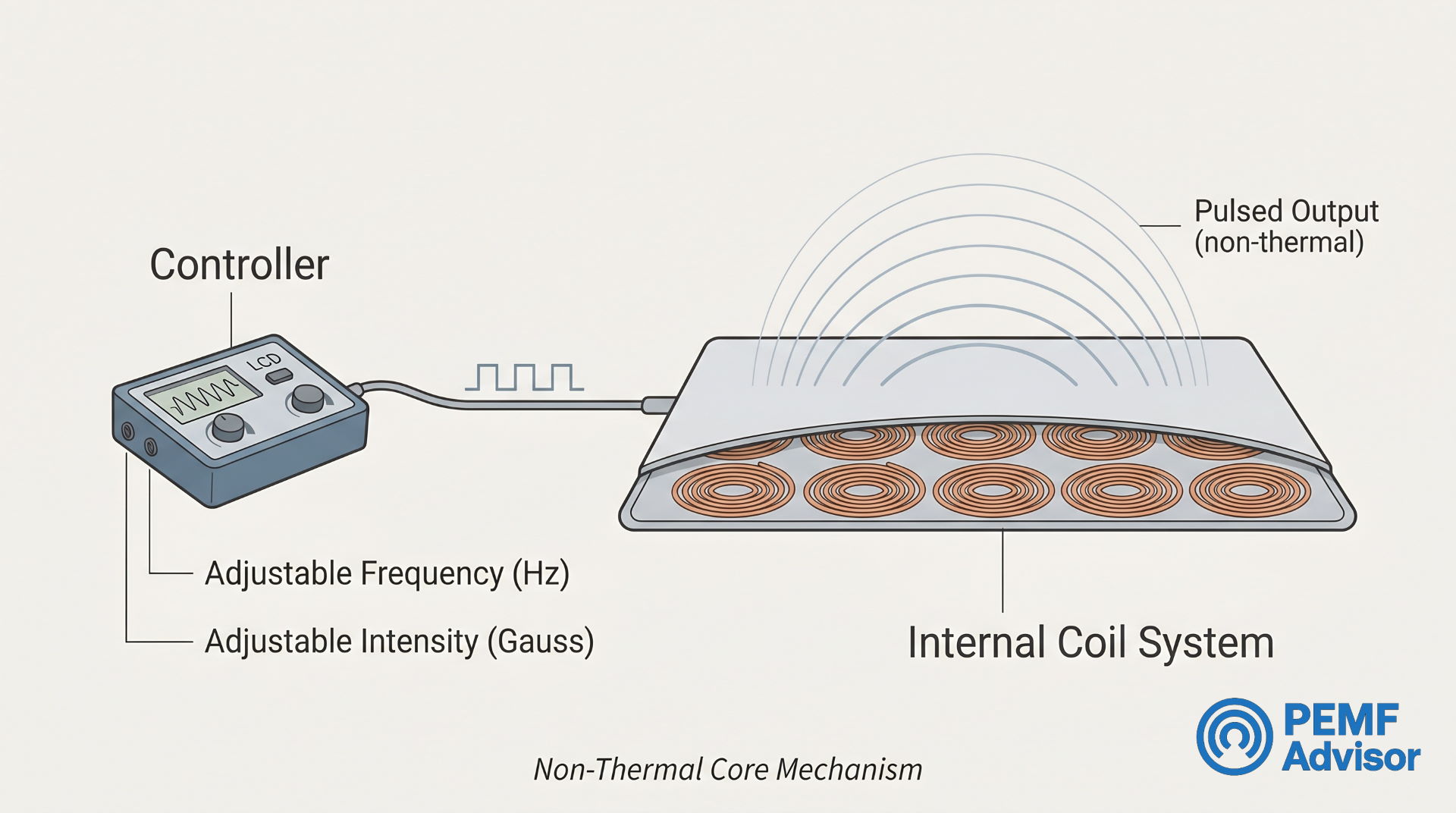
A PEMF mat is distinct because of three architectural facts: it contains internal copper coils, it uses a controller to shape the signal, and the coils and controller together produce a field whose frequency (Hz) and intensity (Gauss) can be described in numerical terms. The mat does not rely on heat to do its primary job. That combination is what separates it from every other category on the list.
Powered field generation and induction coils
At the hardware level, a PEMF mat is built around an array of copper induction coils sewn or embedded into the mat material. When electrical current passes through those coils, the coils generate a pulsed electromagnetic field across the surface. This is the active mechanism. Remove the coils, or remove the current, and there is no field.
This is different from a heating pad, where the current heats a wire, or from an infrared mat, where the current drives an emitter that radiates warmth. The coils in a PEMF mat are not primarily there to warm the user; they are there to produce the field. Coil design (copper quality, coil count, layout) determines how evenly the field spreads across the mat, which is a real engineering variable rather than a marketing detail.
Frequency controller dependence and adjustable settings
The second defining piece is the controller. A PEMF mat typically ships with an external control unit that sets how many times per second the field pulses (frequency, in Hz) and how strong each pulse is (intensity, often expressed in Gauss). On higher-end systems, the controller may also handle programs, timers, and separate channels. On simpler systems, the controller may hold only a preset frequency and a handful of levels.
The controller matters because it is often what distinguishes a PEMF mat from a mat that merely includes a copper layer. A heated mat has a thermostat. A PEMF mat has a controller that shapes a signal. Controller presence and programmability are one of the clearest category-defining signals on a product page. If a product labeled “PEMF” has only an on/off switch and a heat dial, that is a reasonable moment to look more carefully at what the device is actually doing.
Hz and Gauss as technical descriptors
Hz and Gauss are the two numerical descriptors that show up most often on PEMF product pages. Hz describes how often the field pulses per second. Gauss describes how strong each pulse is. They are useful as comparison fields because they describe the device itself rather than its marketing story.
| Spec | What it means | How to read it |
| Hz (frequency) | Pulses per second of the electromagnetic field | A technical descriptor. More Hz is not automatically “better”; it is a different pulse pattern. |
| Gauss (intensity) | Magnetic flux density of each pulse | A technical descriptor. Labels like “high” and “low” are not standardized across brands. |
Treat these numbers as evidence fields on the product, not as outcome proof. They describe what the hardware is doing, which is useful for comparing one PEMF mat to another. They do not, by themselves, say anything about what a given setting is supposed to achieve.
Why PEMF is non-thermal by core mechanism
The core mechanism of a PEMF mat is electromagnetic, not thermal. The field does not need to warm the user in order to do its primary job. Many PEMF mats do include a heat layer, because heat is a comfortable and marketable add-on, but the heat is separate from the PEMF function and is typically controlled separately.
This is the boundary that makes infrared and heated mats adjacent comparison contexts rather than parent categories. Infrared and heated mats are built around thermal output. PEMF is not. Once that separation is clear, bundled products become easier to read: the PEMF function runs on one mechanism, the heat function runs on another, and they can coexist inside the same mat without collapsing into a single category.
Concreteness aid: a simple “controller plus coil” mental model
A workable mental model for a PEMF mat is: controller plus coil. The controller is the brain, the coil array is the output hardware. The controller tells the coils how often to pulse and how strongly. The coils produce the field. Neither piece works without the other. Comparing any PEMF mat to another, or to a non-PEMF mat, comes down to what those two pieces look like and whether they exist at all.
Why infrared, gemstone, and heat features are often bundled with PEMF
Most wellness mats sold as “PEMF” today are actually multi-layer products. Infrared heating elements, gemstone layers, and thermal pads frequently appear in the same mat as the PEMF coil array. There are design and marketing reasons for this, and sorting them out prevents buyers from treating a stacked product as if it had one merged mechanism.
Infrared as adjacent mechanism, not the definition of PEMF
Infrared is its own mechanism: thermal radiation from a heating element, typically in the far-infrared range. It warms the body by emitting heat. Some PEMF mats include an infrared layer to make the surface comfortably warm during use, which is a legitimate design choice. What it is not is a definition of PEMF. A mat can have an infrared layer without producing a pulsed electromagnetic field, and a mat can produce a pulsed field without any infrared at all. Infrared sits next to PEMF in product design; it does not replace it or define it.
Gemstone layers as material-stack components, not field generation
Gemstone layers are material-stack components. Amethyst, jade, and tourmaline are the most common stones used, placed as a layer between the coils and the surface fabric. They change the feel and the material composition of the mat, and when the mat is heated, they retain and radiate warmth.
Some sources claim that specific gemstones create synergy effects with PEMF or infrared. These are low-stability claims under the framing used here. What can be said with confidence is narrower: gemstones are a material layer. They do not, by their presence alone, establish active field generation. A gemstone mat without coils and a controller is not a PEMF mat, regardless of stone type.
Heat as a secondary feature versus the primary mechanism
Heat inside a wellness mat comes from a heating element: typically a resistive wire or carbon fiber layer that warms when current passes through it. In a pure heated mat, that heating element is the product. In a PEMF mat with a heat layer, the heating element is an add-on, separate from the coil system, usually with its own controls. The presence of heat does not redefine the category; heat is additive, not category-defining.
| Feature in a bundled mat | Category role | Defines the primary mechanism? |
| PEMF coils + controller | Active electromagnetic system | Yes (for PEMF mats) |
| Infrared heating layer | Thermal add-on | No |
| Gemstone / crystal layer | Material-stack component | No |
| Heating pad / thermal element | Secondary heat feature | No |
The feature-stack problem in product marketing
The feature-stack problem is what happens when a product listing combines PEMF, infrared, gemstone, heat, red light, and negative-ion layers into a single “5-in-1” or “7-in-1” wellness narrative. Each layer becomes one of the “benefits,” and the distinct mechanisms collapse into one therapeutic story. This is low-stability framing. It obscures which mechanism is doing what, and it puts marketing claims ahead of technical specifications.
The evidence-first way to read such a product is to decompose the stack: which layer is the PEMF system, is there a controller, is the Hz and Gauss information available, which layers are purely thermal or material, and which “benefits” are being claimed from which mechanism. Specifications travel better than bundled narratives because they describe the hardware directly.
The main buyer decision filters when comparing mat types
Turning the mechanism comparison into something actionable means setting a short list of filters in priority order. The filters below are not recommendations about which category to buy; they are about how to read the product clearly before deciding anything.
What buyers should compare first: mechanism, controller, and evidence fields
The highest-signal filters come first. They are the ones most resistant to marketing language, because they describe the device itself.
- Primary mechanism: What is the device fundamentally doing? PEMF, thermal radiation, resistive heat, or a passive material layer?
- Controller presence and type: Is there a programmable controller with frequency and intensity settings, or is it an on/off or thermostat-only device?
- Evidence fields: Are Hz and Gauss (or equivalent technical specs) listed for the PEMF function? Are they listed for the whole mat, or only for the coil system?
- Mechanism separation: Are the primary mechanism and the secondary features (heat, light, stones) described and controlled separately, or blended into one “mode”?
Secondary filters: materials, dimensions, flexibility, portability, format
Once the mechanism layer is clear, a second set of filters refines the choice. These matter but do not define the category.
- Material stack: Which layers are present (gemstone type, infrared film, heating element, charcoal, fabric), and in what order?
- Dimensions and flexibility: Full-body mats are usually stiffer because of the coil protection layers; pad-sized devices are more portable but cover less area.
- Portability: Foldable, rollable, or fixed. Control unit size and cable layout affect this as much as the mat itself.
- Format: Home-use versus professional-grade systems sit in different parts of the intensity and control-complexity range.
Professional-format versus home-format differences
Professional-format PEMF systems typically offer wider intensity ranges, more programmable controllers, and hardware sized for clinic use. Home-format mats are usually built around preset programs, a narrower intensity range, and simpler interfaces. Neither format is inherently better; they are built for different use contexts, and the complexity difference is a setup and ownership consideration, not an outcome claim.
Ownership and setup complexity without verdict framing
Mats that plug in need an outlet. Programmable controllers need a surface and a cable route. Larger mats need flat, stable storage. Multi-layer mats add cleaning and wear considerations. None of this favors one category over another; it simply affects whether the device fits comfortably into a given space and routine. These are neutral buyer-support factors, not verdicts.
Constraints, limits, and non-equivalence in wellness mat comparisons
The comparisons above are design comparisons. They stop there for a reason. Several kinds of claims that appear in wellness mat marketing do not travel well past the mechanism layer, and the boundaries below are where this article deliberately does not go.
Why operating differences do not justify superiority language
Different operating logic does not establish clinical superiority. A PEMF mat is functionally distinct from an infrared mat or a heated mat; that is a description, not a ranking. Health-outcome comparisons between these categories are governance-restricted under the framing used here, and this page does not make them. The appropriate language for a mechanism difference is “functionally distinct” or “different operating logic,” not “more effective,” “healing,” or “better for” a specific condition. This article is not a replacement for professional evaluation.
Intensity-label ambiguity: “high” and “low” are not stable standards
Intensity labels on PEMF mats are not standardized across the category. One brand’s “high intensity” may sit at a Gauss value another brand would call “medium,” and some product pages describe intensity qualitatively without listing numbers at all. Even when Gauss values are published, the measurement point on the mat (surface, a few inches above, center versus edge) is not consistently reported. The practical effect is that “high” and “low” intensity are unstable category standards and should be read as marketing descriptors unless the underlying spec is given and comparable.
Regulatory and source-context interpretation
Information about wellness mats comes from several source classes, and each one shapes how the claims should be read.
- Manufacturer sources describe their own product. Technical specifications tend to be accurate; benefit claims tend to be promotional.
- Regulator context (FDA, FCC) applies to device classification and electrical safety, not to wellness benefit claims. A device being FCC-compliant is a safety signal, not a therapeutic endorsement.
- Affiliate and review sources often combine product description with recommendation language; the recommendation layer is typically not independent of the commercial relationship.
Reading source class along with the content of the claim is the cleanest way to calibrate trust without treating this article as a regulatory or medical source itself.
Where marketing claims become unstable or low-trust
Several recurring claims in the wellness mat market sit in the low-trust zone under the framing used here: that specific gemstone combinations create synergy effects with PEMF or infrared; that “5-in-1” bundles deliver a unified therapeutic outcome rather than several adjacent mechanisms; that PEMF affects cellular repair in a predictable consumer-grade way; that infrared mats meaningfully detoxify the body. These are either governance-restricted or low-stability claims. The evidence-first alternative is narrower and more useful: compare products by mechanism, component, specification, and controller, and treat benefit claims as marketing language that needs its own separate verification.
Not a replacement for professional evaluation
This article is buyer-support comparison content. It does not provide diagnosis or treatment guidance. Electronic interference with pacemakers, defibrillators, implanted devices, and similar equipment is a restricted caution context that should be handled with a qualified professional, not with a self-assessment from a product description. For any condition-specific question, the appropriate step is a conversation with a healthcare provider, not a purchase decision based on mechanism comparison alone.
FAQ
Is a PEMF mat the same thing as an infrared mat?
No. PEMF mats generate a pulsed electromagnetic field through copper coils and a controller; infrared mats produce thermal radiation from a heating element. A mat can contain both layers, but sharing a form factor does not make the mechanisms the same.
Can a wellness mat be both PEMF and infrared?
Yes, many are. A multi-layer mat can include a PEMF coil array and an infrared heating layer inside the same product. The two mechanisms run in parallel and are usually controlled separately. When comparing such a mat, the primary mechanism and the secondary features should still be identified distinctly rather than treated as one merged system.
Are gemstone mats automatically PEMF mats?
No. Gemstone presence describes the material stack of the mat. It does not, by itself, establish active electromagnetic field generation. A PEMF mat needs coils and a controller. A gemstone layer added to those components is a feature of the mat; a gemstone layer without them is not PEMF, whatever the stone type.
Why do PEMF mats list Hz and Gauss while many other mats do not?
Because Hz and Gauss describe the electromagnetic signal the coils produce. Infrared, heated, and pure gemstone mats do not generate that signal, so those descriptors do not apply to them. Treat the Hz and Gauss on a PEMF product page as technical descriptors of the device, not as proof of a specific outcome.
Does heat make a mat a PEMF mat?
No. Heat is produced by a heating element and can appear as a secondary feature in many mat types. Heated mats differ from PEMF mats because their primary mechanism is thermal, not electromagnetic. A PEMF mat may include heat, but heat alone does not define PEMF.
What is the difference between an active and passive mat system?
An active system generates its defining output through powered hardware; a PEMF mat is active in the electromagnetic sense, and infrared and heated mats are active in the thermal sense. A passive or heat-led stack relies on material layers or simpler heat functions instead of powered generation of an electromagnetic field. Pure gemstone mats are typically passive, even when they include a basic heat setting.
Are bundled “5-in-1” wellness mats one mechanism or several?
Several. A bundled mat usually combines distinct layers: a PEMF coil array, an infrared heating layer, a gemstone layer, and sometimes red or near-infrared light. The “5-in-1” framing presents them as one unified therapeutic output, which is low-stability under the framing used here. The more evidence-first reading is to identify the primary mechanism and list the secondary features separately.
Does a different mechanism prove one mat type is better for health outcomes?
No. A different mechanism is a design difference. Health-outcome comparisons between PEMF, infrared, heated, and gemstone mats are governance-restricted under the framing used here. This article is buyer-support comparison content, not condition-led guidance.
Why is intensity hard to compare across PEMF mats?
Because “high” and “low” intensity labels are not standardized across brands, and Gauss values, when listed, may be measured differently or at different points on the mat. Specification-level comparison is possible, but brand-to-brand intensity language should be treated cautiously rather than taken as a universal scale.
What should a buyer verify before comparing wellness mats?
A short verification pass is usually enough: identify the primary mechanism, confirm whether a controller is present and what it does, check whether Hz and Gauss are listed for any PEMF function, and distinguish the active output from material layers and secondary heat features. That sequence keeps the comparison anchored to the device itself rather than to bundled marketing language.

The PEMF Advisor Editorial Team reviews consumer PEMF mats and related wellness devices. Our work focuses on verified specifications, documentation, usability, materials, warranty/returns, and ownership considerations. We do not provide medical advice or evaluate health outcomes. See our Review Methodology and Editorial Standards.