Quick answer: PEMF Advisor covers safety, regulatory, and medical-boundary content in buyer language, not in treatment language. That means we explain how products describe precautions, labels, and limitations, how regulatory wording should be read, and where product discussion must stop before it turns into diagnosis, protocol advice, or health-outcome claims.
PEMF products live in a category where product evaluation and health-adjacent language often sit too close together. A product page may describe specifications, controls, and warranties, then move quickly into safety reassurance, treatment implication, or regulatory language that sounds more authoritative than it is. This page explains how PEMF Advisor handles that territory, what we are willing to cover, and why the boundaries matter.
What this page is for
This page exists to make our handling of safety, regulatory, and medical-boundary content visible.
PEMF Advisor is a buyer-oriented review and comparison publisher for home-use PEMF products. That means we discuss product information, ownership considerations, feature interpretation, policy terms, and descriptive safety or regulatory issues when they help a buyer understand what they are looking at.
It does not mean we act as a medical authority.
We do not use this site to diagnose conditions, recommend treatment use, create clinical protocols, or tell readers whether a PEMF product is appropriate for a medical need. That boundary is part of how the site stays readable, trustworthy, and stable in a health-adjacent category.
The shortest version of our approach
We handle this area through three separate layers:
- descriptive safety content
- regulatory and administrative wording
- medical-boundary enforcement
Those layers often get blended together on product pages. We keep them separate on purpose.
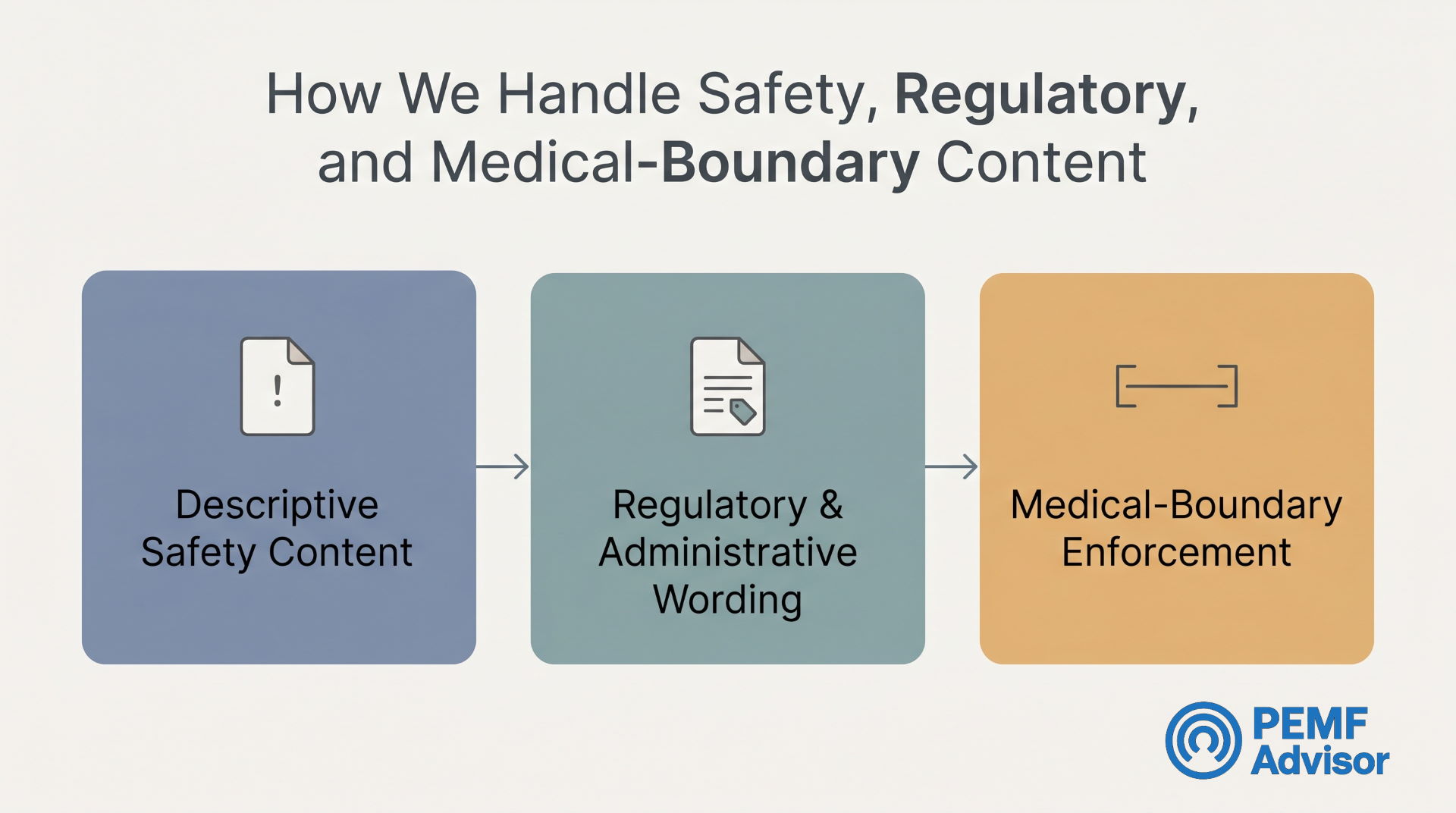
A buyer can benefit from knowing that a product includes a precaution, uses specific regulatory wording, or frames its claims in a certain way. But that does not turn the page into clinical guidance, and it does not turn the publisher into a treatment authority.
What we do cover
We cover descriptive safety information
When a PEMF product includes safety-related wording that matters for a buyer’s understanding of the product, we may discuss it in descriptive terms.
That can include things like:
- precautions stated on the product page
- usage limitations stated in manuals or support materials
- warnings presented by the brand
- product-positioning language around home use
- ownership-related handling or setup considerations
- general buyer-facing caution language
The key point is that we discuss these as product-facing disclosures, not as personalized medical instructions.
We cover regulatory wording in buyer language
PEMF product pages often use words that sound stronger than they first appear. Terms like registered, cleared, compliant, non-ionizing, professional, or wellness device can influence how buyers read the product even when the practical meaning is narrower.
We may explain what those terms mean in product-page context, how they are being used, and what a buyer should not assume from them automatically.
That is a publishing and interpretation job. It is not the same thing as certifying a product medically.
We cover where the product discussion should stop
Some of the most useful work in this category is not adding more claims. It is defining where the claim boundary sits.
For example, we may explain that:
- a measured field is not the same thing as a proven outcome
- a regulatory phrase is not the same thing as clinical proof
- a safety statement is not the same thing as individualized medical guidance
- a product description is not the same thing as a treatment protocol
That boundary-setting work is part of buyer education, and it is one of the main ways we reduce confusion in this category.
What we do not cover
We do not provide diagnosis
This site does not help readers decide whether they have a condition, what the condition means, or what kind of product use is medically appropriate for them.
A buyer may arrive with a symptom or condition in mind. That does not change the role of the page. The site remains a product-evaluation publisher, not a diagnostic resource.
We do not provide treatment guidance
We do not tell readers how to use PEMF products to treat a condition. We do not write symptom-led use instructions. We do not turn settings, durations, or product types into treatment recommendations.
That includes avoiding content patterns like:
- best product for a condition
- what setting to use for a symptom
- how often to use the product for a health goal
- which device is safest for a medical situation
- which protocol works best for a diagnosis
Those are not slight adjustments of product content. They are a different authority domain entirely.
We do not provide clinical protocol logic
A clinical protocol is not the same thing as a buyer guide.
A review page can explain how a controller works. It can explain whether settings are manual or preset-driven. It can explain whether a product discloses its specifications clearly. It cannot turn that information into a protocol-style instruction set for health use.
That boundary is deliberate.
Why this distinction matters
The easiest way for PEMF content to become unstable is for product information to slide quietly into treatment logic.
A page may begin with a product comparison and end up implying:
- who should use the device medically
- what a reader should expect therapeutically
- when a user should avoid or prefer certain settings for health reasons
- which product is better for a symptom or condition
Those moves change the page from buyer education into medical-adjacent guidance.
We do not allow that shift to happen casually. The whole point of this site is to help buyers understand products as products.
The main content types and how we handle them
The table below shows the practical boundary we use most often.
| Content Area or Claim Type | How We Handle It | Why the Boundary Exists | What We Do Not Do |
|---|---|---|---|
| Product safety wording | Describe it in buyer language and clarify what it refers to | Helps buyers understand what the brand is actually saying | Turn it into individualized medical advice |
| Regulatory wording | Explain the practical meaning of the wording and where interpretation should stop | Prevents labels from being overread as proof | Treat a label as automatic clinical validation |
| Precautions listed by the brand | Note them as part of product disclosure and caution language | Buyers should understand what the product materials say | Rewrite them as treatment instructions |
| Product limitations | Explain them as ownership, feature, or disclosure limits | Makes product evaluation more honest | Convert them into diagnostic recommendations |
| Settings and controls | Explain what the device lets a user adjust and what remains fixed | Helps product understanding | Suggest settings for symptoms or conditions |
| Field-generation claims | Clarify what is measurable and what remains interpretation | Separates product mechanism from outcome language | Present the mechanism as proof of treatment effect |
| Broad wellness claims | Classify them carefully and keep them bounded | Prevents marketing language from becoming the page’s authority | Repeat them as settled therapeutic facts |
How we handle safety content in practice
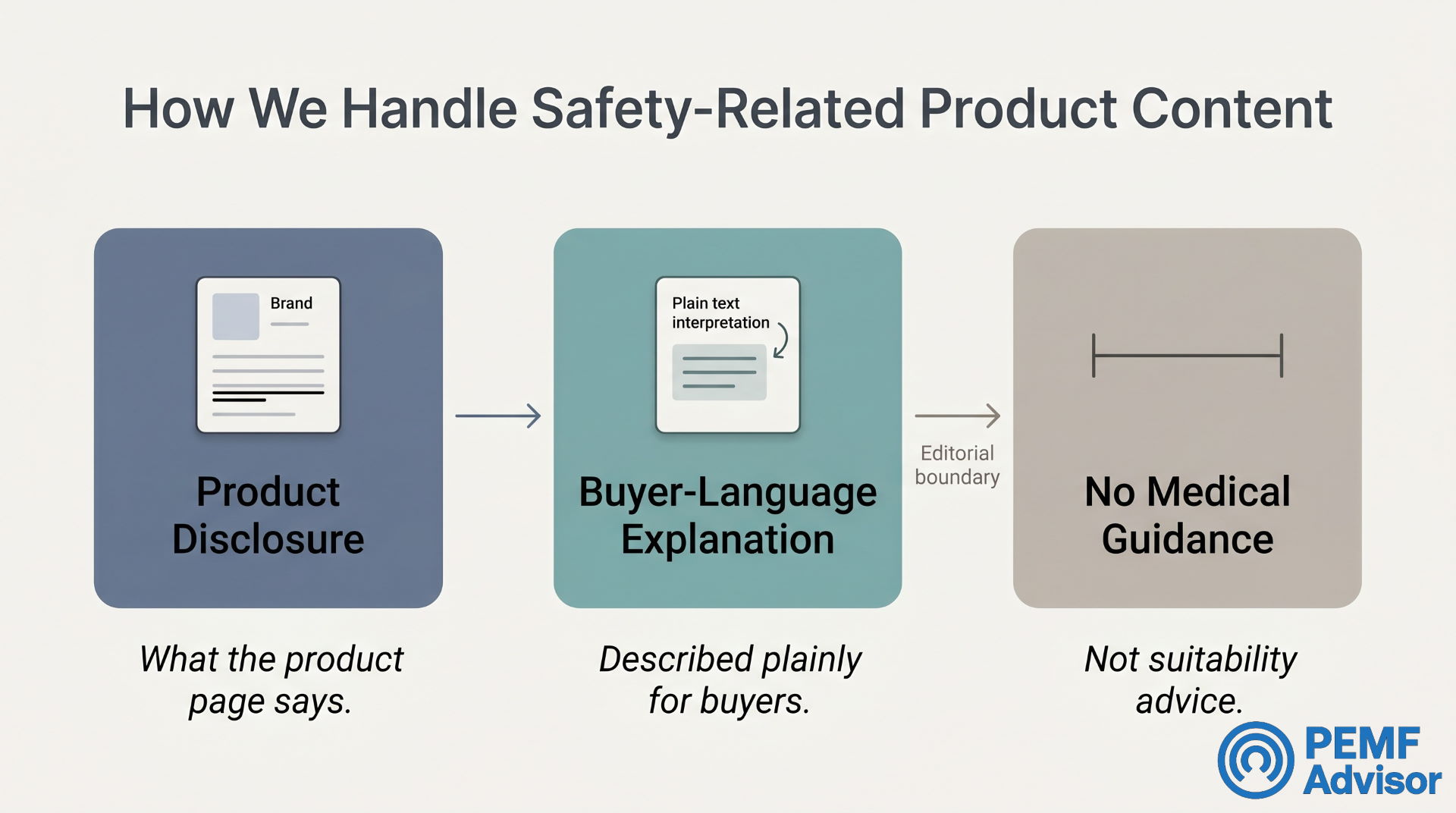
We treat safety as descriptive, not prescriptive
A product page may include warnings, limitations, or caution language. Those are part of the product’s public-facing information. We may discuss them because they affect how a buyer interprets the product.
But we do not move from:
- “the brand includes this precaution”
to - “here is the medical guidance you personally should follow”
That second step belongs to a different kind of authority.
We keep the language product-centered
When we discuss safety or limitation issues, we keep the language anchored to the product, the disclosure, or the claim structure.
That usually means we frame the issue through questions like:
- What is the product page saying?
- What kind of caution is being disclosed?
- Is the language broad or specific?
- Is the warning clear enough for a buyer to understand?
- Is the brand using caution language honestly, or mostly as positioning?
This keeps the page inside its actual job.
We do not turn buyer caution into medical screening
A buyer may want certainty. But a publisher cannot responsibly pretend that a public-facing product page can replace professional medical evaluation.
That is why our safety handling remains bounded. We can clarify what the product says. We can explain what the wording means. We can show where the product page becomes vague or inflated. We do not screen readers for medical suitability.
How we handle regulatory content
We interpret wording, not just labels
In PEMF and adjacent wellness markets, regulatory language is often used as a trust shortcut. Buyers see a term that sounds official and assume it answers a larger question than it really does.
Our job is to slow that down.
If a product uses regulatory or administrative language, we may explain:
- what the wording appears to refer to
- what a buyer can reasonably take from it
- what the wording does not automatically prove
- where the term is being stretched beyond its natural meaning
That makes the content more useful than simply repeating the label.
We avoid authority theater
A regulatory phrase can sound more definitive than it is. That is one reason this page exists.
A buyer-facing publisher should not try to borrow authority by stacking official-sounding terms until the page feels clinically settled. That creates the illusion of certainty without necessarily creating better understanding.
So when we discuss regulatory or administrative wording, we use it to clarify product-page meaning, not to perform expertise.
How we handle medical-boundary issues
We separate product understanding from treatment inference
This is the main rule behind the whole page.
A product can be:
- clearly described
- structurally legible
- transparent about its settings
- honest about its warranty and policies
- cautious or careless in its claims
All of that can be evaluated without the page deciding whether the product is medically appropriate for a person.
That separation is what keeps the site consistent.
We do not allow “best for X condition” logic
Condition-led framing changes the role of the content immediately. Once the page starts matching products to diseases, symptoms, or health outcomes, it stops being a buyer-guide system and starts behaving like a therapeutic guidance system.
That is outside scope, and we do not disguise it as normal comparison language.
We do not allow protocol drift
Protocol drift happens when a page starts with settings, timing, controls, or product differences, then quietly turns them into use instructions for health goals.
We avoid that pattern across the site, especially in educational pages, reviews, and setup-related content. A controller explainer should stay a controller explainer. A product review should stay a product review. A safety page should stay a safety-boundary page.
Why these limits make the site stronger, not weaker
Some readers assume a stricter boundary makes a page less useful. In practice, the opposite is often true.
A page becomes more trustworthy when readers can tell:
- what kind of information it is giving them
- what kind of authority it is not claiming
- what it is willing to interpret
- where it stops before drifting into unsupported guidance
That clarity matters in a category where many product pages blur mechanism, reassurance, regulation, and outcomes into one continuous marketing story.
Boundary discipline improves buyer understanding because it reduces category confusion.
How this affects the rest of the site
This page supports the way PEMF Advisor handles:
- reviews
- comparisons
- buyer guides
- product-operational explainers
- descriptive safety content
- regulatory interpretation
It explains why some topics are discussed in bounded form, why some claims are classified cautiously, and why certain content patterns are excluded entirely.
That is important because trust does not only come from saying what a site covers. It also comes from showing how the site decides what not to cover.
What readers should expect from us
Readers should expect us to:
- explain product-related safety and caution language in buyer terms
- interpret regulatory wording carefully
- keep mechanism and ownership explanations grounded
- avoid treatment-style claims and protocol language
- maintain the line between product education and medical guidance
Readers should not expect us to:
- diagnose symptoms or conditions
- recommend products for diseases
- suggest protocols or treatment use
- interpret individual medical suitability
- turn product content into therapy advice
That is the working boundary.
FAQ
Does PEMF Advisor discuss safety at all?
Yes. The site may discuss safety, precautions, limitations, and regulatory wording in descriptive buyer language. It does not provide individualized medical advice.
Does this site tell people whether a PEMF product is safe for their condition?
No. That falls outside the site’s role. The site does not provide condition-specific safety guidance or product suitability advice for medical needs.
Why do you talk about regulatory wording if you are not giving medical guidance?
Because regulatory and administrative terms influence how buyers understand products. Explaining that wording helps readers avoid overreading labels or treating them as automatic proof.
Do you explain contraindications or precautions?
The site may reference precautions or caution language when they are part of product disclosure, but it does not turn those references into individualized treatment guidance or medical instructions.
Can a product page’s wording count as proof that the product works medically?
No. A product page may disclose specifications, labels, or caution language, but that is not the same thing as proving a therapeutic outcome.
Why avoid condition-based “best for” content?
Because it pushes the site out of product evaluation and into treatment-style authority. That is not the role PEMF Advisor is built to serve.
Do reviews and buyer guides follow this same boundary?
Yes. This boundary applies across the site. Reviews, comparisons, educational pages, and trust pages all stay inside product and buyer-evaluation territory rather than drifting into clinical or therapeutic instruction.
Is this page a substitute for professional medical advice?
No. This page explains the site’s editorial boundaries. It is not a replacement for professional evaluation.

The PEMF Advisor Editorial Team reviews consumer PEMF mats and related wellness devices. Our work focuses on verified specifications, documentation, usability, materials, warranty/returns, and ownership considerations. We do not provide medical advice or evaluate health outcomes. See our Review Methodology and Editorial Standards.