Quick answer: We evaluate PEMF products as products, not as treatment promises. That means we look at what a device clearly discloses, how it is built, how its controls and specifications can actually be interpreted, what it is like to own, and where marketing language outruns what a buyer can reasonably verify.
PEMF product pages often mix real specifications with broad claims, feature stacking, and vague superiority language. That creates a simple buyer problem: it becomes hard to tell which details help comparison and which details mostly create noise. This page explains the framework PEMF Advisor uses to review and compare home-use PEMF mats and devices so readers can understand what we are evaluating, what we are not evaluating, and why that boundary matters.
What this page is for
This page exists to make our review logic visible.
PEMF Advisor covers home-use PEMF product reviews, comparisons, rankings, buyer guides, pricing and ownership considerations, product-operational explanations, and descriptive safety or regulatory interpretation. It does not provide diagnosis, treatment guidance, clinical protocols, or health outcome claims. That boundary shapes every product evaluation we publish.
In practical terms, we ask product questions such as:
- What does this device clearly disclose?
- How readable and comparable are the specs?
- What kind of controller logic does it use?
- How is the product built?
- What ownership burden comes with it?
- What does the warranty, refund window, or return policy actually mean for a buyer?
We do not ask this page to answer medical questions such as whether a product treats a condition, resolves a symptom, or functions like a therapeutic protocol.
The shortest version of our approach
We evaluate PEMF products through five layers:
- product transparency
- technical readability
- design and control logic
- ownership reality
- claim discipline
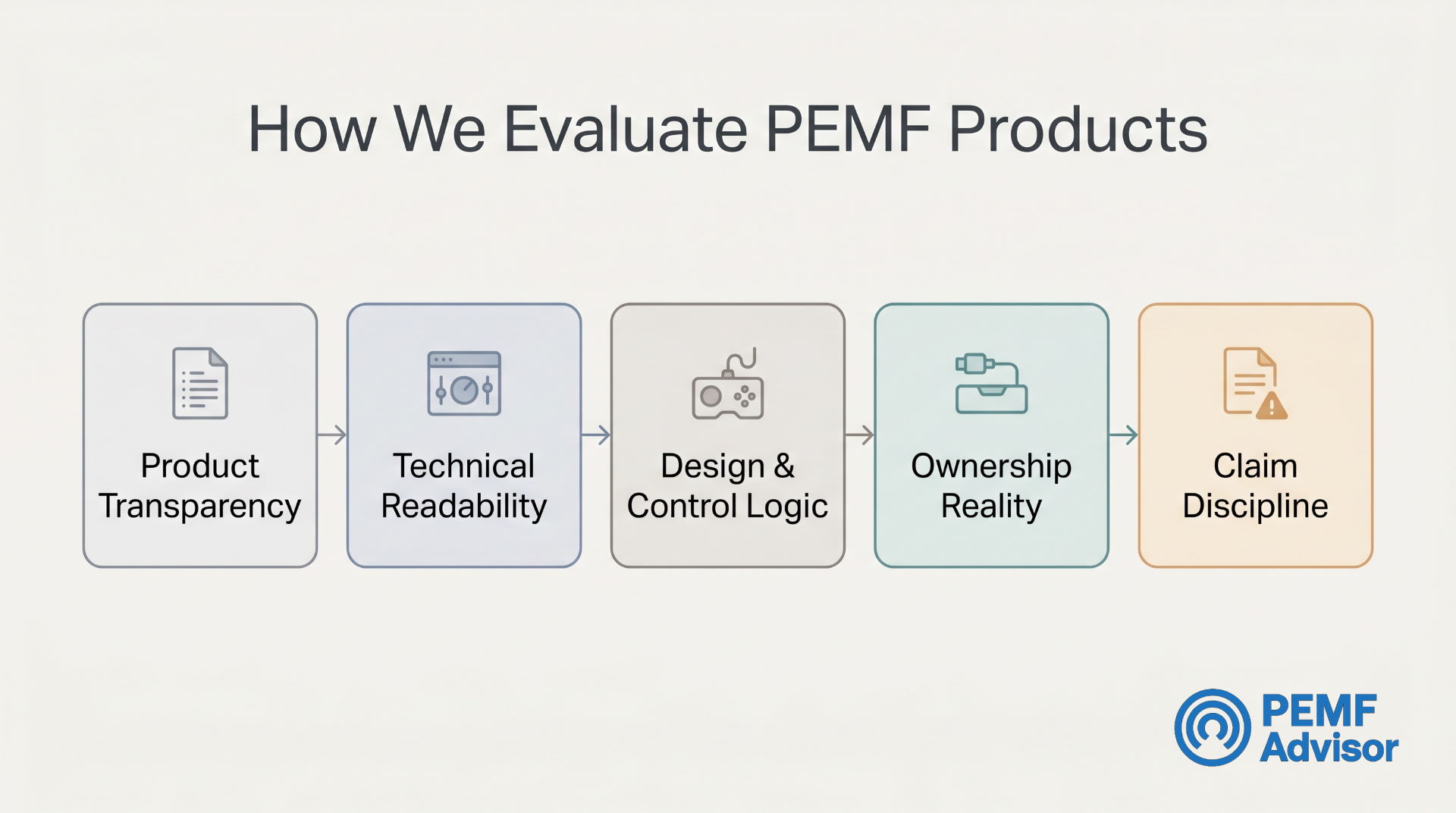
A product does not score well here because it sounds advanced. It scores well when a buyer can understand what it is, how it operates, what it lets the user control, what it is like to own, and where the brand is being clear rather than evasive.
What we are actually evaluating
We evaluate the product as a device
The first question is always whether the product can be understood as a real, legible device.
That includes things like:
- controller type and settings
- coil or field-generation disclosure
- frequency and intensity disclosure
- waveform naming, if provided
- product format and coverage style
- power and connection logic
- layout, materials, and feature stacking
This is basic product legibility. A buyer should not have to guess what kind of device they are looking at.
We evaluate what the specifications actually tell a buyer
Specifications matter, but only if they are interpretable.
For example, a brand may list Gauss, frequency, waveform, presets, or controller modes. Those are useful only when they are presented with enough context to compare them honestly. A field-strength number without measurement context is weaker than it sounds. A long list of presets without explaining what the user can or cannot change may look impressive while still being hard to interpret.
We therefore evaluate not just whether a specification exists, but whether it is disclosed clearly enough to help comparison.
We evaluate how much control the product gives the user
Controller logic matters because it changes what the device is like to use.
Some products expose more direct control over settings. Others rely heavily on fixed programs or branded modes. Neither approach is automatically better in every case, but they are meaningfully different product designs. A buyer should be able to tell whether a device is:
- more manual
- more preset-driven
- more opaque
- more adjustable
- more simplified
- more layered or complicated than it first appears
That is part of evaluation because it changes both usability and comparability.
We evaluate ownership, not just surface appeal
Many PEMF products look clearer on the product page than they do in real ownership.
A product may sound attractive until the buyer notices:
- its size and storage burden
- setup friction
- controller complexity
- cable management
- heat or stacked-feature trade-offs
- return friction
- warranty limitations
- support uncertainty
That is why we evaluate ownership reality, not just product-page presentation. A product is not easier to recommend just because its marketing is polished.
We evaluate how disciplined the claims are
A strong product page does not only describe benefits. It also makes clear what is being claimed, what is being described, and what is left vague.
We pay attention to whether a brand:
- distinguishes specs from outcomes
- uses regulatory wording carefully
- avoids inflating materials or feature stacks into proof
- discloses enough context for a buyer to compare the product honestly
- relies on broad superiority language where precise explanation should exist
Claim discipline matters because PEMF is a category where technical-sounding language can easily create the illusion of certainty.
The main evaluation areas we use
The table below compresses the framework into the categories we return to most often.
| Evaluation Area | What We Look At | Why It Matters for Buyers | What It Does Not Prove |
|---|---|---|---|
| Product transparency | Clear disclosure of specs, controls, layout, and product structure | Makes comparison possible without guesswork | Does not prove better outcomes |
| Controller and settings | Whether the device is preset-driven, manual, locked, or adjustable | Affects usability, control, and spec interpretation | Does not prove one control style is universally better |
| Frequency and intensity disclosure | Whether values are named clearly and presented with context | Helps buyers compare products more honestly | Does not prove quality by number alone |
| Coil and layout disclosure | Whether field-generating parts are explained clearly enough to understand the product | Improves category literacy and comparison accuracy | Does not prove superiority from coil count alone |
| Construction and feature stacking | Whether PEMF is core to the product or layered with other features | Helps separate core product function from add-on complexity | Does not prove that stacked features improve PEMF performance |
| Ownership burden | Setup, storage, portability, maintenance, and everyday friction | Affects whether the product fits real use conditions | Does not prove stronger or weaker field delivery |
| Pricing and policy terms | Price, trial window, return policy, refund conditions, and warranty | Shapes buying risk and long-term confidence | Does not prove technical quality |
| Claim discipline | Whether the brand distinguishes measurable specs from broader claims | Reduces overread and buyer confusion | Does not prove outcomes either way |
What we consider strong product evidence
A PEMF product does not need to sound dramatic to be well-evaluated here. In many cases, the strongest products are the ones that reduce ambiguity.
Strong product evidence usually includes:
Clear specification disclosure
A buyer can see what is being described without relying on vague brand language. If field strength is mentioned, the context is clearer. If frequency is mentioned, it is presented as a signal attribute rather than a mystical category. If controls are included, the device logic is understandable.
Honest separation between PEMF and stacked features
A product page is stronger when it separates its PEMF system from its non-PEMF additions. If a mat includes heat, infrared, gemstones, or other feature layers, those should not be used to blur what the PEMF part of the device actually is.
Usable ownership information
A buyer should be able to understand what the product is like to own, not just what it is like to imagine owning. That includes size, storage profile, handling burden, warranty, support, and return realities.
Restraint in superiority language
We generally trust product pages more when they explain clearly instead of escalating emotionally. A product that names its design choices and limitations can be easier to evaluate than a product that keeps repeating that it is stronger, deeper, more professional, or more advanced without enough comparability behind those claims.
What we do not treat as proof
This part matters as much as the positive framework.
Some signals may sound persuasive while still being weak forms of comparison evidence.
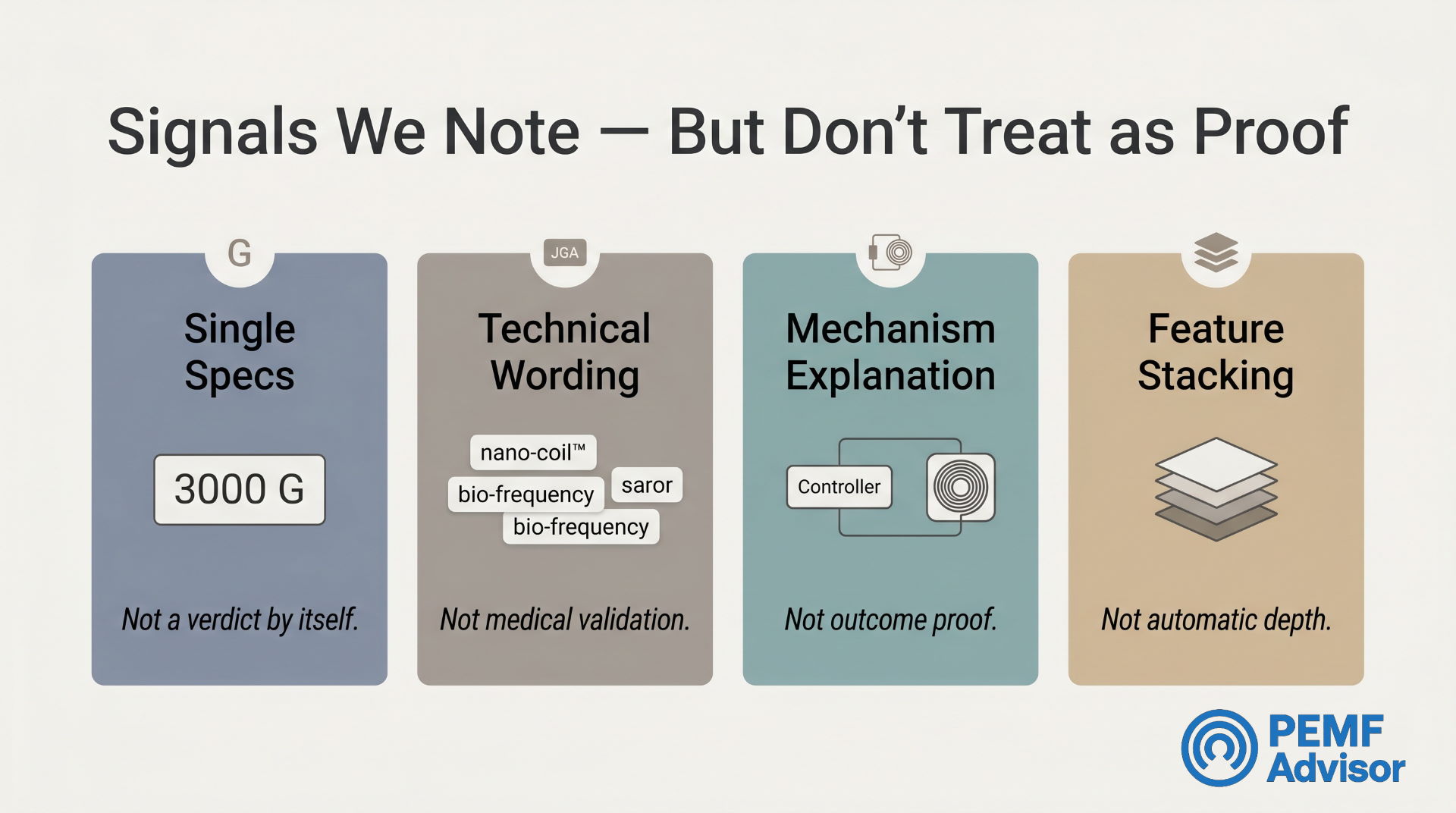
We do not treat a single spec as a verdict
Higher Gauss alone is not a verdict. More presets alone are not a verdict. More coils alone are not a verdict. A more expensive product is not automatically a better-disclosed product. A stacked product is not automatically a more meaningful PEMF product.
Single numbers can help comparison, but they do not finish it.
We do not treat technical wording as medical validation
Terms like non-ionizing, registered, clinical, advanced, proprietary, or professional can shape perception quickly. But wording is not the same thing as demonstrated buyer value, and it is definitely not the same thing as clinical proof.
That is why we separate product evaluation from treatment inference.
We do not treat mechanism explanation as outcome proof
A PEMF product may clearly explain how it generates a field. That is useful. It helps a buyer understand the product as a device. It does not prove what the device will do for a person.
That line stays in place throughout our reviews and comparisons.
We do not treat feature stacking as automatic product depth
A mat with heat, infrared, gemstones, and PEMF may be more layered. That does not automatically make it more transparent, easier to compare, or better as a PEMF product. Sometimes feature stacking increases confusion faster than it increases clarity.
How our framework handles common PEMF comparison areas
Specs are interpreted, not worshipped
We do not dismiss specifications. We use them. But we read them in context.
A number only becomes useful when the buyer can understand:
- what is being measured
- where it is being measured
- how it compares to another product honestly
- what it actually changes in product understanding
That is why our reviews and guides spend so much time translating specs into buyer language.
Policies matter because risk is part of the product
A return policy, warranty term, or trial period is not extra decoration around the product. It is part of the buying risk. For higher-cost PEMF products, policy quality often matters more than buyers expect.
That is why we treat pricing and ownership economics as review-relevant, not peripheral.
Simplicity can be a product advantage
Not every product has to expose the same level of controller complexity to be readable or useful. Some buyers want more manual control. Others want lower friction. Our framework does not assume one design style wins automatically. It asks whether the product is transparent about the style it uses.
How this framework shows up across the site
This page explains the framework. Other page types apply it differently.
On review pages
Review pages use this framework to evaluate one product in context. They can make contextual judgments about whether a product is clear, well-disclosed, hard to compare, easy to own, or limited in important ways.
On comparison pages
Comparison pages apply the same framework side by side. That means the emphasis shifts toward comparability: which product discloses more clearly, which controller logic is easier to interpret, which ownership terms reduce or increase buying risk, and where one product page is easier to trust than another.
On rankings and SK-level decision pages
The site’s final evaluative gravity belongs to the Keystone layer, not to every page equally. This methodology page supports the logic used across the site, but it is not itself a rankings page and does not act as a universal recommendation page.
Why this framework is useful for buyers
The point of a review framework is not to sound sophisticated. The point is to reduce confusion.
Buyers in this category often face three kinds of noise at once:
- technical language that is hard to interpret
- feature stacks that blur product identity
- outcome language that runs ahead of what a product page really proves
A useful framework cuts through that noise by asking simpler questions:
- What is the product, clearly?
- What can I actually compare?
- What is being disclosed well?
- What is being stretched?
- What would ownership really look like?
That is what this site’s evaluation model is built to do.
What this framework does not try to do
This page does not claim to answer everything a buyer may want.
It does not:
- diagnose medical needs
- tell a user which product is appropriate for a condition
- provide protocol-style recommendations
- validate therapeutic outcomes
- substitute for professional medical evaluation
It is a product-evaluation framework for home-use PEMF products. That boundary is not a limitation by accident. It is part of what keeps the framework readable, stable, and trustworthy.
FAQ
Does PEMF Advisor evaluate products as medical devices or treatment tools?
No. PEMF Advisor evaluates home-use PEMF products as products. The framework focuses on transparency, controls, construction, ownership, pricing, policy terms, and claim discipline rather than treatment guidance or clinical protocol logic.
Do you use this framework for both reviews and comparisons?
Yes. The same framework supports both review pages and comparison pages, though the emphasis changes depending on whether the page is evaluating one product or comparing multiple products side by side.
Does a product score better here if it makes stronger claims?
No. Stronger wording does not automatically improve evaluation. In many cases, clear disclosure and disciplined language are more useful than broad superiority claims.
Do you treat higher specs as automatic proof of a better product?
No. Specs matter, but they only become useful when they are interpretable and comparable in context. A single number does not settle product quality by itself.
Do stacked features automatically improve a PEMF product evaluation?
No. Added features may change comfort, complexity, or perceived value, but they do not automatically improve the readability or core comparability of the PEMF system.
Why do you include pricing, warranty, and return policies in product evaluation?
Because buying risk is part of product evaluation. A higher-cost product with weak policy terms can create more ownership risk even if the product page sounds impressive.
Do you evaluate whether a PEMF product works for a specific health condition?
No. That falls outside the scope of this site’s product-evaluation framework.
Why does this page focus so much on transparency?
Because in this category, transparency is one of the fastest ways to separate useful product information from marketing heat. A transparent product is easier to compare, easier to understand, and usually easier to trust on buyer terms.

The PEMF Advisor Editorial Team reviews consumer PEMF mats and related wellness devices. Our work focuses on verified specifications, documentation, usability, materials, warranty/returns, and ownership considerations. We do not provide medical advice or evaluate health outcomes. See our Review Methodology and Editorial Standards.